
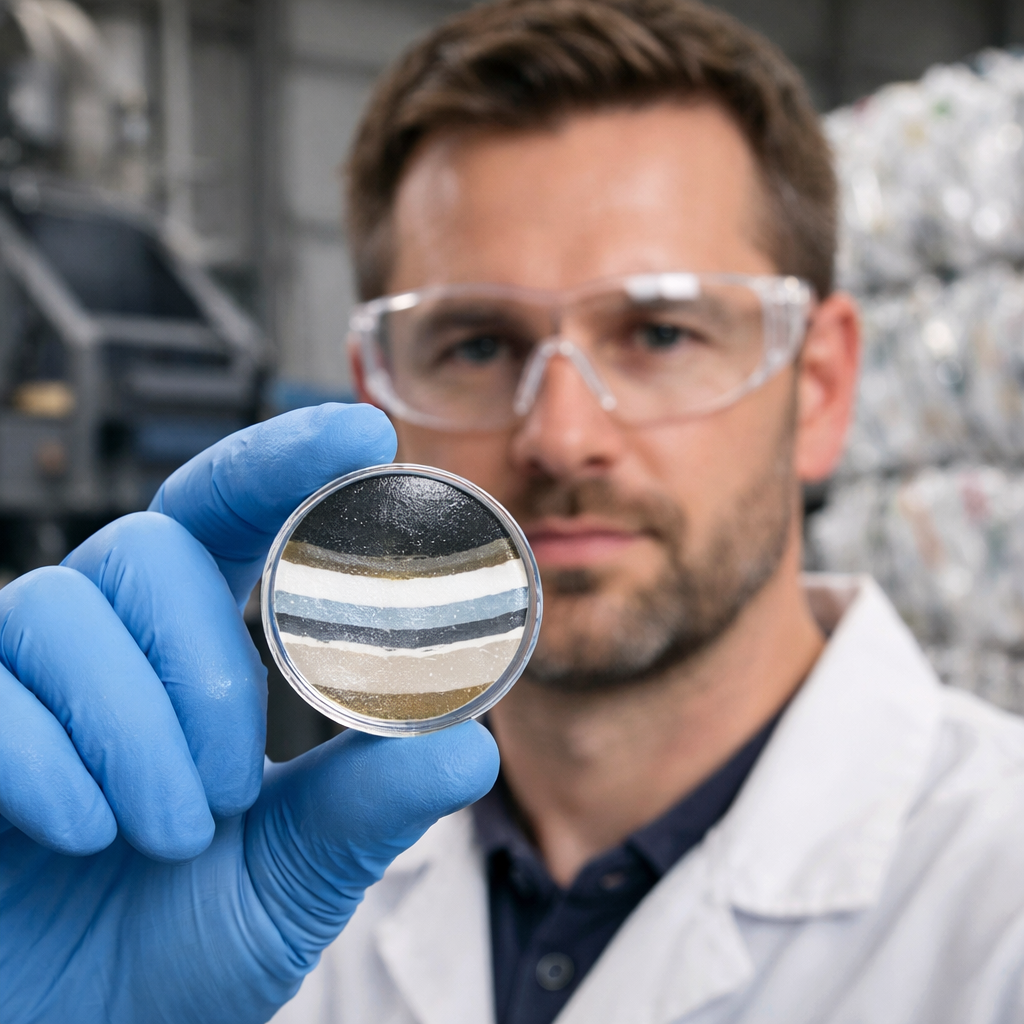
Who Offers Multilayer Packaging Recycling Tech? Vendors, Capabilities, and Fit
Multilayer packaging combines two or more polymers (e.g., PE, PET, PA) or metalized layers to deliver barrier and strength at low weight; this complexity makes end‑of‑life separation and recycling difficult. Common polymers include PP, PE, PS, PVC, PET, PA, PC, and metalized plastic layers. Two primary technical routes exist: mechanical (delamination, sorting, compatibilization) and advanced/chemical recycling (pyrolysis, solvent‑based, hydrolysis/catalysis). Pyrolysis, catalytic cracking, and gasification are among the most mature processes for complex plastics, and solvent‑targeted approaches like STRAP show promise for multilayer films, especially where food‑grade is required. In Europe, policy pressure is accelerating adoption, and partnerships often beat acquisitions for traction. Roughly 17% of circulating plastic packaging is multilayer—about 3.03 million tonnes—so selecting the right vendor stack matters. Below, Garbage Advice maps leading technologies and vendors to streams, plant realities, and end‑use targets, with scorecards, pilot steps, and integration tips.
Strategic Overview
- Concise definition and context: Multilayer films intentionally blend polymers (PE, PET, PA, EVOH) or thin metalized layers for barrier, yet the fused interfaces, inks, and adhesives resist separation and sorting. A technical review characterizes pyrolysis, catalytic cracking, and gasification as relatively mature for mixed/complex plastics, and notes STRAP‑style solvent processes as promising avenues for multilayer film recovery (see the open technical review on multilayer recycling routes). The share of circulating packaging that is multilayer is material—about 17% (≈3.03 Mt) in Europe—raising both the urgency and opportunity to recover it, despite heterogeneous feed and inconsistent volumes that impede economics (see the MERLIN Baseline Study for share, efficiencies, and market barriers).
- Two principal routes:
- Mechanical: delamination/debonding, NIR sorting, compatibilizers, hot washing, and pelletizing.
- Chemical/advanced: pyrolysis and catalytic cracking to hydrocarbon feedstocks; solvent‑targeted dissolution/precipitation (e.g., STRAP); hydrolysis/catalysis for specific polymers.
- Why now: Policy signals and market pull are aligning, while partnerships, not acquisitions, are increasingly the go‑to path to scale pilots and demonstrations (documented in market analyses).
Reference links:
- Maturity of pyrolysis and promise of STRAP: see the preprint technical review on multilayer packaging recycling.
- Share of multilayer packaging and barriers: see the MERLIN Baseline Study.
Snapshot of multilayer packaging recycling
- Mechanical recycling averages around 60% efficiency for packaging, with polymer‑dependent variance; yields drop with heterogeneity and inks/adhesives (MERLIN Baseline Study).
- About 17% (≈3.03 Mt) of circulating plastic packaging is multilayer, and food accounts for 87% of European demand for flexible multilayer composites (MERLIN Baseline Study).
- Heterogeneous feed and low, inconsistent volumes impede economically viable delamination and steady plant utilization (MERLIN Baseline Study).
- Regulations (e.g., EU Single‑Use Plastics Directive and recycled‑content mandates) strongly influence tech adoption timelines and off‑take decisions (reported in market analyses).
Advanced recycling, in brief (40–50 words): Advanced (chemical) recycling converts hard‑to‑recycle plastics into hydrocarbon feedstock or monomers via processes like pyrolysis or solvent‑targeted separation, enabling circular use when mechanical recycling is infeasible. It can re‑enter cracker or polymerization routes, supporting food‑grade targets when quality controls are rigorous.
Keywords naturally in play: multilayer film recycling, compatibilizers, solvent‑based delamination, NIR sorting, food‑grade recyclate, recycled‑content mandates, PPWR compliance, STRAP process.
How to choose a vendor for multilayer packaging
Use Garbage Advice’s simple 1–5 vendor scorecard to compare options:
- Technology readiness: pilot, demo, or commercial; nameplate throughput; uptime and MTBF.
- Feedstock tolerance: film vs laminated trays; PET/PE and PE/PA; aluminum or metallized OPP handling; printed/ink‑heavy material.
- Output quality: industrial vs food‑grade pathways; NIAS risk management; contamination tolerance.
- Integration fit: NIR sorting interfaces, hot wash lines, debonding adhesives, data capture/traceability, plant retrofit complexity.
Decision flow:
- If mono‑material redesign is feasible, prioritize design‑for‑recycling to avoid future sorting complexity.
- Else, screen compatibilizers plus debonding adhesives on your dominant structures.
- Upgrade NIR sorting (calibrate for films, metallized signatures) and hot‑wash capacity.
- Route residuals that miss mechanical specs to solvent‑targeted or pyrolysis partners.
- Lock offtake and mass‑balance claims before scale.
Partnerships and joint ventures dominate multilayer progress; prioritize vendors with proven collaborations, pilot data, and reference plants documented in recent market assessments. Garbage Advice provides neutral scorecards and checklists to structure these collaborations.
Mechanical routes and where they fit
Compatibilization, in 40–50 words: Compatibilization uses additives or reactive resins to improve interfacial adhesion and dispersion among immiscible polymers (e.g., PET-in-PE), stabilizing blends during extrusion so mechanical recycling yields pellets with better tensile, impact, and processability. It enables “good‑enough” performance for non‑food uses and select film applications.
Where mechanical wins:
- PE‑rich, PET/PE, or PE/PA films aiming first at non‑food applications (industrial sacks, shrink, collation).
- When combined with NIR sorting, hot washing, and ink/adhesive management.
Core line equipment and yield levers:
- Shredders/granulators: reduce size to expose interfaces for washing and improve densification.
- Friction washers/hot wash: remove adhesives, inks, and residual organics; boost purity and odor control.
- Float‑sink or hydrocyclones: polymer density separation.
- Melt filtration/degas: remove fines, gels, and volatiles for stable extrusion.
- Pelletizers: create spec pellets; additives/compatibilizers can tune MFI and properties. For a practical overview of equipment and bottlenecks in multilayer recovery, see this Recycling Today explainer on multilayer packaging challenges and solutions.
Note: Ongoing advances focus on PE‑based multilayers, with compatibilization and rheology control improving pellet quality and consistency (highlighted across recent technical reviews).
Chemical and solvent-based routes and where they fit
Definitions and fit:
- Pyrolysis: thermal depolymerization that converts mixed plastics into oils, waxes, and gases, with relative maturity for complex composites. Deinking is unnecessary; chlorine and metals must be managed to protect catalysts and meet specs.
- Solvent‑targeted recovery (e.g., STRAP): selective dissolution/precipitation that separates polymers in multilayer films with minimal degradation, enabling high‑purity streams and food‑grade pathways when validated.
When to deploy:
- Highly fused laminates with EVOH barriers, heavy inks/adhesives, or aluminum layers that defeat mechanical targets.
- Food‑grade re‑entry or cracker‑grade feedstock under mass‑balance schemes. Expect higher capex/opex and stringent solvent/water management, but potential for premium outputs and PPWR‑aligned claims. For a concise review of STRAP and pyrolysis maturity, see this peer‑reviewed overview of solvent‑targeted and thermochemical routes.
Integration with sorting, washing, and plant operations
A retrofit‑first flow can unlock recovery without a greenfield build:
| Step | Purpose | Key tech | Notes |
|---|---|---|---|
| Inbound QC | Stabilize feed | Bale specs, moisture | Contract for known laminates and ink loads |
| NIR fractionation | Split PET/PE, flag metallized | TOMRA‑class NIR | Calibrate for films; tune false‑reject |
| Adhesive debonding | Enable delamination | Debonding adhesives | Apply in converting; triggers in hot wash |
| Hot washing | Remove inks/adhesives | Krones‑style systems | Control temp, alkali/surfactant, residence |
| Separation | Density or solvent steps | Float‑sink, STRAP | Route by stream quality and end‑use target |
| Pelletizing/chem route | Produce outputs | Melt filter, pelletize or pyrolysis | QA on MFI/IV, odor, NIAS, mass‑balance |
An industrial trial by BASF, Krones, SÜDPACK, and TOMRA reported 69% component separation on PET/PE multilayers by combining debonding adhesive, NIR sorting, and hot washing—evidence that targeted retrofits can move the needle without scrapping existing assets (documented in the Grand View Research multilayer film recycling market report).
BASF
BASF has demonstrated debonding adhesive systems and compatibilizer know‑how in PET/PE multilayer pilots, notably collaborating with TOMRA (sorting), Krones (hot wash), and SÜDPACK (converter) in a 69% separation trial. Where it fits: PET/PE laminates needing adhesive debonding, paired with NIR sorting and hot washing in brownfield PRFs.
Evaluation prompts:
- Adhesive application windows (coating weight, cure, line speed).
- Food‑contact and NIAS status across EU/US.
- Wash chemistry compatibility (alkali/surfactant) and trigger reliability.
- Impact on pellet IV/MI and downstream seal/clarity performance.
Dow
Dow’s design‑for‑recycling playbook centers on mono‑material PE films, compatibilizers, and SURLYN ionomers, with published claims of enabling up to 20% recycled content in multilayer PE structures while maintaining package performance (see Dow’s sustainable packaging hub). The company’s “self‑recyclable” concept favors mono‑PE designs that sort and reprocess without specialty routes.
Where Dow fits:
- Front‑end redesign to mono‑PE or PE‑rich formats to hit recycled‑content mandates.
- Blend optimization using compatibilization to absorb PE‑rich recycled streams.
- Accelerating PPWR compliance with credible, scalable mono‑material pathways.
TOMRA
TOMRA’s sensor‑based sorting underpins fractionation of film/heavy‑laminate streams. In the PET/PE pilot referenced above, NIR correctly separated components once debonding and hot washing exposed interfaces.
Implementation tips:
- Define detection targets (PET vs PE spectral signatures) and metallized flags.
- Specify acceptable false‑reject/missed‑sort rates; test on printed and ink‑heavy films.
- Retrofit KPIs: purity (%), yield (%), uptime, and maintenance windows.
Krones
Krones’ hot‑washing systems are central to adhesive removal and label/ink management in delamination workflows. In the PET/PE trial, temperature control, alkali/surfactant dosing, and sufficient residence time were critical to reach component separation.
Guidance:
- Specify temperature and alkalinity bands for adhesive triggers.
- Engineer water‑reuse loops and DAF to control opex and COD.
- Pair with optical sorters and debonding chemistries for best‑in‑class yields.
SÜDPACK
As a converter, SÜDPACK accelerates recyclable laminate trials via rapid A/B testing of adhesives, layer stacks, and sealant choices. In the cited trial, real tray/laminate formats were used to validate separation and downstream pellet properties.
Fit and asks:
- Co‑develop recyclable laminates; validate seal strength and OTR/MVTR pre/post redesign.
- Share line trial data: delamination ease, recycling yields, and pack performance.
Recycling Technologies, Plastics Energy, Neste
These advanced recycling players convert complex fractions to hydrocarbon feedstocks or monomers, with pyrolysis a leading method for multilayer and ink‑heavy materials. Fit them as outlets for multi‑polymer fractions, metallized films, or residues that miss mechanical specs.
Vendor questions:
- Feedstock specs and chlorine/metals tolerance.
- Product slate (naphtha, wax), upgrading needs, and consistency.
- Mass‑balance certifications and food‑grade pathways with brand offtake.
APK AG, Ingenia Polymers, Pluss Advanced Technologies
Specialists filling targeted gaps:
- APK AG: solvent‑based separation targeting PE/PA or PE/PET.
- Ingenia Polymers, Pluss Advanced Technologies: compatibilizers and additive packages to stabilize blends and tune properties. Pilot guidance: validate recovery rate (%), solvent recovery (%), resin property retention (MFI, tensile), color/odor, and cost per ton. The landscape is nascent; only a few have shown scale‑ready multilayer recycling—so stage‑gate your scale‑up. For a scan of innovators focused on packaging recycling, see this Packaging Gateway landscape.
SUEZ, Waste Management, KW Plastics
Role of large waste processors and reclaimers:
- Aggregate and stabilize feedstock via long‑term contracts.
- Deploy NIR upgrades and hybrid lines; route residuals to advanced recycling partners.
- Negotiate service‑level KPIs: bale specs, contamination thresholds, inbound moisture, and data visibility (purity/yield dashboards).
Enval, Deink 4D
Niche technologies address specific pain points:
- Enval: metallized layer handling and recovery pathways.
- Deink 4D: deinking for ink‑heavy films that confound NIR sorting and hot washing. Use cases: graphic‑dense pouches, snack films, and aluminum‑containing laminates. Evaluate print/adhesive removal efficiency, pellet color/odor impact, and downstream film performance.
Fit guidance by packaging stream and end use
| Stream | Constraints | Best Route | Likely Partners |
|---|---|---|---|
| PET/PE film | Adhesives, inks; food contact in some SKUs | Compatibilized mechanical with debonding; solvent‑targeted for food‑grade | BASF (debonding), TOMRA (NIR), Krones (wash), SÜDPACK (converter) |
| PE/PA film | Strong interfacial adhesion; oxygen barrier | Solvent‑based delamination (e.g., APK‑style); compatibilized mechanical for industrial | APK AG (solvent), additive suppliers (compatibilizers), TOMRA |
| Metallized OPP | Aluminum layer, NIR interference; odor/color | Pyrolysis for residues; selective delamination/deinking for print‑heavy | Enval (metallized), deinking vendors, advanced recyclers (Neste/Plastic Energy) |
Rules of thumb:
- If food‑grade is required, pilot solvent‑targeted recovery or depolymerization and validate NIAS.
- If mono‑PE is possible, partner on design‑for‑recycling and compatibilizers; upgrade NIR sorting to reduce cross‑contamination.
- Combine the three pillars—design‑for‑recycling, mechanical, and chemical routes—to maximize recovery and compliance.
Policy, economics, and technology readiness checkpoints
- Regulatory alignment: Map EU Single‑Use Plastics rules and recycled‑content/PPWR mandates into contracts and mass‑balance claims (market reports detail adoption dynamics).
- Infrastructure realities: Global capacity and infrastructure are uneven; tailor solutions to local MRF/PRF capabilities and logistics (see this analysis of global recycling infrastructure disparities).
- Economics: Heterogeneity and inconsistent volumes depress utilization and returns; scale, feedstock security, offtake premiums, and by‑product revenue are decisive (MERLIN Baseline Study).
- Trend watch 2025: Expect an accelerated shift to mono‑material designs; on‑pack monomaterial claims grew roughly seven‑fold from 2023 to 2024 (see Packaging Insights’ 2025 trends briefing).
Building a pilot and partnership roadmap
Six steps to de‑risk:
- Stream audit and NIR detectability baseline (printed, metallized, adhesive variants).
- Lab screening of debonding and compatibilizers on priority laminates.
- Sorting and hot‑wash trials; tune setpoints for delamination and purity.
- Resin testing: MFI/IV, tensile/impact, odor/NIAS; color and gel counts.
- End‑use trials: food vs non‑food; qualify film, molding, and seal metrics.
- LCA and business case: recovery (%), purity (%), %food‑grade, opex/ton, GHG/ton, uptime (%).
Partnership structure: Combine converter, chemistry, sorter, and recycler; JVs and MOUs are the norm for shared risk and faster validation (as echoed in market analyses).
How this connects to Garbage Advice readers
Garbage Advice’s consumer and municipal guides mirror the stepwise approach above:
- Home waste know‑how (including our roundups on garbage disposals—from Moen to Waste King—septic‑compatible units, and splash guards) builds the same habit of staged testing, maintenance, and contamination control you’ll apply in plant retrofits. See our garbage disposal buyer’s guide for a practical, KPI‑first mindset.
- Logistics from our dumpster rental sizing and provider guides transfer neatly to take‑back programs and bale specs; plan capacity, contamination thresholds, and service SLAs upfront. Browse our dumpster sizing explainer when scoping dock space and haul frequency.
- Industrial water reuse and AI water analytics are essential for hot‑wash loops; and our heavy‑industry decarbonization due‑diligence checklists parallel the TRL, capex/opex, and offtake vetting you’ll do for recycling upgrades.
Frequently asked questions
What makes multilayer packaging hard to recycle?
Layers made of different polymers and metals are fused with inks and adhesives, which are difficult to separate in standard sorting and washing lines. Garbage Advice breaks down these failure points so you can target the right route.
Is mechanical or chemical recycling better for multilayers?
It depends on your stream and end use: mechanical routes work for PE‑rich structures with compatibilizers, while chemical routes like pyrolysis or solvent‑based separation handle complex laminates and can target food‑grade outputs. Garbage Advice maps stream‑to‑route choices against end‑use and compliance goals.
How do I verify if my multilayer pack is sortable in local facilities?
Run NIR detectability tests and plant trials with local MRF/PRF partners, then check purity and yield on real bales. Garbage Advice provides simple checklists to structure those tests.
What KPIs should I require in a multilayer recycling pilot?
Track recovery (%), purity (%), pellet properties (MFI/IV), %food‑grade qualification, uptime (%), cost/ton, and GHG/ton, plus reject rate and contamination thresholds. Garbage Advice uses this KPI set in vendor scorecards.
How do regulatory targets affect vendor selection and contracts?
Recycled‑content and labeling rules push selection toward solutions that deliver verified, compliant outputs at scale; Garbage Advice recommends performance‑based clauses tied to purity, content, and certification to de‑risk compliance.