
Trusted Drinking Water Testing: Verify Accreditation, Methods, and Chain of Custody
Trusted water testing starts with one goal: defensible results that regulators, courts, and treatment professionals will accept. If you’re looking for trusted PFAS testing labs for drinking water—or other emerging contaminants—focus on three pillars: the lab’s accreditation, the exact analytical method, and documented chain of custody. Together, these determine whether your data will stand up to scrutiny. Below, we explain what to ask, how to verify a lab’s scope, which methods meet regulatory acceptance, and when to use professional sampling—so you can confidently choose a state‑accredited lab for emerging contaminants testing and home water safety. Garbage Advice distills these steps into plain‑language checklists you can use before you sample.
Why trust matters for drinking water testing
Defensible data is analytical information produced by an accredited laboratory using approved methods and a fully documented chain of custody, with QA/QC and audit trails sufficient for regulatory or legal review. Inspectors routinely scrutinize sampling, preservation, method adherence, calibrations, and records before accepting results, especially for drinking water compliance.
Enforcement and monitoring priorities make the stakes real for homeowners and small systems: nitrates, arsenic, and disinfection byproducts remain core concerns, while PFAS and other emerging contaminants are rapidly moving into routine oversight, as summarized in an EPA drinking water compliance guide from industry experts (see this EPA drinking water compliance guide).
When your decisions hinge on home water safety, property transactions, or environmental disputes, only defensible results should drive action.
Accreditation versus certification explained
“Lab accreditation/certification” means a state or approved third‑party program—often to ISO/IEC 17025—evaluates a laboratory’s competence and authorizes specific analytes and methods. In drinking water, “accredited” and “certified” are frequently used interchangeably, but both refer to a formal scope tied to analyte‑method pairs (see this certified and regulatory compliance testing overview).
There is no single nationwide certification. EPA sets standards and approves methods, but it does not directly certify labs. Always request the lab’s current accreditation certificate and detailed scope listing each analyte and method. Be aware: some labs are accredited only for a subset (for example, bacteria), not PFAS or VOCs.
How to verify a lab’s accreditation scope
A five‑minute check can prevent weeks of delays:
- Ask for the formal accreditation scope showing analyte‑method pairs, accreditation body, and expiration date. Verify that your exact analyte and method are covered; many labs hold broad scopes, but others cover only a few parameters.
- Use your state’s accredited lab search to confirm status and scope details (for example, Pennsylvania’s DEP search supports lookups by location and method; see Penn State Extension chain of custody guidance).
- Confirm the lab’s record retention commitments (see the Reporting section for examples) and whether they support electronic data deliverables for regulated submittals.
Garbage Advice quick accreditation checklist (fill in before sampling):
| Analyte | Method number/code | Accreditation body (state/NELAP/ELAP) | Scope page/reference | Expiration date | Status (verified/not verified) |
|---|---|---|---|---|---|
| PFAS (e.g., PFOA/PFOS) | EPA 533 or 537.1 / state‑approved | [Your state] | Page/line | mm/dd/yyyy | |
| VOCs (e.g., benzene) | EPA 524.x (GC‑MS) | [Your state/NELAP] | Page/line | mm/dd/yyyy |
Secondary cues to look for: ISO/IEC 17025, ELAP/NELAP recognition, and the precise lab accreditation scope language matching your needs.
Methods that meet regulatory acceptance
An EPA‑approved method is a standardized analytical procedure designated by EPA or adopted by a state for compliance monitoring. It specifies calibration, quality control, detection and reporting limits, preservation, and holding times. Laboratories must demonstrate proficiency and follow the exact version to produce comparable, acceptable results.
Ask the lab for the exact method code/number, reporting (and detection) limit, and written confirmation they follow state/EPA‑approved procedures for your jurisdiction. Reputable providers note that accredited labs perform testing to federal, state, regional, or international standards based on client and location needs (see these drinking water analysis services). Use the accreditation checklist above to record method codes and reporting limits.
Common method families to match by purpose:
- Microbiology: membrane filtration vs enzyme‑substrate methods.
- Metals: ICP‑MS for trace‑level detection.
- VOCs: GC‑MS methods (e.g., EPA 524.x).
- PFAS: LC‑MS/MS using EPA 533/537.1 or state‑approved equivalents; verify parts‑per‑trillion reporting limits.
Chain of custody basics for defensible results
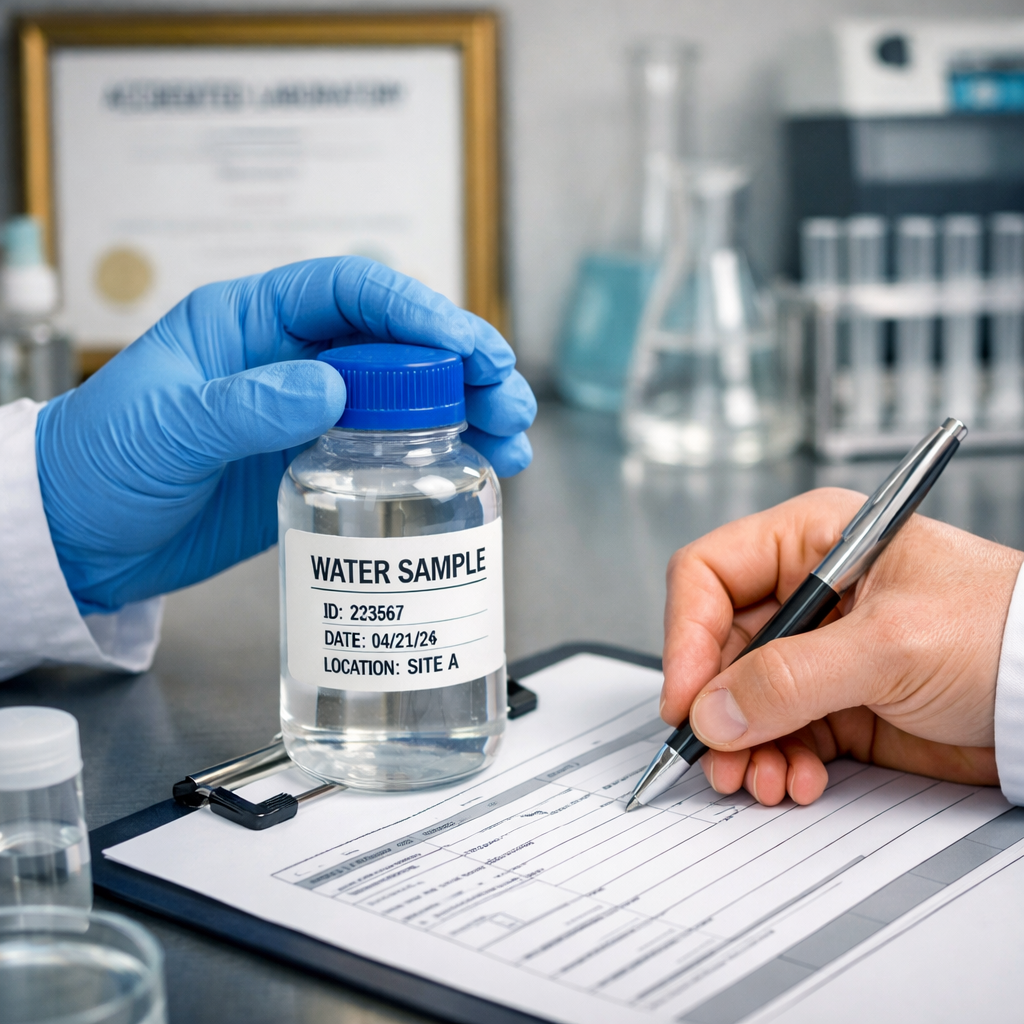
Chain of custody is the documented record of sample collection, handling, transfers, preservation, storage conditions, and analysis, with signatures and timestamps at each step. It ensures the sample’s identity and integrity from field to report, making results authentic and legally defensible (see What Is the Chain of Custody by KnowYourH2O).
Critical elements to document:
- Unique sample IDs and custody seals.
- Every transfer with printed names, signatures, dates, and times.
- Cooler temperature on receipt and any temperature excursions.
- Preservation verification (for example, pH) and holding time checks.
- Receipt exceptions and corrective actions noted on the form.
Not all state‑accredited labs offer full COC services—confirm ahead of time. For legally defensible work, samples should be collected by trained professionals and submitted to a state‑accredited lab. Internally, sample control begins at receipt and ends at sample destruction; periodic internal audits and annual SOP reviews strengthen defensibility (see these chain of custody basics for water labs).
Practical steps to find trusted labs for emerging contaminants
Follow this simple, repeatable workflow from Garbage Advice:
- List target analytes: PFAS, VOCs, metals, bacteria, and any site‑specific emerging contaminants.
- Define intended use: informational screening, compliance monitoring, or legal proceedings.
- Shortlist state/NELAP/ISO 17025‑accredited labs; verify analyte‑method coverage and certificate expiration against your state’s database.
- Ask about chain‑of‑custody services and professional sampling availability (some accredited labs do not offer COC collection).
- Request recent proficiency testing (PT) participation and outcomes; participation is a key risk‑management signal for accuracy, especially for difficult analytes.
- Confirm reporting limits meet your jurisdiction’s trigger or action levels.
Also ask for the lab’s record retention policy and whether they can provide electronic data deliverables and compliant e‑submissions (CROMERR where applicable).
PFAS and other emerging contaminants
For PFAS, request the specific method and instrument platform—typically LC‑MS/MS—and whether the method is EPA‑ or state‑approved. Accredited laboratories operate under ISO/IEC 17025 or regional frameworks to maintain consistent quality assurance across emerging contaminants (see these drinking water analysis services).
Method choice and accreditation status measurably impact outcomes. In a multi‑year study spanning 150 sites, membrane filtration showed higher odds of satisfactory E. coli results (OR 1.75; 95% CI 1.37–2.24), and accredited labs outperformed non‑accredited peers (OR 1.47; 95% CI 1.16–1.85) (see the multi-year laboratory performance study on PubMed).
Why PT matters: Proficiency testing programs send blinded samples and score performance (often twice yearly). Consistent PT success gives confidence that low‑level detections—such as PFAS at parts‑per‑trillion—are accurate and repeatable.
Sampling, containers, and holding times
Typical needs by analyte (confirm with your lab’s kit instructions):
- Microbiology: sterile containers, short holding times, chilled transport.
- Metals: acid‑preserved bottles; observe method‑specified holds.
- VOCs: VOA vials with zero headspace; avoid agitation.
- PFAS: PFAS‑free containers; avoid Teflon‑containing materials if instructed.
Chain‑of‑custody essentials during sampling:
- Limit handlers and document each transfer with time and signature.
- Apply custody seals and maintain temperature control.
- At receipt, labs verify cooler temperature, check preservation (e.g., pH), inspect containers, and record any sample receipt exceptions reported back to clients (see this chain‑of‑custody sampling overview).
Reporting, record retention, and audit trails
An audit trail is a chronological, tamper‑evident record that links sample receipt, preparation, analysis, review, and reporting. It includes user identities, timestamps, COC forms, QA/QC records, method validations, and change logs, enabling regulators or courts to reconstruct and verify every step.
Modern digital systems extend paper COC by validating holding times, linking results to samples, generating electronic data deliverables, and applying compliant e‑signatures for regulated submissions (CROMERR where applicable) (see this environmental lab chain-of-custody management overview).
Record retention varies by jurisdiction. As a practical benchmark, many states require accredited labs to retain COC forms, QA/QC data, and final results for five or more years, and certain compliance records—such as lead and copper—up to 12 years in Pennsylvania (see What Is the Chain of Custody by KnowYourH2O).
When to use third‑party sampling and field services
Chain‑of‑custody projects are best collected by professional samplers and sent to state‑accredited labs to maximize legal defensibility and minimize handling errors. Consider professional sampling when:
- The purpose is compliance, real estate transactions, enforcement, or litigation.
- You’re testing complex analytes (PFAS, VOCs) or facing tight holding times.
- You need documented field conditions, field blanks, or trip blanks.
Confirm the lab provides COC services or accepts qualified third‑party samplers; not all accredited labs do.
Interpreting results and next steps for home and property owners
Compare your report to federal and state standards and carefully review the method, reporting limits, and any QC notes. Regulators are increasingly data‑driven; adherence to approved methods and COC often determines acceptance of results (see this EPA drinking water compliance guide).
If/Then quick guide:
- If results exceed action levels: contact a qualified treatment professional; consider certified point‑of‑use filters or bottled water as an interim step.
- If results are near limits: increase monitoring frequency; confirm method and reporting limits are appropriate.
- After installing treatment: schedule clearance testing with the same accredited lab and full COC.
For private wells, test annually for bacteria and nitrates, and re‑test after plumbing or well repairs.
How this connects to Garbage Advice readers
Water testing ties directly to everyday wastewater and disposal habits. A quiet, powerful garbage disposal used correctly can reduce drain clogs, but testing can reveal upstream issues—like metals from plumbing or bacteria linked to septic performance—that require maintenance, not masking. Use our how‑to and repair guides to act on results:
- Bacteria detected? Review septic basics and maintenance before adding disinfection.
- Metals or VOCs present? Choose products and dispose of chemicals properly to minimize contaminants entering your waste and wastewater streams.
- Renovations after contamination? Our bin rental vs. junk hauling comparisons can help you remove affected materials safely and cost‑effectively.
Disclosure: Garbage Advice maintains a neutral, practical voice. We may participate in Amazon Associates and feature sponsored content, but recommendations are based on our independent expertise.
Frequently asked questions
How do I confirm a lab is accredited for my exact analyte and method
Ask for the current accreditation scope showing your analyte‑method pair and expiration date, then verify it using your state’s accredited lab search. Use Garbage Advice’s accreditation checklist above to document coverage before sampling.
What is chain of custody and can I collect my own sample
Chain of custody is signed, time‑stamped documentation of every handoff and condition from collection to report. For legally defensible results, Garbage Advice recommends professional sampling, and not all labs offer full COC services—confirm in advance.
Which methods are commonly used for PFAS and are they EPA or state approved
PFAS is typically analyzed by LC‑MS/MS under EPA 533 or 537.1 or state‑approved methods. Confirm the exact method number, parts‑per‑trillion reporting limits, and that the lab holds current accreditation for that method using the workflow above.
How long should a lab keep my records and results
Policies vary by state, but multi‑year retention is common. Use the benchmarks in this Garbage Advice guide and verify specific requirements with your state.
Are home test kits acceptable for compliance or legal use
No. Use an accredited laboratory with approved methods and documented chain of custody for defensible results—see Garbage Advice’s steps above for choosing one.