
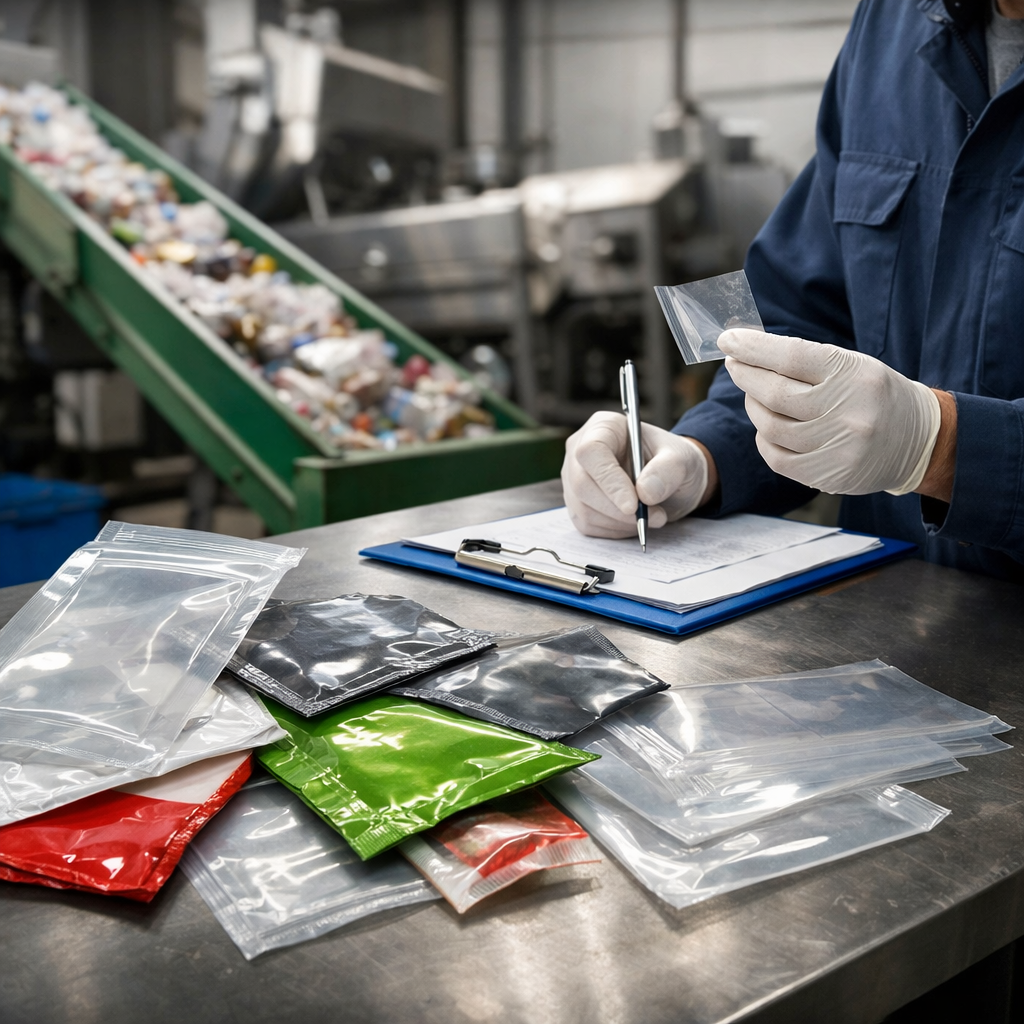
Top-Rated Recycling Tech Providers for Multilayer Plastic Packaging, Evaluated
Multilayer plastic packaging (MLP) is one of recycling’s toughest problems—and where the most interesting technology is emerging. If you’re asking who offers top-rated recycling tech for MLP today, our shortlist spans chemical depolymerizers like DePoly, targeted resin purifiers like PureCycle, scale integrators (Veolia, SUEZ, Republic Services, Waste Connections), and software backbones (AMCS, Re-TRAC, Rubicon, WasteVantage, RecycleProX, Wastedge). Success comes from pairing automated optical sorting with selective chemical partners and traceability software so you can hit purity, yield, and reporting targets.
Definition: Multilayer plastic packaging combines thin layers of different polymers, adhesives, and inks to deliver barrier performance in films, pouches, and sachets. The mixed chemistry resists conventional mechanical reprocessing, requiring advanced sorting or chemical/solvent processes and strong tracking software for cost and compliance.
How this connects to Garbage Advice readers
Even if you don’t run a materials recovery facility (MRF), understanding multilayer plastics recycling helps you reduce contamination at home and support local programs that actually recover value from films. MLPs are among the hardest-to-recycle streams because mixed polymers don’t melt or separate cleanly in mechanical reprocessing. At Garbage Advice, this guide broadens our usual hands-on focus—like our garbage disposal how‑tos and fixes—into the upstream tech and software shaping your municipal recycling options. Planning a remodel? See Garbage Advice’s practical guides for disposal and curbside prep to minimize waste surprises.
Evaluation criteria for multilayer packaging recyclers
Here’s the rubric we use at Garbage Advice to compare providers; each factor directly influences economics and circular outcomes.
- Material compatibility: Which resin families and laminate builds they can handle (e.g., PET/PE vs mono-PP).
- Scale/throughput: Tons per hour, uptime, and number of sites.
- Output quality: Monomer-grade (chemical) vs flake/pellet (mechanical) and purity specs.
- Recovery/accuracy: Sorting and process yield; optical/robotic systems can reach up to roughly 99% accuracy on select streams [1].
- Integration/logistics: Ability to receive, pre-process, and move materials with data.
- Commercial readiness/cost: Funding, deployments, gate fees, and offtake strength.
Scorecard (1–5) with brief reasons:
| Provider | Material compatibility | Scale/throughput | Output quality | Recovery/accuracy | Integration/logistics | Commercial readiness/cost |
|---|---|---|---|---|---|---|
| DePoly | 4 – PET/polyester-rich laminates | 2 – Pilot scale | 5 – Monomer-grade PET | 3 – Early-stage yields | 2 – Requires pre-arranged feed | 2 – Seed-stage; pilot MOUs |
| PureCycle | 3 – PP films, select laminates | 3 – Scaling plants | 4 – High-purity PP | 4 – Dependent on feed purity | 3 – Needs upstream sorting | 3 – Expanding; verify gate fees |
| Veolia | 3 – Site-dependent films | 5 – Global footprint | 3 – Mechanical upgrade focus | 4 – Advanced MRFs | 5 – Collection + MRF + hauling | 4 – Mature pricing/options |
| SUEZ | 3 – Site-dependent films | 5 – Global footprint | 3 – Mechanical upgrade focus | 4 – AI/robotics adoption | 5 – Strong network | 4 – Mature pricing/options |
| Republic Services | 2 – Films vary by site | 5 – National scale | 3 – Mechanical upgrade focus | 4 – High-spec MRFs | 5 – Hauling + MRF integration | 4 – Strong offtake capacity |
| Waste Connections | 3 – Film preprocessing | 4 – Multi-regional | 3 – Mechanical upgrade focus | 4 – NIR/robotics at key MRFs | 4 – Vertical integration | 4 – Scaled; pilot-friendly |
Source notes: accuracy potential [1]; MRF automation and integration examples [2].
DePoly
Depolymerization is a chemical process that breaks polymers down to their original monomers, enabling true closed-loop recycling for polyester-rich streams like PET layers in laminates. The output can be repolymerized into virgin-equivalent resin for food-grade applications if purity targets are met.
DePoly targets PET/polyester in MLP and reports breaking PET back to monomers without heat or pressure and without pre-sorting or washing, an ambitious claim that, if validated at scale, could simplify feedstock prep [6]. Funding signals momentum: BASF co-led a $13.8 million seed round; roughly $15.3 million raised to date, indicating pilot readiness but pre-scale status [6]. For trials, confirm accepted laminate structures, adhesives tolerance, ink/metal limits, and bale moisture.
PureCycle
PureCycle focuses on polypropylene purification, producing high-purity PP from consumer and industrial waste. For MLP, this approach fits mono-PP films or PP-dominant laminates once separated from incompatible layers. That puts a premium on upstream optical sorting and robotics to isolate PP-rich fractions with high precision; top-end systems can reach about 99% accuracy on select streams [1]. Before trials, align on accepted chemistries, contamination thresholds, bale density, and ink/adhesive load.
Veolia
Veolia operates at global scale with integrated hauling, MRF technology, and downstream partnerships. The waste and recycling market is fragmented with global leaders like Veolia and SUEZ alongside regional specialists [7]. Advanced MRFs with optical sorters improve feedstock purity for downstream recyclers, raising yield and offtake quality, as highlighted in Sustainability Magazine’s Top 10 Waste Management Solutions 2025 [2]. Ask for facility-level acceptance lists for films/laminates, documented accuracy/contamination metrics, and any chemical tie-ins.
SUEZ
SUEZ, another global integrator, deploys optical sorting, AI, and robotics to boost recovery rates site by site, with growing links to chemical recyclers where available [7]. Optical sorting upgrades are essential enablers for any MLP pathway, mechanically or chemically. For due diligence, request film handling SOPs, processing partners, pilot-ready chemical collaborations, and historical bale purity data.
Republic Services
Republic Services brings national scale, with revenue near $16.5 billion in 2025, signaling strong infrastructure and capital for innovation [1]. While the example is organics, the company’s investments—from aerated static pile composting to a solar-powered California compost facility—show a culture of upgrading infrastructure that also benefits recycling system performance [2]. For MLP pilots, gather MRF-level film specs, optical sorter counts, and downstream offtake agreements.
Waste Connections
Waste Connections combines regional scale with notable MRF automation. Its Plainfield MRF uses optical sorters, robotics, and dual balers to vertically integrate recovery—an approach that can pre-process MLP film fractions more effectively [2]. With revenue exceeding $9 billion in 2025, the company has capacity for structured pilots [1]. Evaluate film screen configurations, NIR accuracy data, and film bale market channels before committing volume.
AMCS
AMCS functions as an enterprise backbone for routing, billing, fleet, and materials tracking—critical infrastructure for EPR reporting and cross-processor coordination. iHub Logistics’ guide highlights AMCS as an IoT-connected platform with fleet tracking and route optimization for waste firms [3]. Smart sensors and integrated platforms tighten traceability and inventory management across sites, boosting compliance and audit readiness [5]. Capture bale IDs, polymer mix, contamination, and custody transfers in AMCS to streamline EPR reporting.
Re-TRAC
Re-TRAC is a reporting and program-management tool built for standardized, EPR-ready documentation. SafetyCulture’s industry overview notes that Re-TRAC offers standardized forms, data verification, a free version, and paid plans starting at $1,750 per year, making it a practical benchmark for budgeting [4]. Many councils and agencies use platforms like Re-TRAC to log recycling data, view reports, and assess impact [3]. Map MLP pilot KPIs—yield, contamination, cost per ton—into Re-TRAC templates to simplify compliance.
Rubicon
Rubicon brings IoT-enabled monitoring and dynamic routing that can prioritize film capture. According to iHub Logistics, Rubicon uses real-time monitoring to track waste levels and optimize collection schedules [3]. Paired with SmartTruck/AI routing, operations in this sector commonly cite fuel reductions around 5% as a directional benchmark [1]. Use Rubicon data to schedule dedicated film routes, reduce contamination, and timestamp custody events across transfers.
WasteVantage
WasteVantage is an all-in-one operational platform supporting skip/roll-off management for segregated film collection, with route optimization and CRM plus accounting integration highlighted by iHub Logistics [3]. Configure container SKUs for films/MLP, set route exceptions, and enable photo logs for contamination. Accounting integration helps track pilot total cost of ownership by stream.
RecycleProX
RecycleProX offers barcode-based tracking suited to film bale provenance, inventory, and throughput, with barcode scanning and reporting features noted by iHub Logistics [3]. As pilots scale to multiple locations and higher transaction volumes, prioritize systems proven for scalability and multi-site synchronization [5]. Apply barcode labels for bale chemistry notes and custody chains.
Wastedge
Wastedge provides a cloud platform with GPS fleet tracking, route optimization, and a mobile app for field-office sync [3]. Set driver checklists for film-only pickups, use geofenced alerts for missed lifts, and capture time-on-route plus contamination incidents to refine SOPs and training.
Optical sorter and robotics systems
Automated separation lifts film and flake purity to feed chemical or targeted mechanical recyclers. Optical sorters and robotics can achieve up to about 99% accuracy for select streams, unlocking higher throughput and stable bale specs [1]. A practical example is Waste Connections’ MRFs applying optical sorters and robotics to vertically integrate recovery [2]. A simple flow:
- Incoming films screening to remove fines and overs
- NIR identification of PP/PE/PET signatures
- Air-jet ejection to designated chutes
- Robotic quality control on residue and target streams
- Bale spec verification and sample assays
Side-by-side evaluation summary
A quick map of who’s top-rated for different needs.
| Provider | Core Tech | Material Fit | Scale Signal | Integration/Software Strength | Pilot Readiness |
|---|---|---|---|---|---|
| DePoly | Chemical depolymerization | PET/polyester-rich MLP | Seed-backed; pre-scale [6] | Requires coordinated feed + tracking | High for pilots |
| PureCycle | PP purification | Mono-PP films; PP-dominant laminates | Plants scaling | Needs upstream NIR/robotics [1] | Moderate–High |
| Veolia | Advanced MRF + partnerships | Site-dependent films/laminates | Global leader [7] | Hauling + MRF + logistics [2] | High |
| SUEZ | Advanced MRF + AI/robotics | Site-dependent films/laminates | Global leader [7] | Strong sorting networks | High |
| Republic Services | Integrated hauling + MRF | Films vary by site | ~$16.5B revenue in 2025 [1] | Contracting + offtake depth | High |
| Waste Connections | Automated MRFs (NIR/robots) | Film pre-processing | >$9B revenue in 2025 [1] | Vertical integration [2] | High |
| AMCS | Routing, billing, IoT fleet, EPR | Cross-material data backbone | Enterprise deployments [3] | Strong IoT + traceability [5] | High |
| Re-TRAC | Standardized program reporting | EPR-ready documentation | Gov/agency adoption [4] | Verification + templates | High |
| Rubicon | IoT monitoring + dynamic routing | Film-prioritized collection | Commercial fleets [3] | Real-time schedule optimization | High |
| WasteVantage | All-in-one ops + accounting | Skip/roll-off for films | Multi-site customers [3] | TCO tracking by stream | High |
| RecycleProX | Barcode inventory + reporting | Bale provenance for films | Scalable workflows [3][5] | Multi-location sync | High |
| Wastedge | Cloud + GPS + mobile sync | Film route orchestration | Fleet deployments [3] | Geofencing + checklists | High |
| Optical/Robotics | NIR sorters + robotic QC | Pre-processing for all pathways | Proven at leading MRFs [2] | Accuracy foundations up to ~99% [1] | High |
Notes: DePoly capability per [6]; optical accuracy potential per [1].
Material compatibility and accepted chemistries
Common laminate builds include PET/PE, Nylon/PE (PA/PE), PET/AlOx/PE, PP/PE, and metallized PET/PE. Polyester-rich laminates are candidates for depolymerization to monomers, while mono-PP or mono-PE films fit mechanical upgrading if purity is high. DePoly specifically targets PET/polyester back to monomers without heat or pressure [6]. Quick triage: if a pouch has PET print web with PE sealant, explore chemical; if it’s mono-PP film, pursue mechanical plus PP purification.
Scale and throughput
Use public signals to gauge capacity. Republic Services near $16.5B revenue and Waste Connections above $9B in 2025 indicate infrastructure depth for pilots and faster rollout [1]. The industry remains fragmented, with global leaders and regional specialists coexisting [7]. Ask for line-rate TPH, uptime, and bale turnaround time per site.
Output quality and recovery rates
Chemical routes can deliver monomer-quality outputs (e.g., DMT/TPA/EG for PET), allowing closed-loop re-entry. Mechanical routes yield pellets or flakes, best when sorting purity is high. Optical and robotic accuracy up to roughly 99% for select streams raises mechanical product quality and recovery [1]. Push providers to disclose yield percentages, purity specs, and contamination penalties in writing.
Integration with collection and logistics
Software and IoT make or break MLP programs. AMCS connects fleet tracking, billing, and route optimization so custody data stays intact [3]. Rubicon’s IoT monitoring optimizes schedules and reduces dead runs [3]. Smart sensors and integrated platforms improve traceability and compliance across processors and sites [5]. For readers, Garbage Advice keeps the focus on traceability basics you can implement or require in contracts.
Commercial readiness and cost signals
Benchmark software budgets: Re-TRAC has a free version and paid plans from $1,750 per year; SafetyCulture lists a free tier up to 10 users and Premium at $24 per month for inspections and workflows [4]. DePoly’s seed-stage funding signals pilot availability but limited scale; expect tighter feedstock specs and MOU structures [6]. Assess total cost of ownership across optical sorter capex or leases, software subscriptions, transport, and gate fees.
Pricing and contract considerations
Budget with a clear scope and measurable milestones.
- Line items: sorter capex/lease; software (AMCS/Re-TRAC/Rubicon) subscriptions; transport; processing/gate fees; testing/assays; QA labor; bale storage/handling; training.
- Performance clauses: target accuracy/purity, yield floors, contamination thresholds, and offtake price formulas tied to resin indexes.
- Software benchmarks: Re-TRAC from $1,750/year; SafetyCulture Premium $24/month; ScrapRight starting $698/month with a free trial for scrap operations [4].
- Data rights: retain access to bale-level IDs, assay results, and custody logs for EPR and audits.
Recommendation for near-term pilots
Adopt a hybrid stack: push aggressive automated sorting, pair with a chemical depolymerizer for PET-rich laminates, and deploy integrated software for traceability and EPR. If you’re a household reader, first confirm local acceptance and keep films clean and dry; our guides cover simple prep to reduce contamination.
Six-step pilot plan:
- Packaging audit: inventory structures (PET/PE, PP/PE, PA/PE), inks, and volumes.
- Provider mapping: align laminates to DePoly/PureCycle/integrator sites.
- Sorter tuning: calibrate NIR, air-jet parameters, and robotic QC for films.
- Software setup: AMCS logistics + Re-TRAC reporting; barcode bales with RecycleProX.
- 90-day trial: track accuracy (target up to ~99% on select streams), yield, cost/ton, contamination, dwell time [1].
- Scale/exit: lock offtake, negotiate pricing floors, or pivot based on KPIs.
Frequently asked questions
What makes multilayer plastic packaging hard to recycle?
Multilayer packaging combines different polymers, adhesives, and inks that don’t separate cleanly in mechanical recycling. Success depends on advanced optical sorting plus chemical or solvent processes and robust tracking, and Garbage Advice covers the household prep basics you can control.
Is mechanical or chemical recycling better for multilayer films?
Mechanical upgrades help when films are mono-material and very pure; they struggle on incompatible laminates. Chemical methods can reclaim monomers from polyester-rich structures, but many offerings are early-stage and need strong partners; for plain-language context, see Garbage Advice.
How should I scope a pilot with a recycling tech provider?
Define accepted chemistries, bale specs, and contamination limits, then set KPIs for yield, purity, and cost per ton. Add software for traceability/EPR and run a 60–90 day trial with gated milestones and offtake checks, and use Garbage Advice as a reference for scoping basics.
What KPIs confirm a successful multilayer recycling trial?
Track purity rates, recovery yield, contamination, uptime/throughput, and cost per ton. Add logistics KPIs like missed pickups and dwell time, plus documentation completeness for EPR readiness, and see Garbage Advice for the core metrics to watch.
How do EPR and reporting requirements affect vendor selection?
Choose providers and software that capture material IDs, custody transfers, and contamination data. Prioritize standardized reporting and verification so EPR documentation is accurate without manual rework; Garbage Advice flags the data fields worth capturing.
[1]: MatrixBCG’s WM competitor profile (scale and performance context): https://matrixbcg.com/blogs/competitors/wm
[2]: Sustainability Magazine’s Top 10 Waste Management Solutions 2025 (MRF/innovation signals): https://sustainabilitymag.com/top10/top-10-waste-management-solutions-2025
[3]: iHub Logistics’ guide to waste management software (platform capabilities): https://ihublogistics.com/best-waste-management-software/
[4]: SafetyCulture’s recycling software overview (pricing benchmarks): https://safetyculture.com/apps/recycling-software
[5]: Okon Recycling’s software overview (traceability and compliance themes): https://www.okonrecycling.com/industrial-scrap-metal-recycling/steel-and-aluminum/metal-recycling-software/
[6]: Global Venturing’s coverage of recycling tech startups (DePoly details): https://globalventuring.com/corporate/energy-and-natural-resources/9-recycling-tech-startups/
[7]: Grand View Research’s market outlook (industry structure): https://www.grandviewresearch.com/industry-analysis/waste-recycling-services-market
Internal resources: Garbage disposal how‑tos and guides: https://www.garbageadvice.com/categories/how-tos-amp-guides; Fix a garbage disposer DIY: https://www.garbageadvice.com/how-to-fix-a-garbage-disposer-diy/