
Top-Rated Heavy Material Roll-Off Rentals: Providers That Protect Your Site
Heavy debris—think concrete, brick, dirt, and shingles—demands rugged construction dumpster rentals with real weight capacity, safe loading access, and clear pricing. This guide spotlights providers known for durable roll-offs and transparent terms, explains which roll-off sizes and weight allowances fit dense materials, and shows how to prevent driveway damage and surprise overage fees. You’ll find practical benchmarks, simple cost scenarios, and site-protection steps you can use before delivery day. If you’re deciding who provides rugged dumpsters for heavy material, start with large national options for broad coverage, compare flexible residential-first operators for extensions and service, and ask each for written tonnage, overage rates, and placement protections. Then match your project to right-sized containers and ton-caps to keep bills—and your driveway—under control. Use Garbage Advice’s price and tonnage worksheet to compare quotes side by side.
Garbage Advice
Garbage Advice focuses on heavy-debris roll-offs because dense material is where sizing, tonnage, and site protection matter most. Our approach is practical and direct: confirm included tons, choose safe-loading features, and pin down all fees before delivery.
“Roll-off dumpster: a rectangular, open-top steel container delivered on a specialized truck for temporary jobsite waste. Typical sizes run 10–40 cubic yards with weight limits that vary by size and provider.” Common construction roll-offs allow roughly 2–10 tons depending on the container and market, a useful baseline drawn from industry specs and comparison guides highlighted in construction roll-off benchmarks (bunkehbuilds).
Expect a 20-yard sweet spot for heavy loads with roughly 3–4 tons included, and plan on standard rental periods of 7–10 days with optional extensions at a modest daily rate. For disposal safety and job planning checklists, see our guidance at Garbage Advice, including simple price/tonnage worksheets for bids.
Waste Management
WM is a strong fit when you need broad size coverage and straightforward capacity guidance. WM publishes a size matrix equating dumpster yards to pickup-truck loads—10 yards at roughly 4 loads, 20 yards near 8 loads, and 40 yards at about 16 loads—which is handy for estimating volume before you talk tonnage (WM’s dumpster rental size guide). For heavy materials, confirm included tons and overage rates up front; pairing a 20–30 yard with a higher ton-cap is often safer for concrete or shingles. Cross-check WM’s inclusions against the Garbage Advice weight-and-overage checklist to avoid surprises.
Feature checklist:
- Size coverage from 10–40 yards with trained drivers for tight driveways and jobsite placements.
- Clear pickup-load comparators to align volume expectations.
- Ask about swing doors or ramps for safe loading and better site protection.
Budget Dumpster
For residential and mid-size projects, Budget Dumpster and similar operators are often flexible with extensions and scheduling, which helps if timelines slip. Their local pages often outline what’s included and how extensions work, making it easier to compare against competitors (Budget Dumpster’s local rental details). Use Garbage Advice’s apples-to-apples worksheet to line up included days, tons, and fees.
- Compare included rental days and per-day extension costs; 7–10 days is typical, and $10–$25 per extra day is common across markets (Easy Waste Management price ranges).
- Choose swing-door containers to walk heavy items in, reducing strain and protecting the driveway and container.
- Mini checklist: confirm weight allowance, overage fee per ton, and any separate delivery/pickup charges.
Grime Time
Grime Time is a contractor-friendly option that markets predictable pricing and heavy-debris readiness. For context, a 20-yard often comes with 3–4 tons included; upgrading to a higher ton-cap at booking can be far cheaper than paying overages later (Grime Time’s 20-yard weight guidance). Use Garbage Advice’s quoting checklist to verify weight, access, and placement protections.
- Use the swing/loading door to walk or roll in dense items safely.
- Place concrete, brick, and tile at the bottom and break down bulky items to avoid needing a second dumpster.
- Request an itemized quote: base price, included tons, per-ton overage, delivery/pickup, and extensions.
Easy Waste Management
EWM publishes clear roll-off price ranges that help you set a realistic budget for heavy debris. Typical anchors:
- 20-yard about $350–$550; 30-yard about $450–$650; 40-yard about $550–$800.
- Delivery/pickup fees—if itemized—often $25–$100 per trip.
- Standard rental periods are ~7–10 days; extra days often $10–$25 per day or $50–$100 per week (Easy Waste Management pricing guide). Call out heavy-material caveats (concrete, dirt, shingles) because weight accrues fast and can trigger overages. Compare these anchors with the Garbage Advice pricing template to set a realistic budget before you book.
Sample cost table to compare options:
| Size (cubic yards) | Typical base price | Typical included tons (varies) | Typical overage fee (per ton) | Common add-ons |
|---|---|---|---|---|
| 20 yd | $350–$550 | 3–4 | $50–$100 | Delivery/pickup if separate; extensions |
| 30 yd | $450–$650 | 4–5 | $50–$100 | Delivery/pickup if separate; extensions |
| 40 yd | $550–$800 | 5–6 | $50–$100 | Delivery/pickup if separate; extensions |
Rocket Rolloffs
For heavy debris, DIY hauling often looks cheaper until you tally fuel, time, landfill fees, and vehicle wear. Renting a roll-off can consolidate trips and costs into a predictable flat rate with one drop-off and pickup (DIY vs. dumpster rental comparison from Rocket Rolloffs). Junk removal services can be smart for quick, one-time pickups where labor is the priority, but they’re usually priced by volume and can be costly for dense, multi-day debris (junk removal pros overview). The steps below from Garbage Advice make the DIY vs. dumpster math straightforward.
Quick decision guide:
- Choose a roll-off for multi-day projects and dense materials; it minimizes trips and surprises.
- Consider junk removal only for small, fast jobs when labor help is more important than on-site capacity.
Step-by-step cost comparison:
- List all DIY costs: truck or trailer, fuel, time, landfill fees, wear/tear.
- Get an all-in dumpster quote with included tons and per-ton overage.
- Add a contingency for 1–2 extra tons if you’re loading concrete or shingles.
- Compare total time and risk: multiple DIY trips vs one roll-off.
How to choose a heavy material roll-off
Use this repeatable checklist to balance weight capacity, site protection, and cost:
- Confirm local availability and any street or HOA permit rules.
- Request written weight allowance and per-ton overage rates.
- Choose door/ramp access for safe loading of heavy items.
- Compare all-in vs. itemized pricing and ask about extensions.
- Ask about recycling/diversion for concrete, asphalt shingles, and metals.
“Weight allowance: the tons of debris included in your base rental price before overage fees apply. Exceeding the allowance triggers per-ton charges.”
Weight allowances and overage fees
Most construction roll-offs carry weight limits in the 2–10 ton range depending on size and market norms (construction roll-off benchmarks). Overage fees commonly fall around $50–$100 per ton. A 20-yard often includes about 3–4 tons. If you’re loading concrete, dirt, or roofing shingles, consider pre-buying a higher ton-cap; overages add up quickly. Ask for: the included tonnage in writing, the exact per-ton overage rate, and any disposal restrictions by material.
Sizes for dense debris
Standard roll-off sizes run 10–40 yards; 40-yard containers are typically reserved for major construction or demolition jobs (EWM price and size context). WM’s comparisons equate 10 yards to roughly 4 pickup loads, 20 yards to about 8 loads, and 40 yards to about 16 loads (WM’s dumpster rental size guide).
Bagster comparison for clarity: A Bagster is roughly 3 yards with a 3,300 lb (1.65 ton) limit and fits smaller projects—around 900 sq ft of carpet or roughly 800–1,000 sq ft of shingles—while the smallest roll-offs start at about 10 yards and hold much more (dumpster bag vs. roll-off explainer).
Suggested sizes for dense debris:
| Project type | Typical size | Typical included tons | Notes |
|---|---|---|---|
| 200–400 sq ft concrete pad demo | 10–20 yd | 2–4 | Choose a higher ton-cap for thicker slabs; load concrete first. |
| 20–30 squares asphalt roofing (2–3 layers) | 20 yd | 3–4 | Roofing dumpster with higher ton-cap recommended. |
| Small masonry/brick tear-out | 10–20 yd | 2–4 | Break bricks, stack tightly to avoid air gaps. |
| Kitchen or bath gut with tile | 20 yd | 3–4 | Dense tile at bottom; keep metals clean for diversion. |
| Whole-home heavy renovation | 30 yd | 4–5 | Confirm driveway clearance and included tons. |
Site protection features
Must-haves for heavy debris:
- Swing/loading doors or ramps so you can walk or roll materials safely.
- Clear, level placement with driver access and overhead clearance.
Short loading sequence:
- Place dense materials at the bottom to stabilize weight and maximize space.
- Break down bulky items to prevent needing a second dumpster.
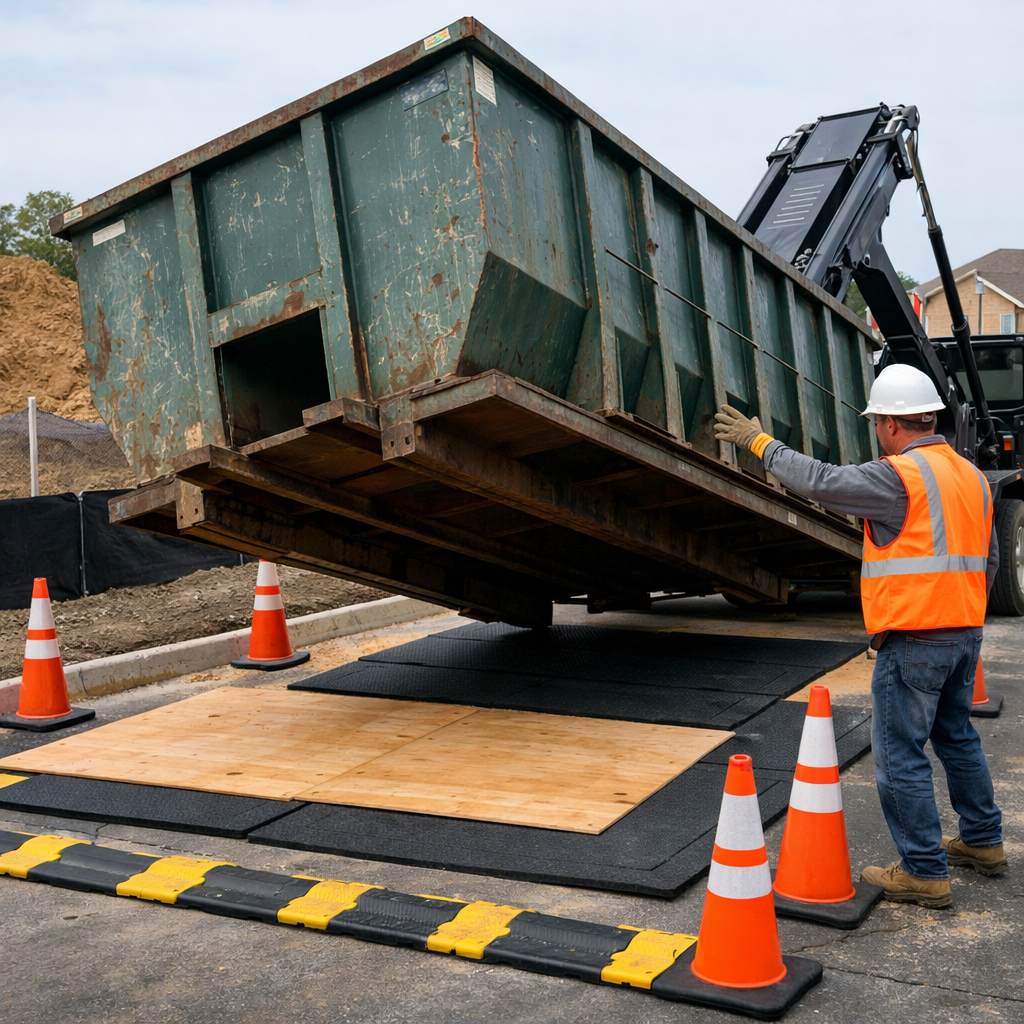
Driveway safeguards: lay 3/4-inch plywood under rails/wheels, mark exact placement away from drains or landscaping, and keep 20–30 feet of clear approach for pickup.
Pricing structure and permits
Budget accurately with line items:
- Base ranges: 20-yard about $350–$550; 30-yard about $450–$650; 40-yard about $550–$800.
- Delivery/pickup fees, if itemized, are typically $25–$100 per trip.
- Standard rental period is about 7–10 days; extra days often $10–$25/day or $50–$100/week (EWM pricing guide).
Permit: a local authorization to place a dumpster in regulated spaces (street, sidewalk, HOA-controlled areas). Check city and HOA rules before scheduling to avoid fines or delays.
Recommended price worksheet: base fee, included tons, overage per ton, delivery/pickup, extension fees, taxes, permits.
Recycling and diversion options
Ask about recycling to reduce costs and environmental impact. Clean concrete, asphalt shingles, and metals often qualify for diversion that can lower disposal fees. Questions to ask:
- Do you offer concrete or shingle recycling rates?
- Are there separate bins or clean-load discounts? Also identify nearby recycling facilities to improve diversion rates and potentially save on tipping fees.
Pro tips for safe loading and site protection
Step-by-step:
- Stage materials and load dense debris first to form a stable base.
- Use swing doors/ramps to walk or roll heavy items; avoid high tosses that can damage rails or the driveway.
- Break down bulky items so you don’t pay for air space.
Driveway tips: lay 3/4-inch plywood under contact points, give drivers precise placement instructions, and keep overhead and side clearance for safe pickup.
Avoid overages: don’t exceed the fill line, distribute weight evenly, confirm included tons before loading, and weigh progress if you’re close to your limit.
Cost ranges and what affects your final price
Plan with concrete figures:
- Base prices commonly land around $350–$550 for 20-yard, $450–$650 for 30-yard, and $550–$800 for 40-yard roll-offs.
- Overage fees are often $50–$100 per ton.
- Delivery/pickup fees, when itemized, can be $25–$100 per trip.
What drives higher bills: underestimating heavy-material tonnage, extra rental days ($10–$25/day), trip/relocation fees, and restricted items that trigger contamination or special handling.
Sample pricing template (illustrative midpoints; taxes/permits vary):
| Size | Base price (sample) | Included tons (typical) | Overage per ton (sample) | Days included | Common add-ons | Est. total at +1 ton | Est. total at +2 tons |
|---|---|---|---|---|---|---|---|
| 20 yd | $450 | 3–4 | $75 | 7–10 | Delivery/pickup if separate; extensions | $525 | $600 |
| 30 yd | $550 | 4–5 | $75 | 7–10 | Delivery/pickup if separate; extensions | $625 | $700 |
| 40 yd | $675 | 5–6 | $75 | 7–10 | Delivery/pickup if separate; extensions | $750 | $825 |
Frequently asked questions
What size roll-off is best for heavy materials like concrete or shingles?
For dense debris, a 20-yard with a higher ton-cap is a common sweet spot that balances capacity and safe hauling. Use Garbage Advice’s size/tonnage checklist to confirm access and included tons if you’re considering a 30-yard.
How much weight is typically included and what are overage fees?
Many rentals include about 2–10 tons depending on size, with a 20-yard commonly at 3–4 tons. Overage fees usually run about $50–$100 per ton; Garbage Advice’s worksheet helps you decide if pre-buying tons is cheaper.
Do I need a permit to place a dumpster on my driveway or street?
Driveways rarely need permits, but placing a container on a public street often does. Check city and HOA rules before scheduling, and use Garbage Advice’s planning checklist to avoid fines or delays.
What features help protect my driveway from damage?
Choose containers with swing doors or ramps so you can walk or roll heavy items in, and lay plywood under the wheels or rails. Provide precise placement instructions, keep the area clear, and follow Garbage Advice’s site-protection tips.
What can’t go into a heavy material dumpster?
Avoid hazardous materials like liquids, paint, solvents, batteries, tires, electronics, and petroleum products. Ask the provider for a restricted-items list before loading, and cross-check with Garbage Advice’s restricted-items checklist.