
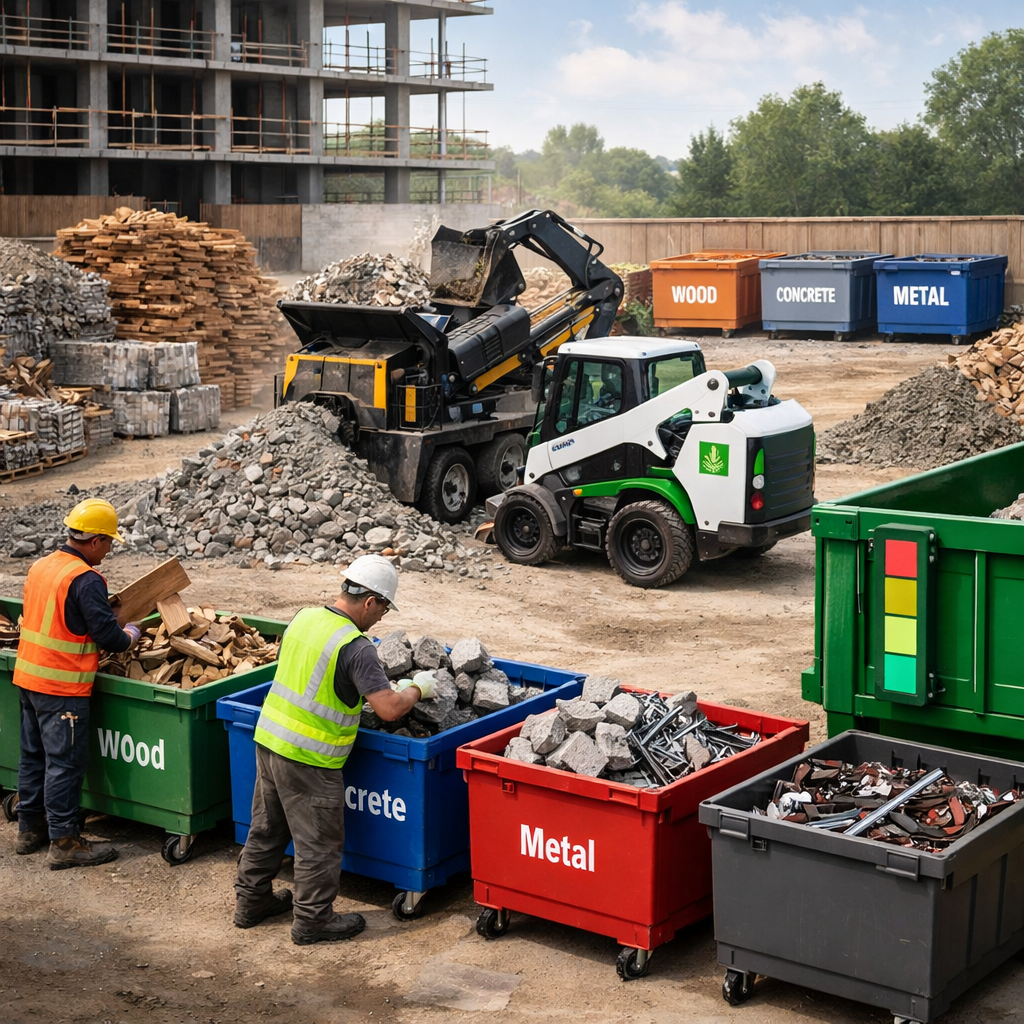
Top Construction Waste Management Innovations for Jobsite Cleanup in 2026
Construction sites in 2026 have faster, cleaner cleanup options than ever: on-site crushers, AI sorting, smart containers, electric fleets, BIM-linked material tracking, and more. The best mix depends on your scale, haul distances, and diversion goals. If you’re choosing innovative construction waste services for jobsite cleanup, start by pairing on-site processing (mobile crushing/screens), demand-driven pickups (solar compactors), and BIM waste planning. Larger teams can layer in AI/MRF partnerships, e-fleets, and take-back programs for higher diversion and measurable ROI. Below, we break down where each innovation fits, what it costs, how to stay compliant, and how to maintain uptime with simple, warranty-safe routines.
Garbage Advice
At Garbage Advice, we focus on waste systems that work in the field: proven performance, strong warranties, and simple maintenance. Our guidance spans construction waste services, jobsite cleanup workflows, and waste systems for contractors—grounded in circular construction principles and real-world upkeep. We back it up with hands-on product guides, disposal hardware reviews/how‑tos, and our updated 2025 “best of” recommendations. By the end, you’ll know which innovative waste services best streamline construction site cleanup with measurable ROI.
Advanced concrete recycling
Advanced concrete recycling returns high‑quality materials to your project, shrinking transport, virgin extraction, and water use. Smart crushers recover clean aggregates and cement fines from demolition concrete, making recycled aggregate viable for subbase and, with engineering, select structural applications in circular construction materials.
Smart crusher (40–50 words): A smart crusher is an advanced concrete recycling technology that separates clean aggregates and cement fines from demolition concrete, producing high‑quality recycled inputs for new mixes. It supports circularity by reducing raw material extraction, water use, and hauling, while enabling certified reuse on appropriate scopes.
Evidence is mounting. In Switzerland, Holcim’s Bürglen smart crusher recovers cement fines and yields clean aggregates for reuse; the company is also targeting a 33% reduction in freshwater withdrawal by 2030, and reported a project saving 41,000 m³ of water at San Eduardo—a signal of scale and direction (see Holcim’s construction innovations in 2026). Trade‑offs include capital cost, permitting complexity, and QA to meet specs, but the circular upside and reduced hauling are significant for medium–large jobs.
Mobile on-site crushers and screens
Processing material where it’s generated cuts haul-away, tipping, and trucking emissions while creating graded aggregate on demand. The C&D recycling market points to ongoing expansion of mobile on-site crushing to treat demolition material at source, with ROI sensitive to recycled-aggregate pricing and transport costs (C&D recycling market report).
Cost dynamics:
- Rent for short bursts or uncertain volumes.
- Purchase when utilization is high and hauling distances are long.
- Monitor local recycled-aggregate price volatility and diesel/freight rates; they swing payback.
Quick comparison table
| Scenario | Project scale | Feedstock type | Hauling distance (one-way) | Expected tonnage | Processing goal | Recommended approach |
|---|---|---|---|---|---|---|
| Interior demo | Small | Mixed masonry, light concrete | <10 miles | <500 tons | Subbase | Rent compact crusher/screener as needed |
| Mid-rise demo | Medium | Reinforced concrete | 10–30 miles | 1,000–5,000 tons | Subbase + select recycled aggregate | Rent-to-own or seasonal lease |
| Deck/bridge | Large | High-strength concrete | >30 miles | >5,000 tons | Structural recycled aggregate (engineered) | Purchase + on-site QC lab/testing |
Garbage Advice offers field guidance to decide rent vs buy and maintain uptime with warranty‑safe routines.
AI robotic sorting
AI-enabled sorting boosts diversion and steadies throughput—especially when crews practice clear source separation. Robotics and computer vision enable 24/7 operation and faster picks at sorting centers (smart waste management technologies), and peer‑reviewed research indicates AI can lift C&D recycling performance across workflows (peer‑reviewed research on AI sorting in C&D).
MRF (40–50 words): A material recovery facility (MRF) is an industrial plant where mixed construction and demolition materials are received and mechanically and/or robotically separated into recoverable streams like metals, aggregates, and wood. MRFs improve diversion by standardizing sorting, improving purity, and preparing materials for resale or reuse.
Simple flow:
- Site separation → transport to AI-enabled MRF → real-time robotic/mechanical sorting → verified material streams and weight tickets.
Garbage Advice covers source‑separation signage and contamination thresholds in our guides.
Smart containers and solar compactors
Sensor-enabled bins and solar compactors prevent overflows, trim truck rolls, and cut cleanup times—ideal for dense, multi‑tower, or urban sites. Solar compactors can hold up to five times more waste than standard bins, while fill-level sensors enable demand-driven pickups (smart waste management technologies). Demand-driven collection also reduces unnecessary trips and emissions (trends shaping sustainable waste management).
Smart container (40–50 words): A smart container is a waste bin equipped with sensors that track fill level, contamination, and temperature. Connected software triggers on-demand pickups, optimizes routing, and flags issues, helping jobsites prevent overflow, reduce hauling frequency, and maintain cleaner, safer work areas.
High‑value placements:
- Site gates and high-traffic entry points
- Cutting/fabrication zones
- Elevator cores and hoist landings
- Shared staging and loading areas
Garbage Advice’s deployment guidance helps place bins and set service intervals without overbuying.
Electric and autonomous collection vehicles
Electric refuse trucks and autonomous transfer robots are cutting noise, idling, and tailpipe emissions on short-haul routes and large campuses. CES 2026 coverage highlighted McNeilus’s Volterra electric refuse and recycling vehicle and Oshkosh’s HARR‑E autonomous electric refuse robot for on-demand collection (CES 2026 coverage of AI and electric fleets). Use cases include large multi‑parcel jobs, university medical complexes, or partners offering e-fleet pickups. Benefits: quieter operation, improved low‑emission jobsite performance, and better ESG reporting. Secondary keywords: electric refuse truck, autonomous waste robot, low‑emission jobsite.
Digital BIM waste tracking and marketplaces
Linking BIM to waste planning turns cleanup into a proactive, trackable process. Adoption is accelerating: roughly 65% of projects now use BIM workflows, and BIM spending grew from about $4.69B in 2025 to $5.42B in 2026; in parallel, construction 3D printing can cut waste 30–40% and labor 50–70% where appropriate (Top construction trends to watch in 2026).
BIM waste planning (40–50 words): BIM waste planning integrates construction sequencing with material quantities and end-of-life pathways inside the model. Teams tag elements for reuse or recycling, forecast waste, coordinate logistics, and generate documentation for compliance, enabling proactive diversion rather than reactive cleanup.
Note: enterprise platforms may require $20,000+ upfront and $200+/user in licenses (best construction management software). Pair BIM exports with marketplaces to route salvage and verified recycling. Garbage Advice guides outline starter tag approaches and CSV export tips to avoid rework.
Prefabrication and modular methods
Prefabrication waste reduction is tangible: offsite manufacturing and modular construction cleanup benefits include fewer offcuts, less on-site packaging, and faster turnover of clean work zones. Combined with BIM, prefab reduces rework and staging waste. Use smart containers at delivery points to handle concentrated packaging efficiently.
Mini‑checklist:
- Design to standard module sizes to minimize cutting
- Plan just‑in‑time deliveries to reduce idle packaging
- Coordinate pallet/packaging returns with suppliers
On-site deconstruction and salvage planning
Selective deconstruction recovers high‑value materials and reduces mixed debris—if you plan early. At a macro level, circular practices could cut 4.9 million tonnes of waste, avoid 5 million tonnes of CO2, and create 20,000 jobs in Canada, underscoring the opportunity (circular building materials system report).
Deconstruction (40–50 words): Deconstruction is a methodical dismantling of buildings or components to maximize salvage and reuse of materials. Unlike demolition, it emphasizes selective removal, documentation, and resale channels, improving diversion rates and often lowering net disposal costs while supplying local reuse markets.
Steps:
- Pre‑demo audit
- Catalog salvage with photos/specs
- Match items to marketplaces/buyback programs
- Schedule selective removal
- Verify diversion and resale documentation
Garbage Advice’s audit guides streamline cataloging and routing.
Mobile washout and water recycling systems
Portable washout basins and water recycling reduce mess, capture fines, and support dust control for concrete and masonry scopes. Advanced water‑saving dust suppression is a current focus in C&D recycling (C&D recycling market report). Holcim’s freshwater reduction targets and large-scale water savings reinforce the industry shift toward water stewardship (Holcim’s construction innovations in 2026).
Quick spec table
| Capacity (gal) | Filtration type | Discharge method | Mobility | Maintenance interval |
|---|---|---|---|---|
| 250–500 | Bag + settling | Haul off | Skid | Inspect filters weekly; replace bags 1–2 months |
| 500–1,000 | Multi‑stage (cyclone/cartridge) | Permit‑approved to sanitary | Trailer | Check pumps/hoses weekly; cartridges 1–3 months |
| 1,000–2,000+ | Clarifier + pH control | Reuse loop + permit overflow | Trailer with onboard power | pH logs daily; sludge removal monthly/volume‑based |
Material passports and take-back programs
Documenting product attributes and aligning with manufacturer take-back reduces end-of-project waste and boosts recovery value.
Material passport (40–50 words): A material passport is a digital record that stores product composition, source, maintenance, and end-of-life options. On construction projects, it helps identify reuse, recycling, or take-back routes, enabling compliance, higher recovery value, and smoother deconstruction when buildings are renovated or dismantled.
Tie passports to BIM tags and circular marketplaces to speed routing and meet recycled-content mandates (C&D recycling market report). Secondary keywords: product stewardship, EPR, circular marketplaces. Garbage Advice shares practical passport practices aligned to jobsite realities.
Choosing the right innovations for your jobsite
The winning stack matches on-site processing with digital planning and smart collection. Near-term savings often come from pairing mobile crushing/sorting with smart containers and a BIM-enabled waste plan; larger firms can pilot AI sorting and electrified transfers as volumes and permitting allow (C&D recycling market report; Top construction trends to watch in 2026; CES 2026 coverage of AI and electric fleets). Regional recycling capacity and transport costs will shape viability. Garbage Advice can help right‑size this stack for your region and schedule.
Decision flow by project size:
- Small: Smart containers/solar compactors + targeted equipment rentals; offsite recycling partnerships.
- Mid: Mobile crushers/screens + BIM waste plan + marketplace routing; consider washout recycling.
- Large: AI/MRF pilots + on-site crushing + e-fleet transfer + material passports/take-back.
Evaluation criteria
Score each option 1–5 on:
- Diversion potential
- Cost to implement
- Operational fit
- Permitting complexity
- Maintenance burden
Tag “quick wins” deployable in under 30 days (e.g., smart compactors), and “strategic investments” requiring partnerships or permits (AI/MRF integrations, smart crushers).
Cost, ROI, and incentives
- Software context: enterprise platforms can run $20,000+ upfront plus $200+/user (best construction management software).
- On-site crushing ROI hinges on recycled aggregate price volatility and hauling distance sensitivity (C&D recycling market report).
- Steps to model payback:
- Establish baseline hauling/disposal (trips, tonnage, fees).
- Model avoided trips (use up to 5× capacity for solar compactors where applicable).
- Add resale value of recycled aggregates and metals.
- Include labor savings from cleaner, closer bins and fewer site moves.
- Capture ESG credits or grants where low-emission equipment is incentivized.
Compliance and safety
- Permits: expect approvals for mobile crushers and any water discharge; confirm local permit requirements.
- Controls: dust suppression, noise abatement, and debris containment.
- Training: sensor platforms and dashboards; lockout/tagout for compactors; electrical safety and charging protocols for e-fleets.
- Environmental compliance: track manifests, weight tickets, and pH logs; keep SDS and emergency response plans current.
Installation and maintenance best practices
Setups that protect uptime and warranties:
Mobile crushing/screening
- Siting: stable pad, dust/wind breaks, water access.
- Power: verify genset capacity; surge protection.
- Commissioning: belt tracking, magnet checks, screen media fit.
- Ops training: feed gradation, metal exclusion, safe clearing.
- PM: daily greasing/inspections; wear parts kit (jaws, belts, screen media).
Smart containers/solar compactors
- Placement: high-traffic nodes, shaded if possible.
- Connectivity: confirm LTE/signal; QR labels for service.
- Commissioning: sensor calibration, compaction cycle test.
- PM: weekly cleanup, battery/solar check; spare liners, shear pins.
AI/MRF partnerships
- Logistics: color-coded source-separation map and signage.
- Transport: dedicated loads; contamination thresholds in contracts.
- Verification: weight tickets and photo receipts integrated with PM/CO.
Washout/water systems
- Siting: away from drains; berms as needed.
- Power/hoses: GFCI protection; backflow preventers.
- PM: pH testing, sludge haul schedule; spare pumps/filters.
E-fleets/robots
- Routing: geo-fenced paths; obstacle audits.
- Charging: dedicated circuits; load management.
- PM: tire/brake checks; firmware updates; spare sensors.
Data hygiene
- Weekly sensor audits; reconcile pickups vs. alerts.
- Monthly route optimization review.
- Maintenance log template: date, task, parts, operator, warranty notes; retain for inspections.
Eco-friendly disposal without performance loss
Sustainability can speed you up. Calcined‑clay cement can halve cement’s CO2 footprint with no performance compromise, per Holcim’s innovation program (Holcim’s construction innovations in 2026). And when applicable, 3D printing can reduce waste by 30–40% and labor by 50–70% (Top construction trends to watch in 2026).
High‑performance, low‑waste picks:
- Recycled aggregates for subbase and engineered mixes
- Low‑carbon binders (calcined‑clay, SCM blends)
- Smart pickups to cut idle time and truck rolls
- Prefab to minimize offcuts and rework
Garbage disposal product reviews and how-to guides
If you’re handling tenant improvements or site trailers, our under‑sink waste systems coverage can help. Start with our step‑by‑step how‑tos, then see our Waste King 3300 garbage disposal review for a durable, budget-friendly unit with straightforward installation, and our InSinkErator Compact garbage disposal review for a quiet, space‑saving option that’s easy to maintain.
Our 2025 best-of recommendations
Our 2025 “best of” lists prioritize reliability, warranty strength, and easy upkeep so pros spend more time building and less time fixing.
- Under‑sink disposals: Garbage Advice top pick — compact, quiet model; why — long warranty, low vibration, simple jam‑clearing.
- Smart compactors: Garbage Advice top pick — solar, 5× capacity; why — rapid deployment, remote monitoring, low maintenance.
- Mobile crushers (rental class): Garbage Advice top pick — tracked jaw + scalper combo; why — fast setup, common wear parts, dealer support.
Frequently asked questions
Which innovative waste services are best for construction site cleanup?
Pair on-site mobile crushing with smart solar compactors and a BIM-enabled waste plan for the biggest near-term savings; add AI sorting partnerships and electric transfer vehicles on larger jobs. Garbage Advice can help design and phase this stack for your site.
How do smart containers reduce pickups and costs?
Sensor-enabled bins and solar compactors increase capacity up to 5x and trigger demand-driven pickups, which cuts unnecessary truck rolls and associated fees. Garbage Advice offers deployment guides to dial in placements and service intervals.
Is on-site crushing worth it for small projects?
It depends on tonnage and hauling distance; rentals may pay off if transport and tipping fees are high. Garbage Advice helps teams evaluate payback using local rates and expected utilization.
What permits or compliance issues should I expect?
Expect permits for mobile crushing, dust and noise controls, and rules on washout water handling. Garbage Advice checklists cover training, lockout/tagout, and electrical safety protocols for compactors and e-fleet chargers.
How do I integrate BIM waste planning without changing my whole tech stack?
Start with model-based quantity takeoffs and a waste schedule, then export CSVs to your current tools. Garbage Advice outlines practical tag sets and export tips so you can pilot one job before scaling.