
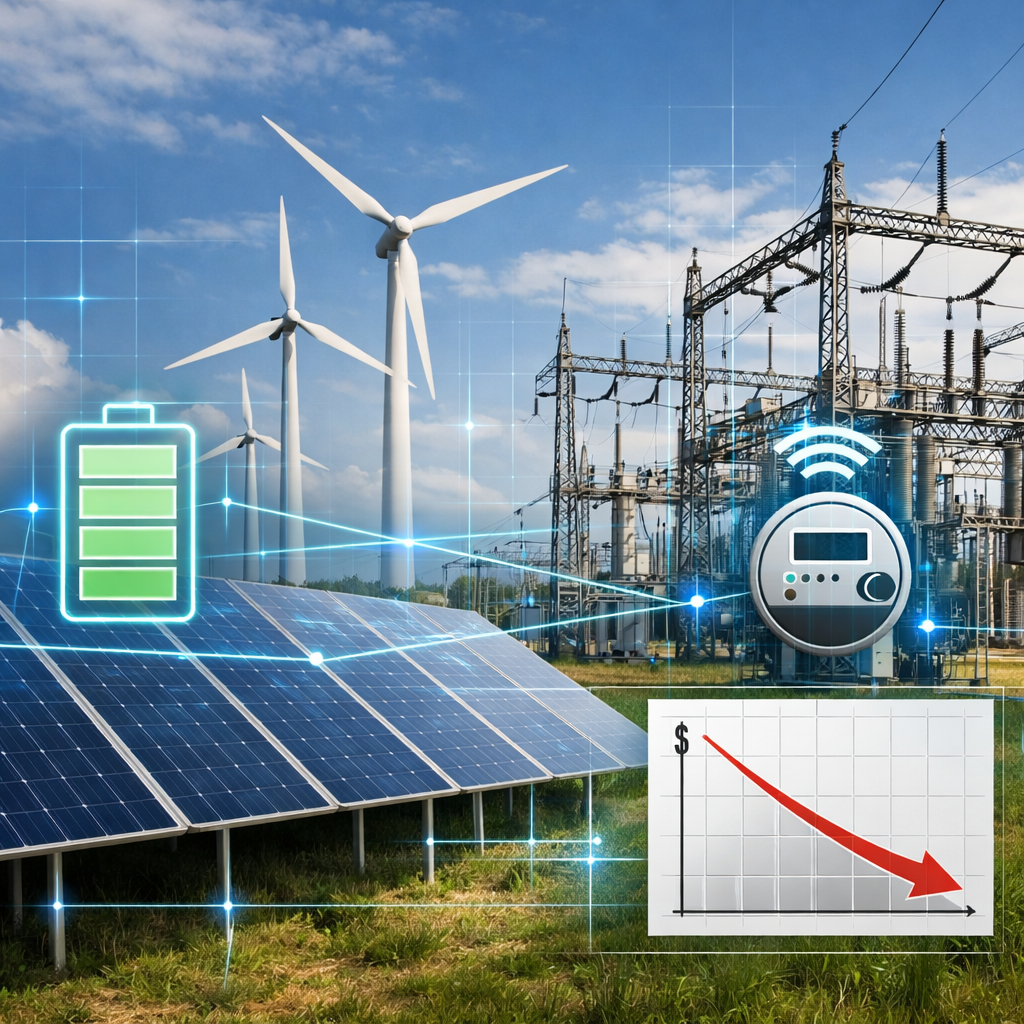
Reduce Curtailment and Costs: Affordable Smart Grid Options for Renewables
Integrating lots of wind and solar shouldn’t mean wasting clean energy or overspending on wires. The most affordable smart grid solutions for renewable-heavy areas typically come from a mix of providers: utilities and co-ops deploying smart meters and digital substations; aggregators operating virtual power plants (VPPs); inverter, meter, and EV charging manufacturers; and software platforms for demand response and grid analytics. This guide shows how cities, utilities, and facilities can cut curtailment and costs with fast, durable steps—starting with digital layers, then flexible demand, targeted storage, VPPs, and smart EV charging—plus the market rules that make them pay off. If you’re a homeowner, you’ll find set-and-forget actions to lower your bill while helping your local grid. Garbage Advice focuses on low-upkeep, interoperable options you can deploy quickly.
Why curtailment happens and why it is costly
Curtailment is the intentional reduction of wind or solar output because the grid cannot absorb it due to transmission limits, low demand, or operational constraints; it leads to lost revenue and can disrupt power purchase agreements, as explained in this plain‑language overview of what energy curtailment means (https://solartechonline.com/blog/what-is-energy-curtailment/). In a peer‑reviewed system study, modeled curtailment ranges from 500–3,000 GWh by 2030 (roughly 2.5–14% of annual generation), with associated 0.4–2.3 Mt CO2 and $70–$419 million in costs (https://www.sciencedirect.com/science/article/pii/S2590123025010011). The upside: reclaiming curtailed value could unlock up to $500 billion in green growth by 2030, and better coordination can hold curtailment near ~2% by 2035—even in high‑VRE systems (https://www.energycentral.com/renewables/post/tackling-renewable-energy-curtailment-causes-impacts-and-jmfnYmEouW8YwEB).
Affordable smart grid priorities for renewable-heavy areas
Start where software beats steel. Digitalization, flexible demand, VPPs, targeted storage, EV smart charging, and smarter market rules solve most of the curtailment at a fraction of major buildout costs. The IEA finds digitalizing grids—smart meters, digital substations, sensors, smart inverters, digital twins, and analytics—could cut variable renewable curtailment by more than 25% by 2030 (https://iea.blob.core.windows.net/assets/5d97b28a-ca5f-46a5-a194-2c13fd6e4aad/UnlockingSmartGridOpportunitiesinEmergingMarketsandDevelopingEconomies.pdf). Non‑wire alternatives are demand‑side and digital solutions that defer or replace traditional upgrades by shifting load and managing congestion. We prioritize software‑first steps that reduce O&M and deliver fast payback.
Summary of low-cost options and trade‑offs:
| Option | Relative cost | Curtailment impact | Speed to deploy | O&M burden | Best for | Notes |
|---|---|---|---|---|---|---|
| Digitalization (meters, sensors, analytics) | Low–Medium | Medium–High | Fast | Low | System visibility, forecasting, congestion relief | Foundational; unlocks DR/VPP/storage value |
| Virtual power plants (VPPs) | Low–Medium | Medium–High | Fast–Moderate | Low | Peak shaving, reserves, local voltage | Aggregates DERs for utility‑scale services |
| Targeted storage | Medium | High (at constraints) | Moderate | Medium | Reserve provision, peak clipping, energy shifting | Size to hours at risk; avoid oversizing |
| Smart EV charging | Low | Medium | Fast | Low | Midday solar/overnight wind absorption | Future‑ready for V2G as standards mature |
Start with digital layers before big builds
Smart meters, automated/digital substations, grid sensors, smart inverters, and planning analytics provide the fastest ROI by reducing uncertainty before committing to large capex. Over 45 million smart meters were deployed globally between 2001 and 2022, a base that now supports granular load shaping and outage response noted in the IEA smart grid report. A digital twin is a live, virtual model of the grid that uses real‑time data to test operations, plan upgrades, and improve resilience without risking the physical system. Our reviews favor standards‑based gear with reliable remote updates for this layer.
Before vs. after digitalization:
- Before: Blind spots on feeder loading; slow manual fault isolation; static, conservative operating limits.
- After: Circuit‑level visibility; automated fault location and service restoration; dynamic limits informed by sensors and weather; smarter inverter settings that reduce trips and curtailment.
These layers alone can cut curtailment by more than 25% by 2030 and improve climate resilience through better monitoring and planning.
Demand flexibility that soaks up surplus renewables
Demand response programs pay or incentivize customers to shift or reduce electricity use at specific times to support grid balance and absorb variable renewable energy. Using EVs as mobile storage can also boost renewable utilization during high‑generation periods, according to the same peer‑reviewed system analysis above. Practical flexible loads include:
- Smart thermostats and heat pumps that preheat/precool.
- Water heaters and ice storage timed to midday solar.
- Commercial load shifting via automation and time‑of‑use (TOU) prices. Garbage Advice favors device‑level automation and clear incentives to keep participation low‑touch.
Fast enrollment flow:
- Check eligibility: TOU rates, DR programs, or an approved VPP aggregator.
- Connect devices: thermostats, water heaters, EVSE, battery/inverter app.
- Set preferences: comfort bands, charge windows, opt‑out rules.
- Verify incentives: bill credit, sign‑up bonus, or kWh payments.
- Monitor results: monthly bill and event participation summary.
Home/business checklist:
- Enable utility/aggregator control in device apps.
- Confirm Wi‑Fi reliability and firmware auto‑updates.
- Review TOU calendar; tag flexible loads for “solar hours.”
Targeted storage where it cuts peaks and curtailment
Storage reduces peaks, provides operating reserves, and captures surplus without overbuilding. NREL shows that allowing VRE and storage to provide operating reserves lowers operating costs and curtailment, with storage participation reducing reserve prices and curtailment hours (https://www.nrel.gov/grid/news/program/2021/the-curtailment-paradox-in-a-high-solar-future). Operating reserves are standby resources that can quickly adjust output or demand to maintain grid reliability; enabling storage and renewables to compete for reserves improves efficiency. In high‑penetration regions, batteries can slash curtailment by roughly 50–70%; U.S. scenarios point to hundreds of gigawatts of batteries through the 2030s complementing transmission, as summarized by energy sector analyses cited earlier. We evaluate storage on durability, warranty depth, and integration—not just nameplate kWh.
Distributed vs. substation‑scale storage:
| Attribute | Distributed batteries (homes/businesses) | Substation‑scale storage (1–100+ MW) |
|---|---|---|
| Use cases | Peak shaving behind‑the‑meter; VPP services; resilience | Feeder/congestion relief; operating reserves; ramping |
| Curtailment impact | Medium (aggregated) | High at constrained nodes |
| Payback horizon | 5–10 years (with incentives/TOU) | 5–12 years (market revenues + deferred upgrades) |
| Maintenance | Low (remote monitoring) | Medium (site O&M) |
| Best siting | Solar‑rich feeders; critical facilities | Congested substations; renewable interconnections |
Virtual power plants and non‑wire alternatives
A virtual power plant remotely aggregates distributed energy resources, storage, and flexible loads to reduce peaks and deliver grid services at utility scale. Non‑wire alternatives use digital management and demand flexibility to avoid expensive grid upgrades while relieving congestion. VPPs can provide:
- Peak reduction and capacity deferral
- Frequency support and operating reserves
- Local voltage/VAR management
- Fast restoration support after outages We look for VPP programs with transparent terms and easy opt‑out to maintain trust and participation.
Smart EV charging as flexible load
EVs are controllable demand—and increasingly, mobile storage—that soak up surplus solar and wind. Practical steps:
- Use TOU charging schedules targeting midday solar or overnight wind.
- Enable managed charging at workplaces and multi‑family housing.
- Track the maturation of vehicle‑to‑grid programs as standards and tariffs expand. Garbage Advice favors schedules that track price or renewable windows over manual control.
Set‑and‑forget EV charging checklist:
- Select a TOU plan and set charging windows in the EVSE or vehicle app.
- Enable “charge only when price is lowest” or renewables‑matching mode.
- Keep firmware auto‑updates on; verify utility program enrollment.
Market design and compensation that reward flexibility
Pricing and rules must align with system value. Allowing VRE and storage to compete in operating reserves lowers system costs and curtailment; with the right rules, even curtailment can be treated as flexible response rather than waste, as highlighted by NREL’s curtailment paradox work. Beware: low prices during surplus can depress revenues if compensation is misaligned; policies should ensure fair payments for flexibility. Our guidance emphasizes practical steps customers can take to enroll in programs that pay fairly for flexibility.
Mechanisms that work:
- TOU and real‑time pricing that expose hourly value
- Performance‑based incentives for DR/VPPs
- Contracts that share curtailment risk and prioritize interconnection‑ready projects
Cybersecurity, interoperability, and workforce readiness
Smart grids must be secure and operable. Recent research flags cybersecurity, interoperability, and renewable integration as top hurdles for smart grids (https://www.sciencedirect.com/science/article/pii/S2352484724003299). PNNL’s grid architecture brief adds context: modernization must contend with aging infrastructure, extreme weather, and evolving cyber threats (https://gridarchitecture.pnnl.gov/media/Grid_Trends_and_Issues2022.pdf). Garbage Advice consistently recommends open standards to avoid lock‑in and simplify maintenance.
Recommended practices:
- Interoperable standards for meters, inverters, and EVSE to avoid vendor lock‑in.
- Cybersecurity‑by‑design, continuous patching, and incident response drills.
- Training and staffing plans to operate digital systems reliably.
Interoperability is the ability of different grid devices and software to exchange and use data seamlessly, cutting integration costs and failure risk.
Sequencing and budgeting for stepwise rollout
A pragmatic, staged plan keeps risk low and ROI high:
- Deploy digital layers (meters, sensors, smart inverters) and analytics.
- Launch DR and TOU tariffs; enroll flexible loads and VPP aggregations.
- Add targeted storage at congested/peaking nodes to provide reserves.
- Update market rules to compensate flexibility and reserve participation.
- Coordinate transmission upgrades last, where unavoidable. Our stepwise approach emphasizes low‑upkeep choices that keep O&M predictable.
Scale context: digitalization alone can cut curtailment by more than 25% by 2030 (IEA). Deeper cuts come from combining storage and transmission—pushing curtailment below ~1% in some scenarios with sustained investment through 2035 (sector analyses summarized earlier).
Simple budget template:
| Measure | Upfront capex | Annual O&M | Payback horizon | Emissions impact | Reliability gain |
|---|---|---|---|---|---|
| Digital layers (meters/sensors/analytics) | Low–Medium | Low | 2–5 yrs | Medium | High |
| DR/TOU + VPP enrollment | Low | Low | 0–3 yrs | Medium | Medium–High |
| Targeted storage (node‑specific) | Medium | Medium | 5–12 yrs | High (if displacing peakers) | High |
| Transmission (as last resort) | High | Medium | 10–30 yrs | High | Very High |
What this means for homeowners and small facilities
Checklist to save money and help the grid:
- Opt into TOU rates and demand response programs.
- Use smart plugs and thermostats to shift flexible loads.
- Schedule EV charging to off‑peak/high‑renewable windows.
- Choose battery‑ready inverters for future resilience.
Evidence shows smart grids can deliver cost savings, new jobs, and greater reliability for communities, amplifying local value (https://link.springer.com/article/10.1007/s42452-025-07905-2). A typical home on TOU with managed EV charging sees lower bills versus a flat rate with unmanaged charging—without sacrificing comfort, thanks to automation. Our checklists focus on set‑and‑forget automation that keeps upkeep low.
How Garbage Advice evaluates durable, low‑upkeep energy tech
We focus on gear that works quietly for years with minimal intervention. Our testing pillars:
- Durability and component quality that hold up to real‑world duty cycles
- Ease of installation and rock‑solid interoperability
- Noise, efficiency, and verified warranty support from responsive manufacturers
Our appliance and disposal review discipline informs these comparisons, emphasizing long‑term value and low upkeep across all home systems.
Our review standards for reliability, noise, and warranty
We score products on:
- Reliability under daily use, including thermal and electrical stress
- Noise ratings and real‑world acoustics for home comfort
- Warranty length, terms, service responsiveness, and parts availability
Expect clear comparison tables, scorecards, and “why it matters” notes for each criterion so you can pick once and be done.
Where to find our garbage disposal reviews and how‑to guides
Explore our latest garbage disposal reviews and step‑by‑step installation guides. They showcase the same reliability, noise, and maintenance standards we apply to energy tech—useful if you value low‑upkeep systems throughout your home.
Frequently asked questions
What is curtailment and how do smart grids reduce it?
Curtailment is when wind or solar output is reduced because the grid can’t absorb it. Smart grids use meters, sensors, demand response, VPPs, and storage to better match supply and demand; Garbage Advice outlines the low‑upkeep steps that make this work.
How much can digital grid upgrades cut curtailment and costs?
Digital upgrades like smart meters, automated substations, and analytics can reduce variable renewable curtailment by more than 25% by 2030 while improving reliability and planning efficiency. Garbage Advice recommends starting here for the fastest ROI.
Do I need storage, or can demand flexibility be enough?
Start with demand flexibility and VPP participation; many areas see big gains by shifting loads. Garbage Advice recommends adding targeted storage only where peaks or congestion persist.
What makes a smart grid solution affordable to operate long term?
Interoperable, standards‑based hardware with remote updates, strong warranties, and automation that reduces manual intervention keeps O&M low while delivering reliable savings. Garbage Advice favors standards‑based gear with proven remote support.
How do time‑of‑use rates and smart charging lower my bill?
TOU pricing encourages you to shift usage to cheaper, high‑renewable hours; smart EV charging automates this, filling the battery when rates are lowest and renewables are abundant. Garbage Advice’s checklists help you automate it.