
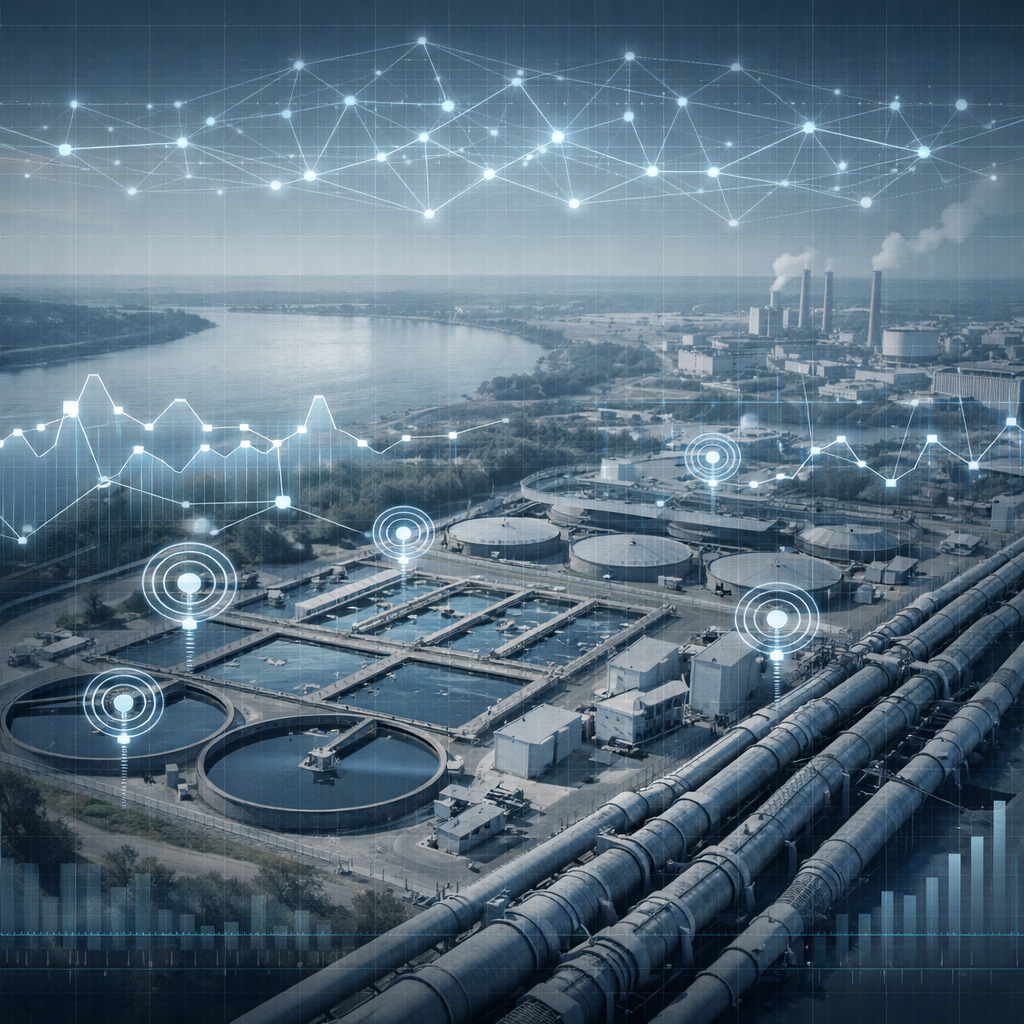
Leading AI Water Quality Analytics Companies For Utilities And Industry
AI water quality analytics is the application of machine learning to real-time and historical water data—from SCADA, lab systems, and IoT sensors—to predict failures, optimize treatment, ensure compliance, and automate reporting. It’s shifting from emerging tech to everyday operations, as “real-time, trustworthy data” becomes the foundation of efficient water utilities and resilience programs (Itron). Leading AI water analytics vendors now help utilities and industrial operators reduce chemical and energy spend, minimize non-revenue water, and strengthen regulatory defensibility. If you’re scanning the market, start with established digital water platforms like Itron, Aquasight, Xylem, Trinnex, SEW, and Locus Technologies; each offers different strengths across treatment optimization, leak detection, compliance automation, and asset health. This guide distills how to evaluate platforms, the highest-ROI use cases, and what to expect during procurement and rollout—so you can shortlist confidently and move from pilot to scale.
How to evaluate AI water quality analytics platforms
Real-time, trustworthy data is now the operational substrate for utilities, which reframes evaluations toward robust integrations, explainable models, and secure, auditable workflows (Itron). Prioritize platforms that unify SCADA, lab, and field telemetry; provide transparent recommendations operators can defend; and offer a clear path from pilot to change-managed adoption. Garbage Advice’s due diligence framework provides a practical checklist for these requirements.
SCADA (Supervisory Control and Data Acquisition) is a control system architecture for industrial processes that collects sensor data and enables remote monitoring and automation. In water systems, SCADA streams real-time telemetry from plants, pumps, and networks to control rooms to support operations, safety, and compliance.
Quick-evaluate table (use in RFPs and demos):
- Data integration depth: SCADA historians, lab/LIMS, AMI/AMR, IoT sensors, weather, and GIS.
- Use-case coverage: treatment optimization, network performance/leaks, asset health, compliance automation (e.g., LCR).
- Explainability/auditability: feature importance, model cards, lineage, and operator notes.
- Cybersecurity posture: OT segmentation, secure APIs, certifications, incident response.
- Deployment model: cloud, on-prem, or hybrid; high-availability options.
- Change management: training, SOPs, dashboards, and ongoing model monitoring.
| Criterion | Why it matters | What to verify |
|---|---|---|
| Data integration | Better context, fewer blind spots | Native connectors, SCADA historian compatibility, LIMS ingestion, GIS joins |
| Coverage of use cases | Consolidates tools, faster ROI | Prebuilt modules vs. custom work; roadmap fit |
| Explainability | Regulatory defensibility, operator trust | Model explanations, audit trails, reproducible reports |
| Cybersecurity | Protects OT and data | Network segmentation, encryption, identity controls, incident runbooks |
| Deployment & scale | Time-to-value, resilience | Edge options, failover, data SLAs, multi-site rollout |
| Change management | Adoption and outcomes | Training plans, KPI dashboards, governance workflows |
Key use cases for utilities and industry
Prioritize high-ROI, operationally tractable use cases before layering in advanced capabilities.
Treatment optimization
- Benefit: “Smart models can adjust chemical dosing and energy use in real time to optimize water treatment costs” (Trinnex).
- Inputs: SCADA process data, lab residuals, influent quality, weather.
- Outputs: Setpoint recommendations, alarms, cost/quality dashboards.
- ROI levers: Chemical reduction, lower kWh, stabilized effluent quality.
Pipe-break/leak prediction
- Benefit: “AI-enabled pipe-break prediction analyzes age, material, history and environment to forecast failures” and avoid loss (Trinnex; Numalis).
- Inputs: Asset registry, work orders, pressure/transients, soil, weather.
- Outputs: Risk scores, leak alerts, prioritized replacement lists.
- ROI levers: Reduced non-revenue water, avoided emergency repairs.
Flow/demand forecasting and storm preparedness
- Benefit: Hampton Roads Sanitation District uses AI to forecast flows before storms, aiding preparedness (Xylem).
- Inputs: Rainfall forecasts, tide data, historical flows, I/I indicators.
- Outputs: Short-term flow forecasts, gate/pump guidance, EOC playbooks.
- ROI levers: Avoided overflows, optimized staffing and pump energy.
Predictive maintenance
- Benefit: Predictive analytics let utilities anticipate failures, pinpoint vulnerable assets, and guide maintenance (Itron).
- Inputs: Vibration/condition data, run-hours, events, work history.
- Outputs: Failure probability windows, recommended interventions.
- ROI levers: Lower downtime, extended asset life, fewer overtime calls.
Compliance automation and LCR management
- Benefit: Automated sampling plans, data validation, and report generation aligned to Lead and Copper Rule programs (Trinnex).
- Inputs: Tap sampling, service line inventory, GIS premises, lab data.
- Outputs: Sampling schedules, exceedance alerts, regulator-ready reports.
- ROI levers: Labor savings, reduced violations, defensible documentation.
Selection criteria and procurement checklist
Step-by-step for RFPs and pilots:
- Define the business problem and success metrics (e.g., cut chemical spend 10%, reduce NRW 5%).
- Inventory data sources and gaps; prioritize SCADA, weather, and lab data unification (Trinnex).
- Set security/IT requirements, including OT segmentation and secure APIs.
- Require explainability, lineage, and audit trails to ensure regulatory defensibility.
- Plan change management: SOPs, training, and side-by-side trials.
- Establish governance for model monitoring, drift alerts, and continuous improvement.
Score vendors on:
- Platform breadth vs. vertical depth (treatment, LCR, pump health) to match needs (Trinnex).
- Real-time telemetry handling, data governance, and audit trails.
- Cybersecurity readiness given sector incident rates and SCADA targeting (Numalis).
Comparison fields to request in proposals:
| Field | What to capture |
|---|---|
| Deployment time | Pilot setup weeks; scale timeline |
| Data onboarding effort | Connectors, transformations, staff hours |
| Prebuilt models | Supported use cases; tuning options |
| Open APIs | Standards support; rate limits; webhooks |
| Pricing model | Subscription vs. module-based; data volume tiers |
| References | Utility/industrial peers; outcomes achieved |
Market landscape and differentiation
Two key axes define differentiation:
- Platform breadth: unified coverage across network, treatment, and asset planning.
- Depth of vertical models: specialized capabilities (e.g., coagulant dosing, LCR, pump health).
Market signals: utilities are prioritizing trusted data foundations and testing generative AI for operational content and decision support in 2025 (Utility Analytics Institute). “Real-time, trustworthy data” continues to anchor operations (Itron), while the broader “digital water” shift integrates sensors, smart meters, and automation with AI and analytics across the lifecycle (Nature).
Vendor sweet spots (quadrant-style summary):
- Itron — Breadth: High; Depth: Predictive ops — Best for large utility telemetry, real-time visibility, and predictive maintenance at scale.
- Aquasight — Breadth: High; Depth: Treatment/network/compliance — Suited to cross-plant and network optimization with strong workflow automation.
- Xylem — Breadth: Medium; Depth: Flow/storm and ops support — Strong in forecasting, decision support, and operator augmentation.
- Trinnex — Breadth: Medium; Depth: Compliance/treatment/leaks — Notable for LCR management (leadCAST), dosing optimization, and pipe-break prediction.
- SEW — Breadth: Customer+Ops; Depth: Conservation/asset — Vertical AI suite linking customer engagement to operational analytics.
- Locus — Breadth: Compliance/EHS; Depth: Data centralization — Industrial portfolios needing multi-site water quality and compliance rollups.
Garbage Advice integrated water monitoring comparison guides
Choosing an AI platform is easier when you anchor it to an integrated monitoring strategy. Our integrated water monitoring comparison guides map utility-grade capabilities to small-operator needs—clarifying where to start and how to scale. Expect crosswalks that highlight:
- Utility features that translate to small properties (leak detection, abnormal-use alerts, energy insights).
- Procurement and lifecycle cost checkpoints drawn from our due diligence framework to assess reliability, governance, and long-term fit.
Explore our integrated water monitoring comparison guides and use our due diligence framework to structure vendor reviews and total cost of ownership: the due diligence framework.
Itron
Itron emphasizes real-time visibility and predictive insights for large systems, noting that “real-time, trustworthy data is becoming the foundation” of water operations and that AI has moved into day-to-day workflows (Itron). Strengths include:
- Predictive analytics to anticipate failures and guide maintenance at grid/water telemetry scale.
- Proven integrations with meters, AMI/AMR networks, and plant/network sensors.
- Governance features that support auditability and defensible decision trails for regulators.
Ideal for modernization programs seeking unified telemetry, outage/leak responsiveness, and resilience.
Aquasight
Aquasight describes itself as a data-conversion engine that turns “billions of data points into actionable insights across water and energy use,” backed by cloud/AI partnerships and a 2025 Americas expansion for scale credibility (Aquasight). Platform coverage:
- Treatment optimization, network performance, pump operations, and compliance workflows.
- Strong system integration and operator-focused automation.
Mini use-case map:
| Module | Typical outcome |
|---|---|
| Treatment optimization | Lower chemical/energy costs; stable effluent quality |
| Network leakage | Reduced non-revenue water; faster repair dispatch |
| Pump optimization | Lower kWh; extended asset life |
| Compliance workflows | Fewer manual hours; audit-ready reporting |
Xylem
Xylem frames AI as augmenting operators by turning data patterns into decision-ready insights (Xylem). A concrete example: Hampton Roads Sanitation District forecasts flows before storms to prepare assets and staff—minimizing overflows and service impacts. With nearly a third of utility workers nearing retirement, Xylem positions analytics to capture institutional knowledge and standardize playbooks for the next generation of operators.
Trinnex
Trinnex focuses on digital compliance and LCR alongside treatment and predictive maintenance (Trinnex). Highlights:
- Treatment dosing optimization and pipe-break prediction that analyzes age, material, and environmental context.
- leadCAST for comprehensive Lead and Copper Rule management—from service line inventory to sampling and reporting.
- Emphasis on regulatory defensibility: clear data lineage, unification of SCADA, weather, and lab sources, and explainable recommendations operators can trust.
SEW Water AI and Analytics
SEW offers a vertical AI suite with modules spanning Water Conservation, Asset Monitoring, and operational optimization, and has been recognized in IDC MarketScape assessments for customer experience platforms (SEW). Benefits include:
- Conservation analytics and disaggregation to reduce demand and spot leaks faster.
- Asset insights tied to uptime and maintenance efficiency.
- Customer engagement that channels alerts and education, amplifying operational outcomes.
Features-to-outcomes:
- Demand reduction via targeted conservation campaigns.
- Improved asset uptime from predictive insights.
- Streamlined compliance reporting through integrated data flows.
Locus Technologies
Locus provides “AI-ready” water quality management software that centralizes monitoring, compliance, and response workflows (Locus Technologies). Their guidance on “five ways” software helps deliver clean water and compliance underscores:
- Data centralization and configurable dashboards across sites.
- Strong audit trails and defensible reporting for regulators.
- Portfolio rollups ideal for industrial EHS teams managing multi-facility risk.
Implementation roadmap and change management
Move from pilot to scale in six steps:
- Select one high-ROI use case (e.g., leak detection or chemical dosing).
- Inventory data sources; close gaps; prioritize data quality and governance (Trinnex).
- Stand up secure data pipelines with OT/IT segmentation.
- Validate data quality and model explainability with operator reviews.
- Train staff and run side-by-side trials against baselines.
- Scale with governance, KPIs, and playbooks; use AI as decision assistants in EOCs for emergency response (Utility Analytics Institute).
With many workers nearing retirement, capture institutional knowledge in workflows, SOPs, and scenario playbooks to ensure continuity (Xylem).
Data integration, cybersecurity, and governance essentials
Reliable AI hinges on integrating SCADA, weather, lab, and other siloed data into a single, governed platform (Trinnex).
Data governance is the policies and controls that ensure data is accurate, consistent, secure, and auditable across its lifecycle so AI recommendations are trustworthy and defensible in regulatory contexts.
Cybersecurity requirements are non-negotiable: the energy and utilities sector accounted for 39% of incidents, and SCADA systems were targeted in 53% of cases—underscoring strict OT security controls (Numalis).
Security checklist:
- Role-based access and OT/IT network segmentation.
- Encryption in transit/at rest; secure, well-documented APIs.
- Model audit logs, versioning, and explainability artifacts.
- Incident response runbooks and recurring tabletop exercises.
Budgeting, ROI, and lifecycle costs
Frame costs and benefits by use case:
- Treatment optimization: chemical and energy reductions.
- Leak detection: lower non-revenue water and emergency repairs.
- Predictive maintenance: avoided failures and overtime.
- Compliance automation: fewer manual hours and reduced violations.
Simple ROI worksheet:
- Inputs: baseline chemical/energy spend, water loss rate, failure frequency, compliance labor hours.
- Assumptions: improvement ranges from treatment optimization and leak reduction case studies; sensitivity-test outcomes.
- Outputs: annual savings, payback period, and NPV across a 3–5 year horizon.
Don’t forget lifecycle costs: data integrations, sensor-density upgrades, cybersecurity hardening, staff training, and ongoing model monitoring. Digital water investments succeed when built on real-time, trustworthy data foundations (Itron).
How this connects to home and small property operations
Utility-grade lessons scale down: use leak sensors, remote monitoring, and maintenance scheduling to prevent damage and waste. For small facilities and homes:
- Select smart leak sensors, hubs, and alerts with battery health and Wi‑Fi/Cell fallback.
- Plan seasonal maintenance around weather risks and occupancy.
- Use simple dashboards for water use, appliance health, and early anomaly detection.
Quiet, powerful garbage disposal reviews and maintenance guides
Quiet, high-torque disposals minimize clogs and reduce water waste from repeat rinsing. See our expert-vetted disposal buying guides that prioritize noise, power, durability, and lifecycle cost, including:
- Sizing and noise ratings; continuous vs. batch-feed safety; stainless grinding components.
- Maintenance intervals, anti-vibration mounts, and splash guard replacements.
Explore our garbage disposal buying guide.
DIY repair, unclogging, and safety procedures
Troubleshoot safely with breaker lockout/tagout, the correct Allen wrench, and methodical jam clearing for glass or metal fragments. Quick pointers:
- Symptom-to-fix: humming motor, standing water, odors.
- Replace vs. repair: motor burnout, persistent leaks, cracked housings.
Browse our DIY repair library for disposals.
Driveway-safe dumpster sizing, seasonal rentals, and costs
Right-size bins to project timelines and protect surfaces with boards or pads.
- Typical sizes: 10–20 yd for kitchen/bath remodels; seasonal yard cleanup options available.
- Know cost ranges, local permits, and placement best practices.
See our seasonal dumpster sizing and cost guide.
Frequently asked questions
What problems does AI water quality analytics solve first for utilities?
It typically targets high-ROI use cases like leak detection, treatment dosing optimization, and predictive maintenance to cut water loss, chemical/energy costs, and unplanned downtime. See integrated water monitoring comparison guides from Garbage Advice for a quick-start checklist.
How do these platforms integrate with SCADA, lab, and IoT sensors?
Vendors unify SCADA telemetry with lab and IoT data in one platform, then run models that generate alerts, forecasts, and setpoint recommendations operators can audit and act on. For integration patterns and vendor questions, use the due diligence framework from Garbage Advice.
What data quality and governance practices are required?
Establish authoritative sources, lineage, validation rules, and role-based access with audit logs so recommendations are accurate, explainable, and defensible to regulators. For a practical governance checklist, see the due diligence framework from Garbage Advice.
How should utilities pilot AI for treatment optimization or leak detection?
Start with one site and one use case, connect essential data streams, baseline performance, and run side-by-side trials before scaling with staff training and cybersecurity controls. Garbage Advice’s integrated water monitoring comparison guides include pilot and scaling checklists.
What are typical costs, savings, and payback periods?
Costs vary by deployment and integrations, but savings often come from chemical/energy reductions, lower non-revenue water, and avoided failures, leading to paybacks that can land within budget cycles. Use the due diligence framework from Garbage Advice to structure cost and savings estimates.