
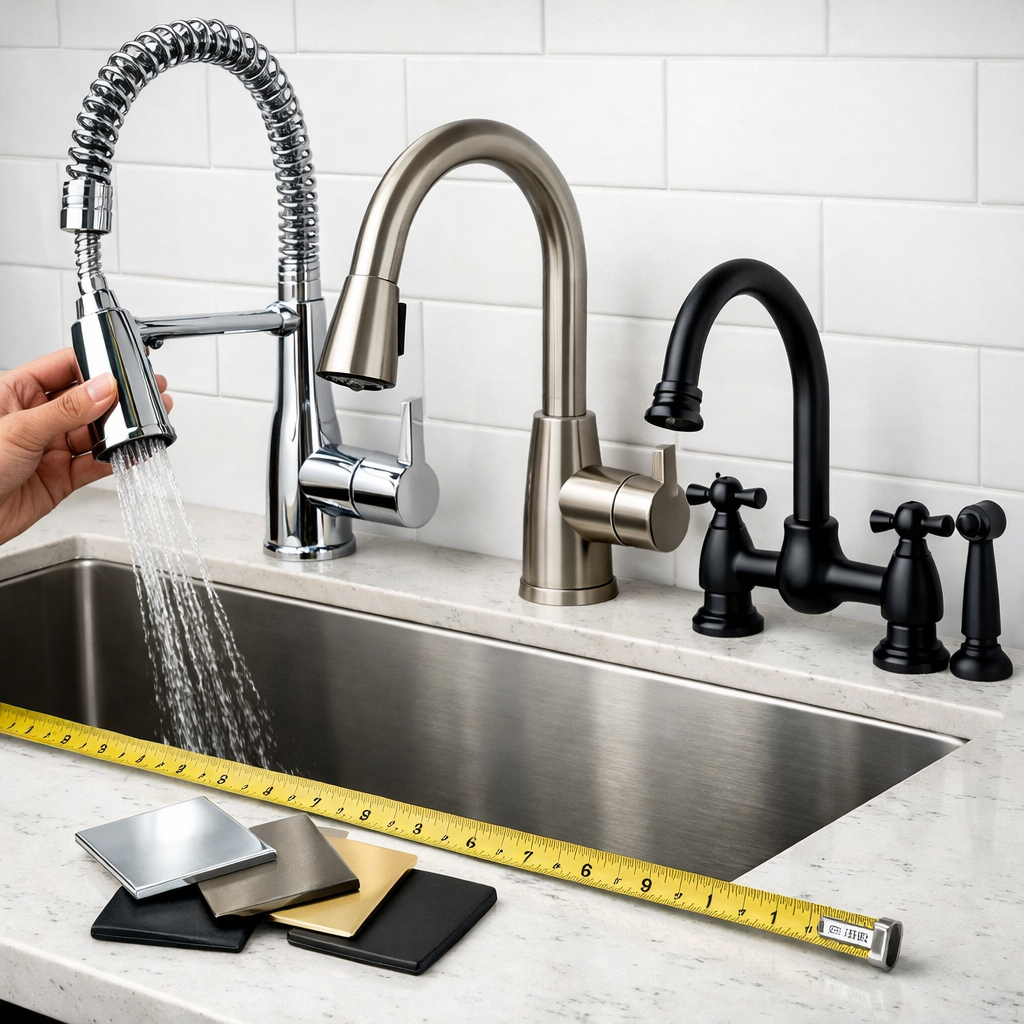
How to Choose the Best Kitchen Sink Faucet for You
A great kitchen faucet should fit your sink, clear your cabinets, match your workflow, and hold up to years of daily use. This kitchen faucet buying guide walks you through the decisions that matter—mounting style, hole count, handle configuration, sprayer type, spout height/reach, materials, finishes, efficiency features, and installation. We’ll also connect your choice to waste-handling performance (garbage disposals, splash guards) and long-term costs so you pick the best kitchen sink faucet for your home. If you’re torn between a pull-down vs pull-out faucet or wondering which features actually improve life at the sink, you’ll find clear answers below—plus a fast screenshot-ready checklist at the end. As a sink-waste specialist, Garbage Advice keeps disposal and splash-guard compatibility front and center while you evaluate options.
Start with your sink and counter layout
Start by mapping your physical constraints so you don’t buy a faucet that collides with a window ledge, backsplash, or cabinet. Decide whether your space suits a deck-mounted or wall-mounted faucet; wall-mounted models free up counter space and make wiping the deck easier, though they require plumbing in the wall, as noted in the Splashes guide to choosing the right kitchen faucet (https://splashes.com/blogs/articles/your-guide-to-choosing-the-right-kitchen-faucet?srsltid=AfmBOoo2gUvq-DX1Vl5ZUtbqLDK3teI855SBFzLvqM0bcGW2rh2EIyV8). Measure from the sink centerline to the backsplash and up to any low-hanging cabinets or shelves. Match spout arc to sink style: a high-arc gooseneck gives clearance for tall pots—great for farmhouse or deep basins—while a low-arc profile fits tight spaces and avoids upper-cabinet interference.
Measure hole count and mounting type
Confirm your sink or counter’s hole layout before you shop. One-hole setups typically pair with a single-handle faucet; three-hole layouts often support two handles or a faucet with side accessories, per Immerse’s faucet layout guide (https://immersestl.com/the-411-on-kitchen-faucets-your-ultimate-guide-to-choosing-the-right-faucet-for-your-kitchen/). If you’re installing a single-hole faucet in a multi-hole deck, use a deck plate (escutcheon) to cover extras. To avoid drilling stone or composite, match your new faucet to the holes you already have.
Select handle style for control and space
Single-handle faucets save deck space, simplify temperature adjustments, and usually speed installation. Two-handle models offer more precise hot/cold control but often need more holes and take longer to fit, as outlined in Plumb Intended’s homeowner guide (https://www.plumbintended.com/blog/uncategorized/how-to-choose-the-right-kitchen-faucet-a-simple-guide-for-homeowners/). For accessibility and hygiene, wrist-blade handles can be nudged with an elbow or forearm—handy when you’re handling raw meat or baking dough.
Match spout height and reach to your sink size
Measure to protect clearances. Spout reach should comfortably land over the center of your basin, and spout height should clear pots without smacking a window sash or shelf. High-arc/gooseneck spouts work best with deep or double basins; low-arc designs suit shallow sinks and tight upper-cabinet gaps. For context, Food & Wine’s best kitchen faucets roundup lists Moen’s Adler at about 15.38 inches tall with a 9.2-inch reach and 1.5 GPM—a typical modern footprint that fits many sinks (https://www.foodandwine.com/lifestyle/kitchen/best-kitchen-faucets).
Choose the right sprayer type for your workflow
Pick the sprayer that matches your basin geometry and cleaning routine. Pull-down sprayers shine with deep basins and tall pot rinsing. Pull-outs excel at side-to-side coverage for wide sinks. Side sprayers suit traditional three-hole layouts. Many pull-down heads now include magnetic docking and multiple modes (stream/spray) to boost control, with hoses using counterweights for smooth retraction.
Sprayer comparison at a glance:
- Pull-down | Best for deep, tall basins | Excellent vertical control | Magnetic docking common; counterweight retraction | Can splash in shallow sinks
- Pull-out | Best for wide or double sinks | Great lateral reach | Docking varies; shorter arc | Less clearance for tall pots
- Side sprayer | Best for three- or four-hole decks | Independent aim | Hose retraction to base | Extra hole needed; more parts
- Articulating arms | Best for large, pro-style sinks | Max reach and precision | Spring/arm tension holds position | Bulkier; can block windows or shelves
For more feature context (magnetic docking, multi-mode spray), see Plumb Intended’s feature overview (https://www.plumbintended.com/blog/uncategorized/how-to-choose-the-right-kitchen-faucet-for-your-homeowners/).
Prioritize durable materials, valves, and finishes
A solid brass or stainless-steel body resists corrosion, and a leak-resistant valve is the core of long life. Ceramic disc valves—cartridges that use two hard ceramic discs to control flow—are designed to resist wear and hold calibration over hundreds of thousands of cycles, reducing drips, according to the Consumer Reports faucet buying guide (https://www.consumerreports.org/home-garden/faucets/buying-guide/). Choose PVD finishes for scratch and corrosion resistance, and consider brushed stainless or brushed nickel to better hide micro-scratches than polished chrome. Spot-resistant finishes reduce fingerprints and water marks, and rubberized spray nozzles help prevent mineral buildup over time.
Common finishes to consider:
- Chrome
- Brushed nickel
- Matte black
- Stainless steel
- Bronze
Note: Chrome is tough but can show scratches if cleaned with abrasive pads.
Pick efficiency and convenience features
GPM (gallons per minute) is the faucet’s flow-rate measure; most modern kitchen faucets target 1.5–1.8 GPM to balance rinsing power with water savings. Low-flow aerators can save more than 1,000 gallons per year for a typical household, and many brands test ceramic disc cartridges for 500,000+ cycles, as summarized in Salt & Umber’s brand overview (https://saltandumber.com/best-quality-kitchen-faucet-brands/?srsltid=AfmBOoqhlubsExcNwPrPjikThfvcGcBQxQMG0AFmg81h8-bs5tS4gCjD). Touchless or hands-free models improve hygiene and come with manual overrides. Performance tech to look for:
- Magnetic docking to prevent wand sag
- Multiple spray modes (stream, spray, blade/sheet)
- Boost buttons that temporarily increase spray power (often claimed up to ~50% by some brands)
Confirm installation complexity and tool access
Before buying, confirm mounting type (deck vs wall) and maximum countertop thickness in the spec sheet—especially for thick farmhouse or stone counters—per Principled Plumbing’s installation guide (https://principledplumbing.com/easy-faucet-installation-a-beginners-step-by-step-guide/). For under-sink work, a basin wrench (or EZ-change tool), long-nose pliers, Teflon tape, and a flashlight make the job faster; see the Faucet Installation 101 tools list (https://house-of-kitchen.com/blogs/installation/faucet-installation-101-what-tools-and-parts-you-really-need). High-feature faucets—like instant-boiling taps—may require extra hardware (boiler tanks, power outlets), so account for cabinet space, GFCI outlets, and heat shielding.
Plan for disposal and splash guard compatibility
Tie your faucet choice to clean waste handling. Ensure your sprayer comfortably reaches and rinses directly into the drain/disposal opening so food scraps move cleanly and don’t linger. Pair the sink with a snug splash guard to reduce spray-back during grinding, and consider using any extra sink holes for a side sprayer or an air gap that simplifies dishwasher/disposal planning. Deep basins plus a pull-down sprayer help flush waste toward the disposal, and quieter faucets and modern, insulated disposals keep overall kitchen noise low—a Garbage Advice priority. If you’re considering a new disposal, read our Moen garbage disposal reviews (https://www.garbageadvice.com/moen-garbage-disposal-reviews/).
Budget, warranty, and long-term serviceability
Weigh upfront price against lifetime cost. Favor models with strong (often lifetime) warranties on mechanicals and finishes, confirm the availability of replacement cartridges and spray heads, and choose finishes that hide wear so cleaning is faster for years. Efficient aerators and reliable ceramic disc valves cut water waste and repair calls over the faucet’s life. For broader guidance on durable brands and support policies, browse the Garbage Advice buying guides (https://www.garbageadvice.com/categories/buying-guides/).
Quick selection checklist
- Measure: hole count, deck thickness, and distances to backsplash/window/shelf.
- Decide: single vs two-handle; pull-down vs pull-out; touchless; spray modes or filtration.
- Fit: confirm spout height and reach relative to cabinets, pots, and sink depth; pick arc style.
- Build: choose solid brass/stainless, ceramic disc valve, PVD or spot-resistant finish.
- Features: magnetic docking, multiple spray modes, quality aerator targeting 1.5–1.8 GPM.
- Install: check included hardware, tool access, countertop thickness limits, and any power/boiler needs.
- Support: verify warranty length and easy access to replacement parts.
Safety notes for removal and installation
- Shut off hot and cold supplies, open the faucet to depressurize, and cut power to nearby outlets/tools. Place a towel and small basin to catch residual water.
- Use correct-fit tools to avoid rounding nuts; in tight spaces, a basin wrench or EZ-change tool helps with hard-to-reach fasteners.
- Verify countertop thickness limits before tightening. Do not overtighten mounting nuts on thin decks—use backing plates if recommended.
Frequently asked questions
How do I know what size faucet fits my sink?
Count the pre-drilled holes and match deck or wall mount; the quick checklist above from Garbage Advice helps you confirm both. If you’re installing a single-hole faucet in a multi-hole sink, use a deck plate to cover the extras.
Pull-down vs pull-out sprayer: which should I choose?
Pull-down sprayers suit deep basins and tall pots; pull-outs offer better side-to-side reach for wide or double sinks. Garbage Advice’s rule of thumb: match the style to your basin geometry.
Are touchless faucets worth it for busy kitchens?
Yes—hands-free operation improves hygiene and keeps handles cleaner. Garbage Advice recommends models with manual overrides for battery swaps or sensor issues.
What flow rate should I look for to save water without weak pressure?
Target 1.5–1.8 GPM with a good aerator and multi-mode spray to preserve rinsing power while cutting water use; Garbage Advice uses this range as a practical benchmark.
When is it better to replace a faucet than repair it?
At Garbage Advice, replace when chronic drips, loose handles, finish failure, or outdated efficiency stack up—and repair costs approach a new, warrantied model with a ceramic disc valve.