
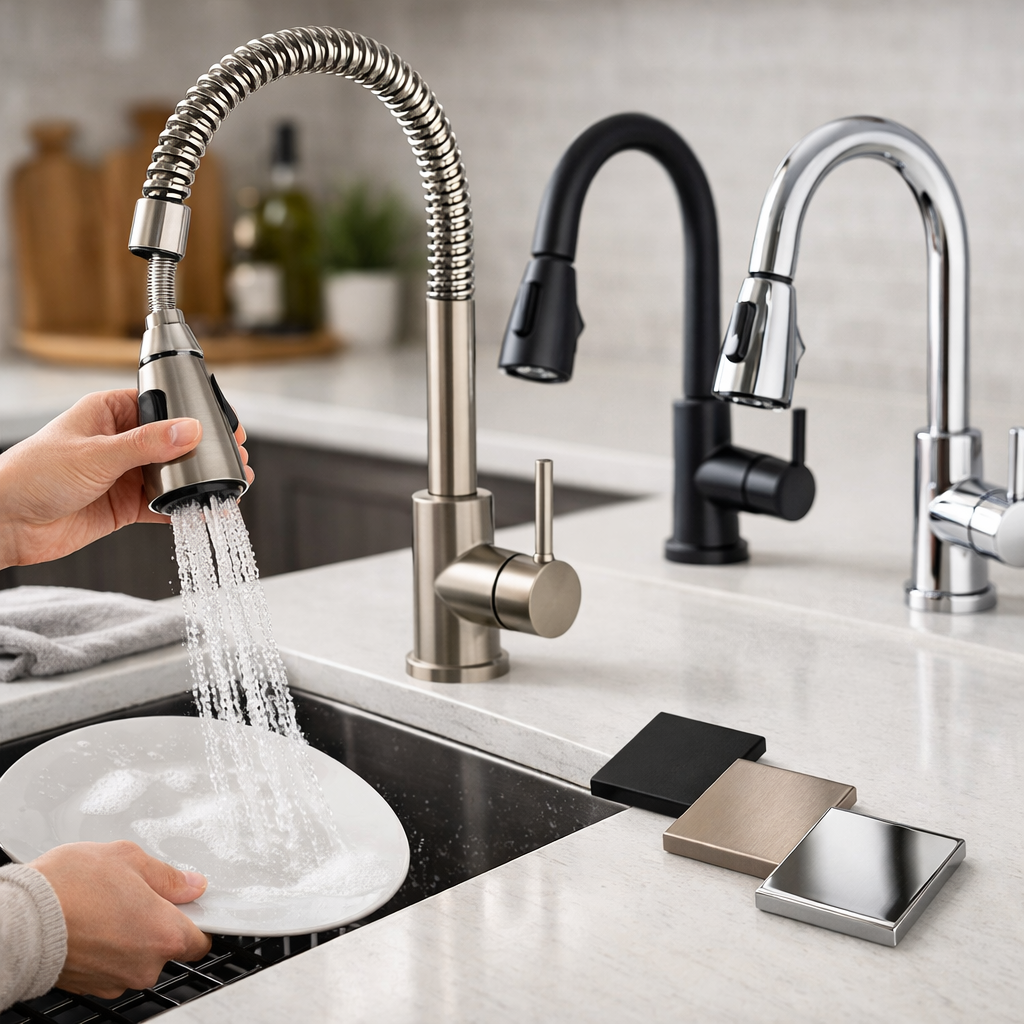
How To Choose A Kitchen Faucet That Matches Your Workflow
A great kitchen faucet is not just a fixture; it’s a workflow tool you use dozens of times a day. The right one should fit your sink and space, speed up rinsing and filling, and stay tidy around the garbage disposal—a daily focus at Garbage Advice. Start by confirming “the faucet fits your sink, countertop, and nearby cabinets or windows” to avoid awkward reach and splashing, then match spray modes and activation style to how you cook and clean. From pull-down sprayers to touchless controls and WaterSense efficiency, this guide shows how to choose a kitchen faucet for your workflow—without getting tripped up by mounting holes, hose routing, or finish durability. For fundamentals on types and setup, see Garbage Advice’s disposal–faucet fit tips and Build with Rise’s kitchen faucet guide, which outlines common mounting types—deck-mount, wall-mount, and sink-mount—and core features.
Start with fit and clearance
Measure first to prevent splashing, blocked handles, and return hassles. Deck-mount faucets install through holes in the sink or countertop; wall-mount models attach to plumbing in the wall. Count existing sink holes and match the faucet configuration; many one‑hole faucets include a deck plate to cover extras. Spout reach is the horizontal distance from the faucet body to the water outlet; the correct reach centers water over the drain and reduces stray spray on counters. For mounting types and the fit‑first principle, see Garbage Advice’s under‑sink fit checks and Build with Rise’s kitchen faucet guide (linked above).
Table: What to measure before you shop
- Measurement | How to Check | Why It Matters | Notes for Garbage Disposal Users
- Sink width and bowl depth | Measure rim-to-rim width and inside depth | Align spout height/reach to bowl size to reduce splash | Deeper bowls tolerate taller arcs; shallow sinks benefit from lower arcs over the disposer
- Spout height and reach | Compare spec sheet to your sink; aim reach at the drain center | Prevents back‑spray and blocked pots | Proper reach helps flush the disposer opening without overspray
- Rear clearance | Measure from faucet center to backsplash/window ledge and to any sill | Ensures handle or lever can sweep fully | Side levers need extra space; avoid bumping into switch/air‑switch for the disposal
- Deck thickness and hole size/count | Check sink/counter thickness, hole diameter, and number | Confirms mount and stability; plan for escutcheon plates | Thicker decks may need longer shanks; keep space for air‑gap or air‑switch
- Under‑sink space (P‑trap, disposal) | Map where the disposal and trap sit | Prevents hose/weight collisions and kinks | Ensure pull‑down hose weights clear a Moen or Waste King disposal body
- Hose weight drop path | Dry‑fit and cycle the spray head several times | Smooth retraction avoids droop and leaks | Keep weights off the disposal discharge elbow and power cord
- Supply line length | Measure from valve stops to faucet inlets | Avoids extensions and extra joints | Leave service loops clear of the disposal housing
Map your sink tasks to faucet types
Match form factor to daily tasks so the faucet actively speeds work:
- Deep pots, stockpots, farmhouse sink: Pull‑down faucets are ideal for deep basins and tall pots thanks to their vertical reach and secure docking, as noted in The Spruce’s faucet picks.
- Wide double bowls or tight under‑cabinet spaces: Pull‑out faucets extend outward, making them great for wide sinks and reaching corners; Splashes’ choosing the right faucet guide also highlights their compactness for low clearances.
- One‑hand operation vs precision: Single‑handle faucets let you adjust temperature and flow with one hand—good for busy kitchens—while two‑handle models provide more precise hot/cold tuning, as summarized in Kraus’s selection tips.
- Accessibility and hygiene: Wrist‑blade levers can be nudged with a forearm or elbow, improving hygiene and ease of use in shared kitchens, per Splashes’ choosing the right faucet guide.
Understand faucet types—pull‑down, pull‑out, single‑handle, two‑handle—so you can quickly filter to a shortlist that suits your routine. If you run a disposal, prioritize spout reach that naturally centers over the drain to keep the guard clear—guidance we underscore at Garbage Advice.
Choose the right spray functions and controls
Modern faucets usually offer multiple spray patterns for rinsing, filling, and gentle washing. Prioritize intuitive controls; large, clearly labeled buttons work better with wet or soapy hands, a point underscored in Build with Rise’s kitchen faucet guide. Some faucets automatically return to stream mode after shutoff, while others keep the last‑used setting. Decide whether you want spray mode memory and check if your spray/stream selector holds its choice across on/off cycles. Consumer Reports’ faucet buying guide explains how magnetic docking secures pull‑down sprayers so the nozzle locks neatly in place and resists droop—helpful for tidy storage and consistent sealing.
Definition (magnetic docking): A magnet or docking system in the spout that pulls the spray head back into place so it aligns and stays put after use, reducing droop and leaks.
Reliable docking also reduces hose rub near a disposal under the sink—one of the small fit issues we flag at Garbage Advice.
Decide on activation style
Manual, touch, and touchless/voice each solve different problems:
- Manual: Simple and reliable. Many single‑handle models “remember” the mixed temperature you set, so you don’t readjust each time, as noted in Consumer Reports’ faucet buying guide.
- Touch: Tap to start/stop with the back of your hand or wrist—great when hands are messy.
- Touchless/voice: A touchless faucet uses a motion sensor to turn water on/off when it detects your hand or an object, cutting cross‑contamination and handle grime in high‑use kitchens. Some smart faucets add voice control and app operation, along with precise presets that can dispense a tablespoon to multiple gallons. Food & Wine’s roundup of best kitchen faucets notes many smart models require a separate smart‑home hub rather than connecting directly to Wi‑Fi, so check compatibility before you commit.
Prioritize materials, flow rate, and finish
Durability and efficiency matter as much as looks:
- Materials and valves: Solid brass bodies resist corrosion and reduce future repairs. Advanced ceramic disc cartridges help prevent drips and maintain smooth action over years of use; USA Builders Depot’s modern faucet guide pairs these with proven longevity signals also echoed by Consumer Reports.
- Water efficiency: Look for the WaterSense label to identify water‑efficient faucets. WaterSense faucets and aerators use at least 20% less water than standard models while meeting performance criteria; many kitchen faucets flow around 1.5–1.75 GPM—verify specs for your pick, per USA Builders Depot’s modern faucet guide.
- Finishes for busy kitchens: PVD finishes resist scratching and outperformed conventional chrome in many scratch tests, and spot‑resist stainless helps hide fingerprints—advantages reinforced in Consumer Reports’ faucet buying guide and USA Builders Depot’s modern faucet guide.
Definition (WaterSense): An EPA program that labels water‑efficient products; WaterSense faucets and aerators use at least 20% less water than standard models while meeting performance criteria.
Plan for accessories and compatibility
Avoid conflicts before you drill or buy add‑ons:
- Filtration: Faucet‑mounted filters do not work on pull‑down, pull‑out, or integrated‑sprayer faucets. For under‑sink filters or reverse osmosis, use a dedicated drinking‑water tap to keep the main spout uncluttered, as explained in Fresh Water Systems’ faucet‑buying guide.
- Side sprayers and extra holes: If your sink has spare holes, a side sprayer, soap dispenser, or glass rinser can be added; many installs are straightforward—Consumer Reports’ faucet buying guide covers common configurations.
- Docking systems and brands: Some brands offer enhanced docking (e.g., AccuDock or AutoDock) for reliable retraction when multiple accessories crowd the deck; see FUSE Specialty Appliances’ brand overview for examples and feature nuances. Confirm spout threading before adding third‑party gadgets. If you use an air‑switch for a disposal, leave deck space—it’s a common gotcha we note at Garbage Advice.
Confirm install details and maintenance needs
Set realistic DIY expectations and reduce leaks:
- Pre‑install checklist: Basin wrench, adjustable wrenches, plumber’s tape, bucket, flashlight, and cut‑resistant gloves are the core kit; Consumer Reports’ faucet buying guide details tools and access tips.
- Fit checks: Confirm hole count, hole size, and deck thickness. Leave rear clearance for handle sweep and window sills. Under the sink, ensure hose weights and pull‑down paths clear the garbage disposal and P‑trap. Garbage Advice suggests dry‑fitting hose travel with the disposal in place before final tightening.
- Maintenance: Favor ceramic disc cartridges, accessible aerators, and spot‑resist finishes that match your cleaning routine. Touchless models need battery changes or an outlet for control boxes; note supply line length and whether you need an escutcheon plate for multi‑hole sinks.
Real‑world testing and long‑term reliability
Don’t judge on unboxing alone. Look for long‑term testing (6–12 months) that reports on docking hold, sensor reliability, and drip resistance—Food & Wine’s roundup of best kitchen faucets often highlights multi‑month performance insights. Do your own 7‑day trial checklist:
- Toggle spray modes with soapy hands—can you find and press buttons easily?
- Check hose retraction smoothness and that magnetic docking fully seats.
- Verify the splash zone in your actual sink at common heights and flows.
- Listen under the sink for hose knock against the disposal or cabinet. Materials like solid brass, ceramic discs, and PVD finishes are reliable signals for longevity, echoing USA Builders Depot’s modern faucet guide and Consumer Reports’ faucet buying guide. If a disposal is installed, include under‑sink interference in your checks—a quick win we focus on at Garbage Advice.
Workflow‑based faucet recommendations
Heavy batch cooking and pot filling
- Task fit: Choose a tall pull‑down or commercial/pro‑style coil faucet for deep pots and high sinks; pull‑downs excel at vertical reach, per The Spruce’s faucet picks.
- Space fit: Confirm spout reach centers over the main bowl; ensure magnetic docking to keep the head secure between fills.
- Maintenance fit: Favor ceramic discs, WaterSense 1.5–1.75 GPM models for efficiency without sluggish fills, and consider touchless/voice with flow presets for repeat recipes; Food & Wine’s roundup of best kitchen faucets notes presets can speed up batch cooking.
Compact kitchens and shallow sinks
- Task fit: Opt for compact pull‑out or low‑arc single‑handle faucets—pull‑outs reach corners without a tall arc, as Splashes’ choosing the right faucet guide notes.
- Space fit: Dial in spout reach to center flow and reduce splash; verify rear clearance for handle sweep near backsplashes or window ledges.
- Maintenance fit: WaterSense models and spot‑resist finishes cut mess and wipe‑downs in tight spaces.
Family kitchens and mess control
- Task fit: Touchless activation reduces cross‑contamination; a single‑handle with temperature memory speeds kid‑friendly starts.
- Space fit: Large, clearly marked spray buttons that work with soapy hands improve usability; magnetic docking prevents droop.
- Maintenance fit: PVD or spot‑resist stainless hides fingerprints and stands up to constant cleaning.
Bakers and frequent handwashing
- Task fit: Touchless or voice faucets with preset volumes make it easy to fill proofing containers or mixing bowls accurately; presets from a tablespoon to multiple gallons are common on smart models, per Food & Wine’s roundup of best kitchen faucets.
- Space fit: Include a gentle spray mode for delicate rinsing and a single‑handle for quick temp setting; two‑handle if you prefer precise hot/cold control, as covered in Kraus’s selection tips.
- Maintenance fit: Consider wrist‑blade levers for elbow taps when hands are doughy.
Entertaining and beverage stations
- Task fit: Pair a main faucet with clear, simple spray controls and a secondary dedicated drinking‑water faucet for RO or filtered water, as advised by Fresh Water Systems’ faucet‑buying guide.
- Space fit: Add a glass rinser if you have spare holes; confirm hole spacing and rear clearance, and choose spot‑resist/PVD finishes to keep the station tidy.
- Maintenance fit: If using voice control for parties, confirm any hub/app requirements ahead of time, per Food & Wine’s roundup of best kitchen faucets.
How your faucet choice affects garbage disposal use
Consistent flow and spray control help move food through the splash guard, reducing residue and odors. Pull‑down hoses and counterweights must route freely around the disposal and P‑trap; blocked retraction can cause kinks and eventually leaks. Choose finishes and handle styles that tolerate frequent disinfecting near the disposer zone—PVD and spot‑resist stainless are smart picks. If you have a compact cabinet with a Moen or Waste King disposal, plan the hose drop carefully to avoid the motor housing and discharge elbow. At Garbage Advice, we focus on disposal‑friendly faucet fit; use the checks below to avoid common snags.
Splash control and odor prevention
- Center the stream: Pick a spout reach that naturally centers water over the drain to limit back‑spray into the splash guard.
- Rinse with purpose: Use a power spray to clear the guard and corners, then switch to stream for flushing.
- Use mode memory wisely: Consistent rinsing in your preferred mode reduces trapped particles that cause odors.
Hose routing and under‑sink clearance with disposals
- Map the path: Test the hose and weight drop so they clear the disposal body, electrical cord, and discharge elbow; cycle the spray head several times before final tightening.
- Plan power and boxes: Check vertical clearance for touchless battery packs or control boxes alongside the disposal.
- Consider alternatives: If space is tight, a compact pull‑out or a fixed spout with a side sprayer can free the center bay.
Accessory fit like splash guards and glass rinsers
- Use extra holes well: Side sprayers or glass rinsers fit many spare deck holes; verify hole diameter and spacing for a reliable seal.
- Keep filtration separate: Skip faucet‑mounted filters on pull‑downs/pull‑outs; install a dedicated drinking‑water tap to keep the main spout nimble.
- Align parts: Match splash guard style and spout reach to limit spray turbulence at the disposer opening.
Frequently asked questions
How do I match a faucet to my sink hole configuration?
Count your sink’s holes and buy a matching configuration (one‑hole faucets often include a deck plate). Also confirm rear clearance, deck thickness, and any space you need for a disposal air‑switch or air‑gap—see Garbage Advice’s quick checks.
What spout height and reach reduce splashing in daily use?
Choose a reach that centers water over the drain and a height that suits your bowl depth—lower arcs for shallow sinks, higher for deep basins—to curb splash and counter mess. Garbage Advice’s sizing tips prioritize drain centering to keep the splash guard clear.
Pull‑down or pull‑out: which fits my workflow better?
Pick pull‑down for deep pots and vertical reach, or pull‑out for wide sinks and corner rinsing. Confirm hose retraction room and under‑sink clearance around your disposal (a common check we stress at Garbage Advice).
Are touchless faucets worth it for busy kitchens?
Yes if you want faster, cleaner starts and fewer fingerprints. Look for reliable sensors and easy battery access—Garbage Advice favors simple, durable controls—and consider presets if you batch‑cook or bake often.
What tools and space do I need to install it myself?
A basin wrench, adjustable wrenches, plumber’s tape, a bucket, and a flashlight cover most installs. Ensure room under the sink for hose weights, supply lines, and any disposal or control box; Garbage Advice’s under‑sink checklist helps you spot pinch points.