
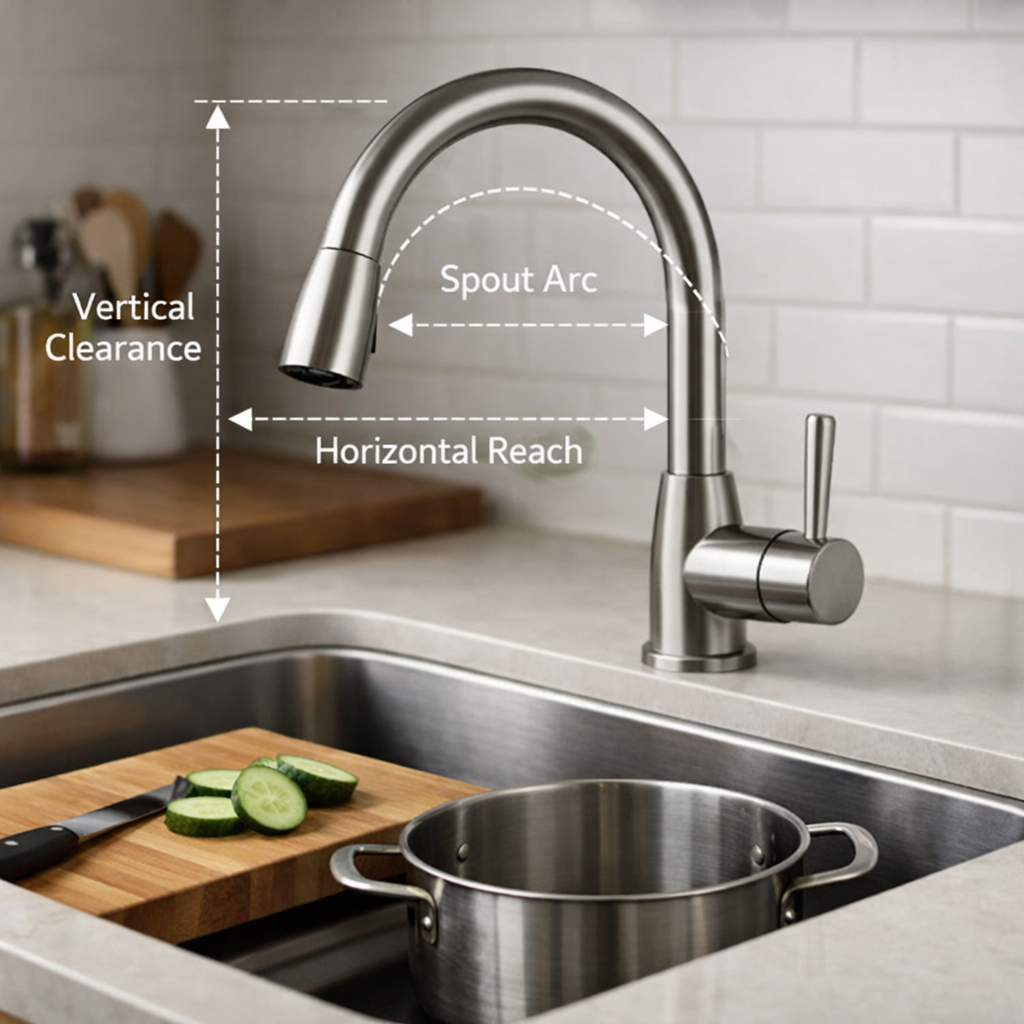
How Faucet Spout Height, Reach, and Arc Affect Kitchen Usability
A kitchen faucet’s geometry—spout height, reach, and arc—quietly dictates how easy your sink is to use. These dimensions determine whether pasta pots fit, whether rinsing is comfortable, and whether water splashes everywhere or drains cleanly. In short: match height to your cookware and sink depth, dial in reach so the stream lands near the drain, and pick an arc profile that balances clearance with splash control. Do those three things and you’ll also make your garbage disposal cleaner and quieter to use, with fewer odors and mess. At Garbage Advice, that drain-centered, deeper-basin pairing is our baseline recommendation for everyday cleanup. The sections below break down how to measure, compare, and choose the right setup for everyday cooking and cleanup.
Why faucet geometry matters for real-world kitchen tasks
Spout height describes the vertical clearance from the countertop to the spout outlet where water actually exits. It’s not the same as overall faucet height, which can be much taller and is mostly about cabinet or window clearance. Height affects whether you can angle baking sheets and stockpots under the flow and how much spray falls before it hits the water line.
Spout reach is the horizontal distance from the faucet’s mounting point to where the water stream lands. It’s different from spout height because it governs where you work in the basin and whether water naturally targets the drain. Overall faucet height still matters for obstructions above the counter, but height and reach drive daily function.
Golden Rule of splash control: aim the water stream at or near the drain/center. That one alignment change reduces ricochet and film on counters. High- vs low-arc choices also shift splash behavior, and deeper sinks (around 9–10 inches) tame splatter under taller arcs, per high- vs low-arc guidance from industry overviews of faucet geometry (see this high- vs low-arc guidance for typical dimensions and trade-offs).
Reference: high- vs low-arc guidance (an overview of arc height, clearances, and fit considerations) is summarized well in this high- vs low-arc guidance from Anmei Faucet.
Spout height and clearance
Spout height (clearance) is the distance from the countertop to the spout outlet where water exits; it’s distinct from a faucet’s overall height, which determines if you’ll hit a window mullion or cabinet shelf above. That nuance matters when you want tall-working clearance without an over-tall body near a window, as noted in high/low-arc comparisons.
Typical ranges and what they mean:
- High-arc or gooseneck faucets usually provide 8–10+ inches of clearance. They create vertical workspace for stockpots, sheet pans, and tall colanders. Most users find them more versatile for frequent batch cooking and baking.
- Mid-arc faucets (roughly 5–8 inches) strike a balance between clearance and sightlines, fitting many family kitchens without dominating the view.
- Low-arc faucets (about 3–8 inches) keep lines horizontal for compact or minimalist layouts; they’re helpful beneath low shelves but limit vertical maneuverability.
Pair taller arcs with deeper basins (around 9–10 inches) to control splash and spray height, a pairing emphasized in high/low-arc selection guidance.
Height type vs. best use vs. splash notes:
| Height type | Best use | Splash notes |
|---|---|---|
| High-arc/gooseneck | Big cookware, deep or workstation sinks | More drop height; pair with deep basin and center the stream over the drain |
| Mid-arc | General-purpose family kitchens | Balanced clearance; moderate splash risk when stream is well-centered |
| Low-arc | Tight sightlines, shallow or decorative sinks | Lowest splash from height, but limited vertical space |
Spout reach and where the water lands
Spout reach is the horizontal distance from the faucet base to where water hits the sink. It’s different from spout height, which is vertical clearance. In most kitchens, an 8–12 inch reach centers the stream in the basin and near the drain, cutting splatter and awkward hand positions, as detailed in spout reach guidance from Electronic Faucet.
What happens when reach is wrong:
- Too short: the stream lands near the back ledge. You’ll wash at the rear wall, bounce spray upward, and struggle to rinse into the disposal.
- Too long: the stream lands toward the front. Expect splash-out onto counters and the floor.
- Don’t confuse total spout length with true reach. Angled goosenecks can look long but land short; always verify the spec’s “spout reach.”
Sink style affects ideal reach. Undermounts, drop-ins, single vs. double bowls, and wall-mount placements all shift where the drain sits relative to the faucet centerline.
Quick steps to get reach right:
- Measure from your faucet hole to the drain center; that’s your target landing zone.
- If you have multiple pre-drilled holes, test with a paper template to see where different bases would put the stream.
- For double bowls, aim for a centered reach that can comfortably serve both drains.
Arc profiles and splash control
Arc, or profile, is the shape and height of the spout—gooseneck/high, mid, or low—that sets both the visual line and working clearance. High arcs draw the eye up and carve out space; low arcs keep horizontals clean and sightlines open.
Pros and cons:
- High-arc: excellent for tall pots and deep rinsing. Because the stream falls farther, it can increase splash unless paired with a deep basin or a stream aimed directly at the drain.
- Low-arc: ideal where you want low visuals and tight control. The trade-off is limited clearance for cookware.
- Mid-arc: the middle ground most households can live with comfortably.
Arc type vs. clearance vs. ideal sink depth vs. splash tips:
| Arc type | Clearance | Ideal sink depth | Splash control tips |
|---|---|---|---|
| High-arc/gooseneck | Highest | 9–10 in. deep basins | Aim stream at the drain; use pull-down spray for close-in rinsing |
| Mid-arc | Moderate | 8–9 in. | Center stream; adjust spray pattern for delicate tasks |
| Low-arc | Lowest | 7–8 in. or decorative | Keep reach shorter; use aerated flow to soften impact |
Matching faucet dimensions to sink depth and layout
The alignment rule: pick a height and reach that place the stream at or near the drain or basin center. That one choice improves splash control, hygiene, and disposal usability. That alignment-first approach is also what we recommend at Garbage Advice.
Good pairings:
- Deep basins (9–10 inches): accommodate high-arc faucets with less splash; a slightly longer reach can be comfortable because the water falls farther before hitting the bowl.
- Shallow or decorative sinks: favor lower or mid arcs and shorter reaches to limit impact energy and spillover.
- Workstation and larger basins: benefit from pull-down heads and a touch more reach to cover boards and ledges, a trend echoed in kitchen workstation sink coverage by Kitchen & Bath Design.
Double-bowl sinks: a centered reach around 8–10 inches often serves both bowls and the disposal side; always verify where each drain sits relative to the mounting hole.
Pull-down, pull-out, bridge, and commercial style impacts on usability
Pull-down faucets route the spray head down from a high arc for precise rinsing inside deep sinks. Pull-out faucets extend horizontally, working well in low-arc setups or tight spaces where vertical clearance is limited—both improve versatility compared with fixed spouts, as outlined in faucet selection primers from L’Atelier Paris.
Trends point to pull-down/pull-out heads getting sleeker and easier to dock, while touchless and even voice features have gone mainstream for hygiene and convenience, according to recent faucet roundups from ReliableRemodeler.
Use cases to compare:
- Pull-down: best match for deep sinks and tall arcs; target the drain without moving large pots.
- Pull-out: great for compact kitchens or lower arcs where overhead space is tight.
- Bridge: timeless aesthetics; double-check hole spacing, deck plate needs, and spout reach.
- Commercial-style: spring or semi-pro designs offer sweeping coverage; verify splash control with deeper basins and an aerated flow option.
Handle note: single-handle controls speed up dish cycles and temperature adjustments during rinse-and-repeat tasks.
Pairing faucets with garbage disposals and splash guards
To minimize odors, clogs, and mess, choose a spout reach that naturally targets the disposal-side drain. When the stream lands at the grinding chamber, scraps move cleanly with fewer hang-ups—the Golden Rule in action.
A deep basin plus a high- or mid-arc with a pull-down head lets you sweep peels and coffee grounds directly into the disposal while containing spray. Mismatched height or overlong reach can drive water toward the front rim, leading to wet counters, louder operation, and extra cleanup. Add a compatible baffle or splash guard to quiet and contain debris, especially with higher-flow or high-arc setups on shallow sinks. At Garbage Advice, we also favor quiet, removable baffles matched to your disposer for easier cleaning.
Septic system considerations and water efficiency
Choose WaterSense-certified faucets to reduce flow without sacrificing usability; lower flow combined with precise reach delivers enough rinse energy while keeping excess water out of septic systems. Smart flow controls and touchless features also encourage on/off discipline.
Septic-friendly habits—moderated flow, targeted rinsing to the drain, and avoiding fats or fibrous waste—reduce solids and stress on the system. Market research notes rising demand for sustainability and smart fixtures in kitchens, trends that reinforce efficiency-first faucet choices, as summarized by The Farnsworth Group’s kitchen and bath fixtures insights.
Measuring before you buy
Mini‑glossary (ground your measurements):
- Spout height — The vertical clearance from the counter to the point where water exits the spout. It’s not overall faucet height, which governs window or shelf interference. Height determines space for pots and trays and affects splash by changing how far water falls (see high- vs low-arc comparisons).
- Spout reach — The horizontal distance from the faucet’s mounting point to where the stream lands in the sink. It differs from height and controls comfort, hygiene, and splash by dictating whether water hits the drain or edges (see spout reach guidance from Electronic Faucet).
Step-by-step:
- Measure sink depth and mark the drain centerline.
- Measure from the faucet hole to the drain center to estimate ideal reach.
- Check vertical clearance to windows, shelves, or cabinets to confirm overall faucet height fit.
- Verify pre-drilled holes and any escutcheon or deck-plate needs before purchase.
Pro tip: cut a cardboard template to simulate spout reach and arc inside your basin and confirm where the stream will land—it’s our go-to sanity check at Garbage Advice.
Common mistakes to avoid during selection and installation
- Confusing total spout length with true reach. The landing point is what matters; verify the spec-sheet “spout reach” dimension.
- Ignoring sink style, bowl layout, and disposal alignment. Wrong reach or arc can cause constant splash, moisture damage, and cleanup headaches—especially on shallow or short-lipped sinks.
- Overlooking availability and install features. Finishes, supply constraints, and pro-friendly mounting systems vary by brand and can affect timelines and fit, as market trend reports have noted.
Brand notes for DIYers: Waste King, InSinkErator, Moen
Across brands, Garbage Advice prioritizes fit and disposal-side alignment; use the steps above to size reach to the drain and pick a compatible splash guard.
Moen’s broad catalog includes pull-down and touchless models that pair well with high-arc/deep-sink setups, aligning with mainstream trends toward intuitive sprayers and hands-free convenience highlighted in recent faucet roundups.
For Waste King and InSinkErator users, prioritize a reach that centers over the disposal bowl and add a compatible splash guard/baffle to reduce spray and noise during grinding. If you’re upgrading a faucet and disposal together, check deck-plate compatibility, hole spacing, and mounting hardware to finish both installs in a single session.
Frequently asked questions
What spout height works best for filling tall pots without excess splash?
Choose a high-arc faucet with roughly 8–10+ inches of clearance and pair it with a 9–10 inch deep sink. Garbage Advice also recommends aiming the stream near the drain to keep splatter down.
How much spout reach do I need so the stream hits near the drain?
In many kitchens, 8–12 inches of spout reach centers the stream near the drain. Garbage Advice’s rule of thumb is to measure from the faucet hole to the drain center for a precise fit.
Do high-arc faucets always splash more?
No. High arcs offer more workspace, and Garbage Advice emphasizes pairing them with a deep basin and a drain-centered stream to keep splatter in check.
How do I size faucet height and reach for a shallow or double-bowl sink?
Use a lower or mid-arc with slightly shorter reach for shallow sinks, and target an 8–10 inch centered reach to serve both bowls. Garbage Advice suggests verifying exactly where the stream will land before you buy.
Will faucet choice affect odors, clogs, or noise with a garbage disposal?
Indirectly, yes. Garbage Advice recommends choosing a faucet that targets the disposal drain and adding a compatible splash guard to reduce residue, spray, and noise.