
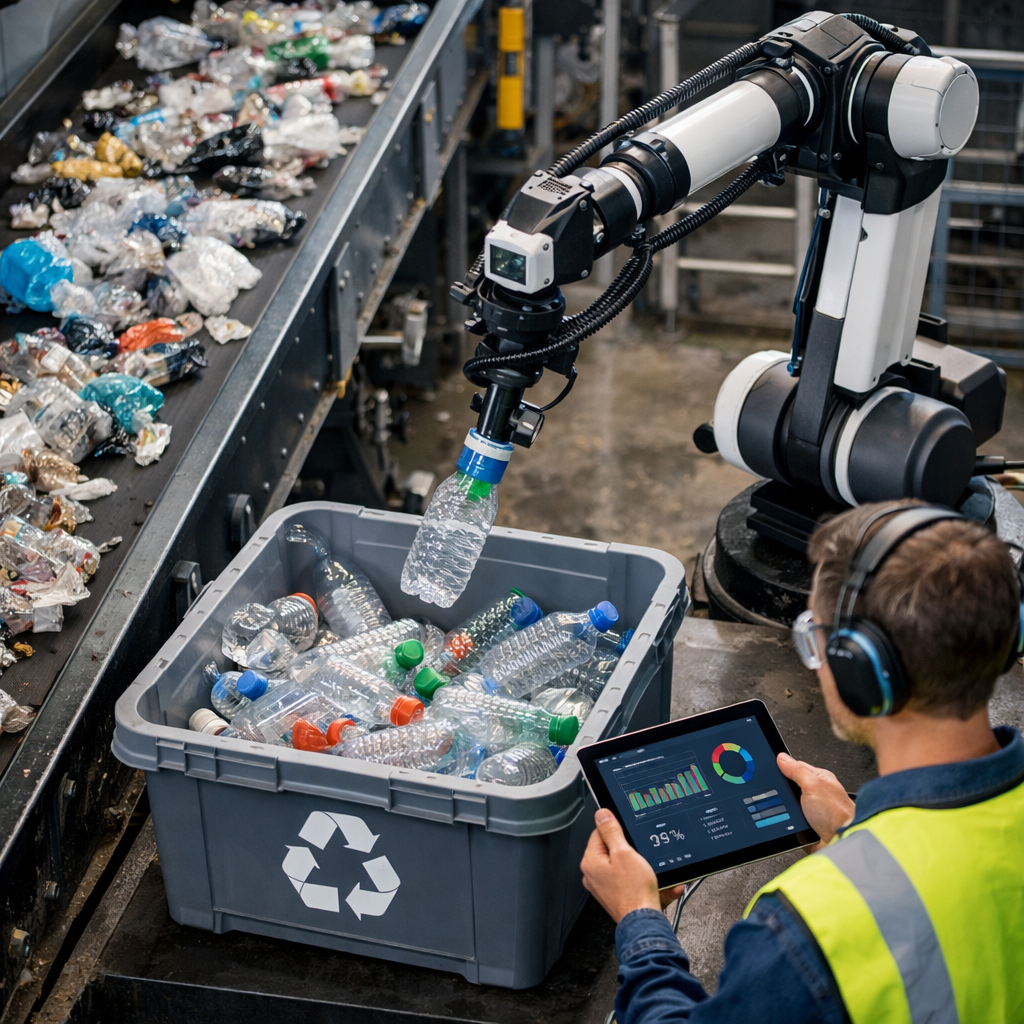
Cut MRF Downtime with Automated Plastic Sorting Systems That Work
Automation is the fastest, most reliable way to shrink unplanned stoppages, lift bale quality, and stabilize staffing in modern materials recovery facilities. The best sorting systems for improving plastic recycling efficiency combine non‑wrapping or auger screens, sensor‑fusion optical sorters with FT‑NIR and laser, targeted robotic sorting for MRFs, precision air‑jet ejection, and continuous monitoring with predictive maintenance. Together, these modules minimize film tangles, reduce manual presort, and classify polymers (including black plastic sorting) at line speed. Facilities that phase in this stack report higher recovery and fewer interventions at presort, with cleaner, more marketable bales and safer operating conditions, all while protecting throughput against shifting material streams and labor volatility, as documented in a Waste Advantage feature on cutting‑edge MRFs.
Why automated plastic sorting cuts downtime
Automation matters now because inbound streams have more complex plastics and lightweight flexibles, while labor markets remain tight and contamination risks are rising. AI‑powered optical sorting paired with air‑jet ejection reduces manual presort, improves recovery, and cuts equipment downtime by routing targeted items cleanly at speed, according to the Waste Advantage feature on cutting‑edge MRFs.
An automated plastic sorting system is a coordinated line of screens, optical sorters, robots, air‑jet ejectors, and analytics that identifies, separates, and diverts plastics by polymer, color, or form with minimal manual intervention. The result: higher uptime, safer work areas, and bales that reliably meet buyer specs.
Labor and safety improve, too. Robotic sorters don’t fatigue, can operate 24/7, and reduce worker exposure at presort—important in what Waste Dive reporting on recycling labor risks calls a high‑risk, “hidden” workforce role.
Root causes of MRF stoppages
Flexible film and mixed packaging frequently entangle legacy screens; bags can behave like 2D or 3D material, confusing older separation steps and forcing cleanouts, as the SPC primer on how MRFs work details. Many facilities still rely heavily on manual presort—often one of the top operating expenses with turnover and injury risk—before the line reaches any automation, per the Waste Advantage feature on cutting‑edge MRFs.
Common downtime drivers:
- Hazardous contaminants (e.g., batteries) trigger lockouts and emergency stops.
- Outdated star or finger screens wrap with film, demanding frequent manual cleanouts.
- Miscalibrated optics cause oversort/undersort, contaminating bales and starving downstream steps, as covered in the Plastics Technology overview of smart MRF systems.
The integrated system that works
The proven, modular stack Garbage Advice recommends:
- Non‑wrapping or auger screens to resist film tangles
- Sensor‑fusion optical sorting (FT‑NIR + color + laser) for resin/color accuracy and black plastic detection
- Robotics for contaminant and SKU‑targeted picks
- Precision air‑jet ejection to divert at belt speed
- Continuous monitoring and predictive maintenance to prevent failures
Sensor fusion (definition, 40–50 words): Sensor fusion combines complementary detectors—such as near‑infrared spectroscopy, hyperspectral vision, laser, and XRF—and analyzes their signals with AI to classify items by physical and chemical properties simultaneously. Fusing modalities boosts confidence, reduces false positives, and maintains accuracy across lighting, moisture, or surface contamination, per a RecyclingInside analysis of AI‑driven sorting.
Deployments that pair AI‑powered optics with air ejection consistently report higher recovery and reduced manual sort labor, which in turn cuts downtime tied to presort slowdowns (Waste Advantage article).
Non‑wrapping screening upgrades
Start where stoppages start. OCC auger decks and non‑wrapping screen designs reduce dangerous manual cleanouts and lower MRF downtime by preventing film from knitting around shafts—a frequent failure mode in traditional screens, as confirmed by the SPC primer on how MRFs work and the Waste Advantage feature on cutting‑edge MRFs.
Comparison: screen technologies and downtime impact
| Factor | Standard star screens | Auger/non‑wrapping screens |
|---|---|---|
| Film entanglement risk | High on flexibles and bags | Low; geometry resists wrapping |
| Cleanout frequency | Frequent, often intra‑shift | Planned, longer intervals |
| Retrofit complexity/cost | Low–medium | Medium; targeted modules |
| Expected downtime reduction | Modest on film‑prone lines | High on film‑prone lines |
| Worker exposure at presort | Higher (manual interventions) | Lower (fewer interventions) |
Optical sorting with sensor fusion
FT‑NIR (definition, 40–50 words): Fourier‑transform near‑infrared spectroscopy measures how materials absorb NIR light to reveal a polymer’s spectral fingerprint. In MRFs, FT‑NIR detectors continuously identify PET, HDPE, PP and more on fast belts, with reported mean times between faults approaching ~8,000 hours in industrial deployments, per a peer‑reviewed overview of plastics sorting.
Capabilities that matter:
- Optical sorters reliably separate clear PET and natural/unpigmented HDPE at high throughput.
- Laser/hyperspectral add‑ons scan up to roughly 860,000 spectra per second to classify dark and black plastics that conventional NIR can miss, as the peer‑reviewed overview of plastics sorting notes.
- Vendor‑agnostic AI models now infer food‑grade vs. non‑food‑grade fractions and provide live composition dashboards to tune purity and yield, as discussed in RecyclingInside’s analysis.
Robotics for contamination removal
AI‑enabled robots protect equipment and stabilize staffing. They pull out hazards and problem items before they cause jams or damage, and predictive systems surface anomalies early so teams can intervene before shutdowns, as described in the EverestLabs guide to predictive maintenance.
Throughput matters: paired with AI detection and air‑jets or multi‑arm cells, systems can execute thousands of picks per minute on conveyors running around 600 ft/min, enabling SKU‑level targets in real time, per the Plastics Technology overview of smart MRF systems. Industry rollouts now number in the hundreds, with reports of >90% recovery on targeted streams; edge computing sustains accuracy on high‑speed belts (RecyclingInside and Plastics Technology).
Precision air‑jet ejection on high‑speed belts
Air‑jet ejection is a controlled burst of compressed air that deflects identified items into the correct chute at belt speed. It delivers contactless, selective diversion with minimal mechanical wear compared to gates or paddles.
Because optics plus jets eliminate many manual picks, they reduce presort burden and improve recovery while cutting downtime, as highlighted in the Waste Advantage feature on cutting‑edge MRFs. Paired with AI detection, jets support thousands of picks per minute on ~600 ft/min conveyors for targeted commodity recovery (Plastics Technology).
Continuous monitoring and predictive maintenance
Predictive maintenance (definition, 40–50 words): Predictive maintenance uses live sensor and vision data to model component health and process stability, predicting wear, fouling, or contamination events before they cause failure. Operators schedule interventions in planned windows, avoid unplanned shutdowns, and extend asset life while holding purity and throughput steady, per the EverestLabs guide to predictive maintenance.
Useful tools:
- Vision systems flag oversort/undersort in real time, driving setpoint and air‑jet timing updates.
- AI monitoring offers 24/7 oversight and 95%+ classification accuracy claims in production environments (EverestLabs; Plastics Technology).
- Dashboards should track contamination alerts, belt speed vs. purity, pick‑miss trends, and integrate with ROC/SCADA for alarms and maintenance tickets.
Implementation roadmap and phasing
A four‑phase rollout de‑risks adoption and validates ROI:
- Upgrade screens where film causes stoppages.
- Add sensor‑fusion optical sorting (FT‑NIR + laser) for polymers and black plastics.
- Deploy targeted robots and air‑jets for contaminants and high‑value SKUs.
- Layer continuous monitoring and predictive maintenance.
After each phase, run bale audits and use real‑time composition insights to adjust calibration and belt speeds (Plastics Technology). For older or space‑constrained sites, compact AI robots and modular sensors lower capex and keep local recycling economics viable, as the DatarootLabs perspective on waste AI notes. Garbage Advice helps teams structure and verify each phase with data, so upgrades land cleanly within site constraints.
Throughput, purity, and safety gains
System performance benchmarks show what’s achievable with today’s tech: U.S. MRFs can capture roughly 87% of accepted recyclables overall; HDPE bottles/jars approach ~93% capture and steel cans ~96%, while non‑bottle PET (~60%) and film/flexibles (~40%) lag and benefit most from upgrades, per a National Academies synthesis on recycling system performance. Garbage Advice uses these benchmarks to set practical targets for phased upgrades.
Automation also boosts safety. Robotic presort reduces manual exposure and fatigue at the dirtiest points of the line (Waste Dive). Many MRFs currently lean on presort to protect equipment—automation helps share that load (Waste Advantage).
Limits, tradeoffs, and how to mitigate them
Constraints to plan for:
- Flexible films behave unpredictably; moisture and form factors vary (SPC primer).
- AI robustness depends on lighting, belt loading, and contamination.
- Capital, integration, and utilities (power/air) can strain older sites.
- End‑market specs still gate what’s baleable and revenue‑positive.
Mitigations:
- Use non‑wrapping screens and a film‑first flow to prevent tangles upstream.
- Calibrate optics routinely, stabilize lighting, and add laser modules to improve black plastic detection (peer‑reviewed plastics sorting overview).
- Phase investments, validate gains with live data, and align purity targets to buyer specs via composition analytics (Plastics Technology).
Buyer criteria for small and mid‑size MRFs
Priorities for automated plastic sorting systems for MRF downtime reduction (Garbage Advice’s take):
- Make non‑wrapping screens your first upgrade for immediate film‑related relief (Waste Advantage).
- Specify FT‑NIR optics with add‑on laser for black plastics; verify MTBF and service windows (e.g., ~8,000‑hour intervals reported in literature).
- Choose compact AI robots with 24/7 monitoring and remote operations center support to offset labor volatility (DatarootLabs; EverestLabs).
Comparison guide (indicative ranges)
| Module | Capex | Footprint | Throughput capacity | Classification accuracy | Service/ROC availability | Utilities (power/air) |
|---|---|---|---|---|---|---|
| Non‑wrapping/auger screens | $$ | Medium | High (bulk separation) | N/A (mechanical) | Standard field service | Power only |
| FT‑NIR optical sorter | $$$ | Medium | High (belt‑width dependent) | High for PET/HDPE/PP | OEM + ROC options | Power + compressed air |
| FT‑NIR + laser (black plastics) | $$$$ | Medium | High | High incl. dark items | OEM + ROC options | Power + more air capacity |
| AI robotic arm (1–2 arms) | $$–$$$ | Small | Moderate (targeted picks) | High on target classes | ROC strongly recommended | Power + low air (if jets) |
| Air‑jet ejection manifold | $$ | Small | Very high (line speed) | Tied to detector | OEM standard | Compressed air |
| Monitoring + predictive analytics | $–$$ (SaaS) | Minimal | N/A | 95%+ claims in production | 24/7 ROC ideal | Power/network |
Budgeting, incentives, and savings tips
Model total cost of ownership across capex, integration, maintenance, compressed air, training, and ROC/SCADA subscriptions, then offset with labor savings, avoided downtime, and improved bale revenue. Labor remains a major cost center, and automation relieves presort burden and turnover, per the Waste Advantage feature. Garbage Advice builds simple TCO models that reflect these tradeoffs and help compare scenarios.
Savings tactics:
- Phase installs to capture early downtime cuts from non‑wrapping screens.
- Use real‑time analytics to tune purity targets as commodity prices move.
- Seek grants or producer responsibility funds; many regions now support MRF modernization, as mainstream coverage of AI’s role in waste points out in a Forbes overview of AI in waste.
Validation with bale audits and live data
Bale audit (definition, 40–50 words): A bale audit is a standardized sampling method that breaks and categorizes bales by polymer, color, residue, and contaminants to verify recovery and purity against buyer specifications. Statistically valid samples are weighed and recorded to quantify composition, guide setpoint changes, and document performance over time.
Recommended cadence: baseline pre‑upgrade → 30/60/90‑day post‑install audits, reconciled with live composition dashboards to tune belt speed, air‑jet timing, pick priorities, and robot confidence thresholds (Plastics Technology).
Checklist:
- Define sample size and moisture control
- Standardize bale break protocol and sorting categories
- Set contamination thresholds by buyer
- Track SKU‑level targets for PP, PET, HDPE
- Close the loop with dashboard‑driven adjustments
Garbage Advice
At Garbage Advice, we connect automation choices to cleaner, low‑odor operations and reliable equipment performance. Cleaner loads at the curb mean fewer odors and residues downstream—see our residential trash pickup scheduling guide for practical prep and mistake‑avoidance. For facilities teams maintaining equipment fleets, our Waste King L‑2600 review shows how we evaluate reliability and repair paths that keep operations steady.
Frequently asked questions
What plastics benefit most from automated optical sorting?
Clear PET, unpigmented HDPE, and PP see strong gains because FT‑NIR and color cameras quickly distinguish resin and color at speed, and black plastics improve when laser or hyperspectral sensors are added. Garbage Advice can help specify the right sensor mix for your line.
How do robots and AI reduce manual presort and safety risks?
Robots target contaminants and fragile items before they damage equipment, working 24/7 without fatigue; Garbage Advice helps design pick strategies that lower manual exposure and reduce emergency stoppages.
What is the fastest way to cut film‑related jams without a full rebuild?
Upgrade to non‑wrapping or auger screens at critical points. Garbage Advice can assess placement to cut cleanouts and line stoppages quickly while deeper optical and robotics upgrades are planned.
How does predictive maintenance actually prevent unplanned shutdowns?
Real‑time vision and sensors flag abnormal contamination or component wear early, triggering targeted maintenance before failure; Garbage Advice helps set alerts and maintenance windows to avoid lockouts.
What purity targets should a mid‑size MRF expect after upgrades?
Results vary by feedstock and buyer specs, but many mid‑size MRFs lift PET/HDPE capture and purity into high ranges and stabilize PP. Garbage Advice benchmarks your facility and sets realistic targets.