
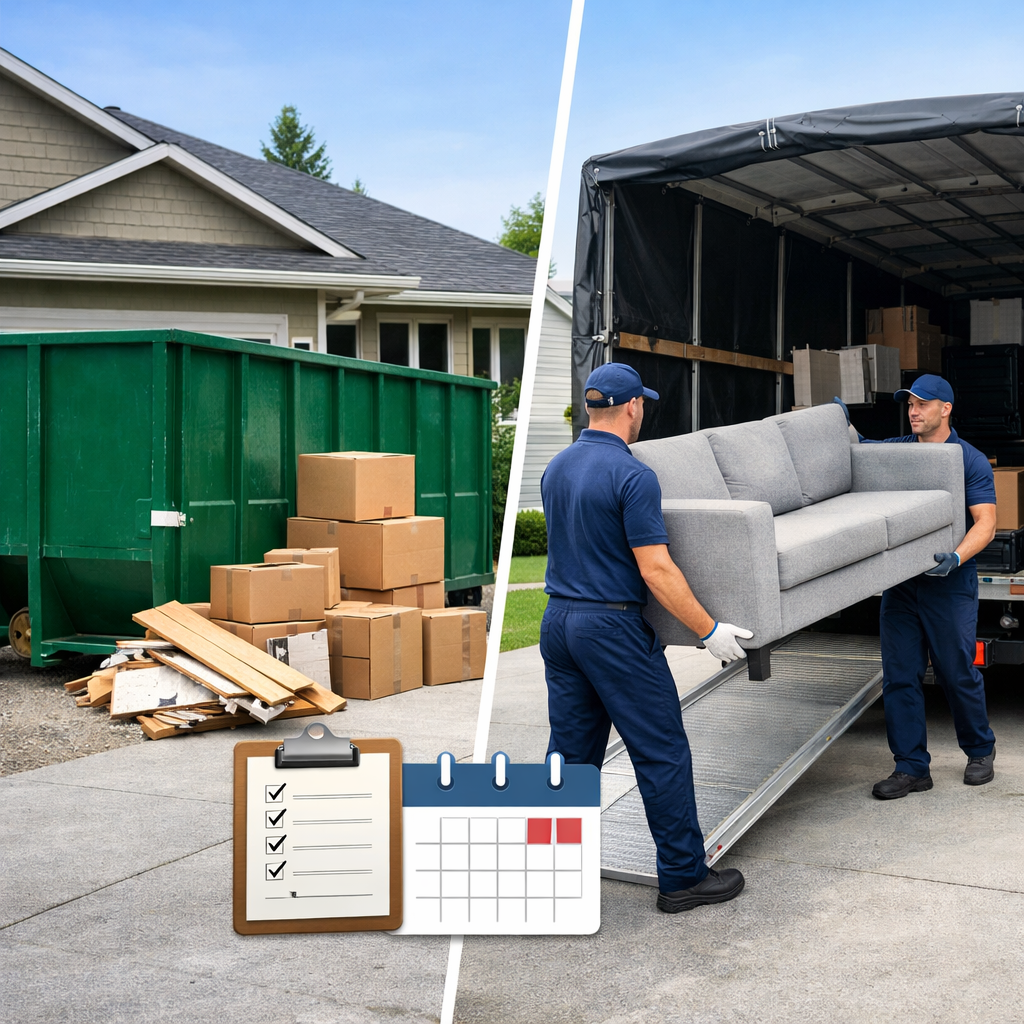
Bin Rental vs Junk Hauling: How to Choose with Confidence
Choosing between a bin (dumpster) rental and full-service junk hauling comes down to control, labor, timing, space, and cost. If you want speed and zero lifting, a crew-based haul is often best; if you’re tackling debris over several days and want control and privacy, a roll-off bin shines. Most junk removal jobs finish in 1–3 hours, while dumpsters stay on-site for days so you can load at your pace, which changes cost and convenience dynamics across project sizes, access constraints, and permit rules (see TurboHaul’s guide). Below, Garbage Advice breaks down definitions, pricing models, project-by-project cost outcomes, and safety and environmental trade-offs so you can pick with confidence and avoid surprise fees.
Quick definitions and core differences
Dumpster/bin rental: A roll-off container is delivered to your property and left for a set period (often 5–7 days). You do the loading, debris sits in the bin on-site, and pickup is scheduled after you’re done. It offers more control and privacy because the container remains until collection (see EN Contracting Disposals). Dumpsters stay for days, fitting multi-day projects (see TurboHaul’s guide).
Junk hauling/removal: A full-service crew arrives, lifts and loads items for you, and hauls them away the same day. They navigate tight spaces and stairs, and most residential jobs finish in 1–3 hours, making it the fastest path for one-time cleanouts (see TurboHaul’s guide).
Related terms you may see: dumpster rental, bin rental, junk hauling, roll-off dumpster, full-service hauling, and Bagster (a disposable dumpster bag for light debris).
How pricing works
Pricing varies by service model and what’s included. Get clarity up front.
- Typical ranges: dumpster rental often runs $300–$700 for a week depending on size and region (see Iowa Dumpsters pricing overview). Junk removal averages around $260 for homes and roughly $525 for businesses, with full truckloads reaching about $1,000 in some markets (see MoveBuddha’s cost breakdown; see Small Haul KC).
- Models:
- Dumpster: a flat rate by container size and rental period with an included weight allowance; predictable if you stay under the limit (see Captain Hook Austin).
- Junk hauling: volume-based (how much of the truck you fill). Quotes can adjust at pickup based on actual load; special disposal or environmental fees may apply (see Small Haul KC).
Comparison at a glance:
| Service | Base pricing model | Typical range | What’s included | Common add-ons |
|---|---|---|---|---|
| Bin/dumpster rental | Flat rate by size + rental length | $300–$700 per week | Delivery, pickup, disposal up to weight cap | Weight overages, extra days, permits, distance |
| Junk hauling | Volume by truck space | ~$260 (homes), ~$525 (business); up to ~$1,000 full load | Crew labor, loading, haul-away | Stairs/labor surcharges, special item fees, access/distance |
Cost comparison by project size
| Project size | Example scope | Likely winner on cost | Why |
|---|---|---|---|
| Small | A few bulky items (chair, mattress) | Junk hauling | You’re paying for speed and labor; a full bin week is overkill. |
| Medium | Single room/garage cleanout | Tie (price both) | Haulers are efficient if near 1/4–1/2 truck; a 10–15 yd dumpster can be competitive if debris trickles in. |
| Large | Multi-room cleanout or renovation | Dumpster rental | Flat weekly rates ($300–$700) can undercut a full truckload that can approach ~$1,000, assuming weight stays within allowance. |
Full truckload junk hauling can near ~$1,000 in some markets, while a mid-size roll-off often stays between $300–$700 (subject to tonnage limits) (see Small Haul KC; see Iowa Dumpsters pricing overview).
Break-even signal: If your pile approaches half a truckload or more—or an entire room’s worth—start pricing 10–20 yard dumpsters. For just a few items, junk hauling usually wins.
Labor, access, and safety factors
- Labor: Hauling crews handle all lifting, stair carries, and tight corners; dumpsters are DIY unless you hire helpers.
- Safety: Dumpsters centralize debris and can reduce tripping hazards on multi-day projects, but self-loading increases injury risk if you overexert or lift awkwardly.
- Quick checklist:
- Are there stairs, low ceilings, or long carries from the house to the driveway?
- How heavy are items (appliances, safes, concrete)?
- Do you and your helpers know safe lifting techniques and have PPE?
- Any HOA, elevator reservations, or quiet hours to respect?
Timeline and convenience
- Speed: Junk removal typically wraps in 1–3 hours—ideal for same-day cleanouts.
- Flexibility: Dumpsters stay on-site for days so you can sort, stage, and load at your pace—best for renovations and phased projects.
- Scheduling notes: Haul crews often confirm with a 20–30 minute heads-up call; some dumpster providers offer same-day delivery for fast starts in many markets (as noted by Small Haul KC and Captain Hook Austin).
Use cases:
- Last-minute move-out, one-day garage sweep, or heavy items you can’t lift: choose haulers.
- Staggered demo, ongoing yard/renovation debris, or “sort-as-you-go” cleanouts: choose a bin rental.
If your timeline may slip, Garbage Advice suggests starting with haulers and adding a bin if debris keeps coming.
Space, permits, and neighborhood fit
- Space reality: A roll-off occupies driveway or curb space for several days. If you lack a driveway or street clearance, junk removal is the better fit.
- Permits: Placing a dumpster on a public street may require a permit, often $50–$200 (see Iowa Dumpsters pricing overview).
- 3-step site check:
- Measure clear, level space (length + width + overhead clearance).
- Verify driveway load capacity (bins and trucks are heavy).
- Confirm HOA/municipal rules for placement, hours, and permits.
Garbage Advice’s simple site-check approach helps you avoid damage and fines.
Environmental considerations
- Diversion: Many junk removal companies sort for donation and recycling and understand local disposal channels, improving reuse and diversion rates (see Angi analysis).
- Emissions: For large jobs, a single dumpster placement can reduce multiple small trips, lowering total transport emissions over the project (as highlighted by Captain Hook Austin).
- Ask providers:
- Do you partner with local donation centers or deconstruction nonprofits?
- How do you handle e-waste, mattresses, and appliances?
- Are mixed C&D loads routed to a sorting facility?
Garbage Advice encourages prioritizing reuse first, then recycling, and proper disposal.
What fits in each service
- Dumpster-friendly debris: Construction and demolition waste such as drywall, lumber, flooring, shingles, brick, stone, and concrete. Common roll-off sizes are 10, 15, 20, 30, and 40 cubic yards (see LoadUp’s guide).
- Limitations: Dumpster bags (Bagster) are cheaper and fine for light debris but not ideal for large appliances or very bulky items (see TurboHaul’s guide).
- Ask before you load: Mattresses, tires, refrigerators (refrigerants), and any hazardous materials (paints, solvents, fuels, asbestos) have local restrictions and special handling rules.
When to choose bin rental
Choose a bin when:
- Debris accumulates over days (kitchen/bath demo, roofing, yard overhauls) or whole-house/estate cleanouts where sorting takes time (see MyGoodMovers overview).
- You want predictable, flat-rate pricing so long as you stay within the weight allowance (as noted by Captain Hook Austin).
- Keeping the site organized and safer matters during multi-day work (reinforced by EN Contracting Disposals).
It’s typically more cost-effective on high-volume projects, especially compared with a full-truck junk haul.
When to choose junk hauling
Choose a hauler when:
- You need a one-day cleanout, can’t (or don’t want to) lift heavy items, or have tight access/permit barriers.
- You value hands-free service and same-day completion in about 1–3 hours.
- You’re moving only a few bulky pieces—volume pricing is efficient for small loads, though full truckloads can approach ~$1,000 in some areas (see Small Haul KC).
Hybrid approach for complex cleanouts
For big, messy projects, combine services to cut cost and stress:
- Phase 1: Book junk hauling first for bulky items that don’t bin well (appliances, donation-worthy furniture).
- Phase 2: Drop a mid-size dumpster for renovation debris and leftovers; keep it through demo and touch-up days to avoid repeat pickups.
Example workflow:
- Day 1 (2–3 hours): Haulers remove appliances, sofas, mattresses; expected volume 1/2–3/4 truck.
- Day 2–5: 15–20 yd dumpster on-site for demo debris and boxes; DIY loading.
- Day 6: Dumpster pickup; final sweep and donation drop-off if needed.
How to compare quotes without surprises
Get written quotes that itemize: base rate, included weight or truck volume, rental length, disposal/environmental fees, pickup window, and any access limits. Dumpster providers often publish transparent rates and size charts online (noted by Small Haul KC). It’s the same checklist we use at Garbage Advice when reviewing providers.
Watch for extras:
- Street permits ($50–$200), tonnage overages ($100+ per extra ton), hard-to-handle items (tires, mattresses, Freon), long carry or stair fees, and out-of-area surcharges (see Iowa Dumpsters pricing overview).
Use this Garbage Advice side-by-side template:
| Provider | Service | Size/Volume | Base price | Included weight/volume | Add-ons quoted | Earliest date | Final haul location |
|---|
Garbage Advice recommendation
Bottom line: Pick a dumpster for multi-day, heavy, or high-volume debris and when you want control over sorting and timing. Choose junk hauling for speed, tight access, and no-lift convenience. Rule of thumb: if your pile approaches half a truckload or an entire room’s worth, price a 10–20 yard roll-off first; for a handful of bulky items, call a hauler. For more smart waste-handling tips, explore Garbage Advice and our DIY garbage disposer guide.
Frequently asked questions
Which is cheaper for my project?
For large, ongoing debris, a dumpster often wins on cost with flat weekly rates around $300–$700; for a few items or a fast one-day cleanout, junk hauling can be cheaper though full truckloads can approach ~$1,000. Check local ranges and use Garbage Advice to price both options side by side.
Do I need a permit for a bin on the street or driveway?
Driveways usually don’t need permits, but placing a dumpster on a public street can require one, often $50–$200. Confirm local rules before booking and see Garbage Advice’s permit tips.
What size bin should I choose?
Most residential projects fit 10–20 cubic yard bins; larger remodels may need 30–40. If you’re near half a truckload or a full room of debris, start with a 15–20 yard bin and see Garbage Advice’s sizing guidance.
How do weight limits and overage fees work?
Dumpster quotes include a weight allowance; if you exceed it, overage fees (often $100+ per extra ton) are added. Junk hauling prices are volume-based but can include disposal or environmental fees—see Garbage Advice for what to ask.
What items are not allowed in bins or with haulers?
Most services restrict hazardous materials like paints, chemicals, fuels, and asbestos; ask about tires, mattresses, and appliances. Rules vary—use Garbage Advice’s quick reference before loading.