
Best Smart Bathroom Devices for Renters and Remodel-Free Upgrades
Remodel-free upgrades are retrofit smart add-ons—plug-in, battery-powered, or screw-on—that install without new wiring or plumbing, and remove cleanly when you move. If you’re renting or just not ready to open walls, you can still add comfort, touchless hygiene, and efficiency with devices that swap onto existing fixtures or sit on shelves. Focus on items that work offline and withstand humidity—Garbage Advice’s baseline—since connectivity-dependent systems can misbehave during outages, so always ensure there’s a manual override or local control as a fallback, as noted in a balanced smart-bathroom overview from USA Bath. See their pros and cons discussion for context on reliability and network dependencies.
Benefits and limitations at a glance:
- Why upgrade: water and energy savings, better hygiene via touchless controls, and more consistent lighting and ventilation.
- Trade-offs: app hiccups, higher upfront cost for premium picks, and mixed brand reliability—House Digest’s roundups show notable variability across smart bathroom categories.
Quick side-by-side: renter-friendly smart bathroom upgrades
| Device type | Install level | Power source | Typical price range | Renter removability | Noise |
|---|---|---|---|---|---|
| Bidet seat | Simple swap on toilet | Plug-in + water tee | ~$200–$800; splurges $1,000+ | High (reversible) | Low |
| Touchless faucet kit | Basic hand tools | AA batteries | ~$60–$130 | High | Low |
| Showerhead speaker | Hand-tighten | Rechargeable | ~$100–$190 | High | Low |
| Portable waterproof speaker | None | Rechargeable | ~$80–$180 | High | Silent |
| Smart scale | None | Batteries | ~$25–$180 | High | Silent |
| LED lighted mirror (plug-in) | Surface-mount | Plug-in | ~$150–$350 | Medium–High | Silent |
| Motion nightlights | Plug-in | Plug-in | ~$15–$40 | High | Silent |
| Plug-in ventilation/window fan | Place/mount | Plug-in | ~$40–$150 | Medium–High | Low–Medium |
| Leak detectors | Place on floor | Batteries | ~$20–$50 each | High | Silent (until alarm) |
| Smart shower controller (surface) | Adhesive/screw | Plug-in | ~$200–$600 | Medium | Low |
| Automatic soap dispenser | Place on counter | Batteries | ~$25–$80 | High | Silent |
| Heated towel rack (plug-in) | Freestanding/wall | Plug-in | ~$120–$300 | High | Silent |
Garbage Advice
Our take is maintenance-first: pick simple, reliable retrofit bathroom upgrades that are quiet, easy to clean, and backed by solid warranties. The same rules we use in our disposal guides apply here—prioritize build quality, moisture-safe materials, and clear support policies. In bathrooms, disciplined upkeep prevents odor and mold, so favor humidity management and easy-wipe surfaces. Cross-check your short list against the five-step framework below to stay aligned on low-hassle ownership.
Bidet seats
Bidet seats retrofit onto existing bowls to add heated seats, warm wash, and warm-air drying. Testers often single out TOTO Washlet models for comfort and lower toilet paper use, and Bio Bidet’s BB2000 is frequently praised for adjustable spray and a capable dryer, as compiled in Pocket-lint’s must-have smart bathroom roundup. Expect mid-range pricing around roughly $812, with all-in smart toilets climbing into the thousands; renters should stick to seat-only retrofits for easy removal, per a HomeLight cost guide.
Fast fit and removal checklist:
- Confirm bowl shape: elongated vs. round.
- Ensure a nearby GFCI outlet or plan a tidy extension-cord route.
- Verify shutoff valve access; install the included T-valve and supply hose.
- Keep your original seat and hardware in a labeled bag for move-out.
Pros: major hygiene boost, paper savings, gentle for sensitive skin. Cons: needs power, occasional nozzle cleaning, and descaling in hard-water areas.
Touchless faucet retrofits
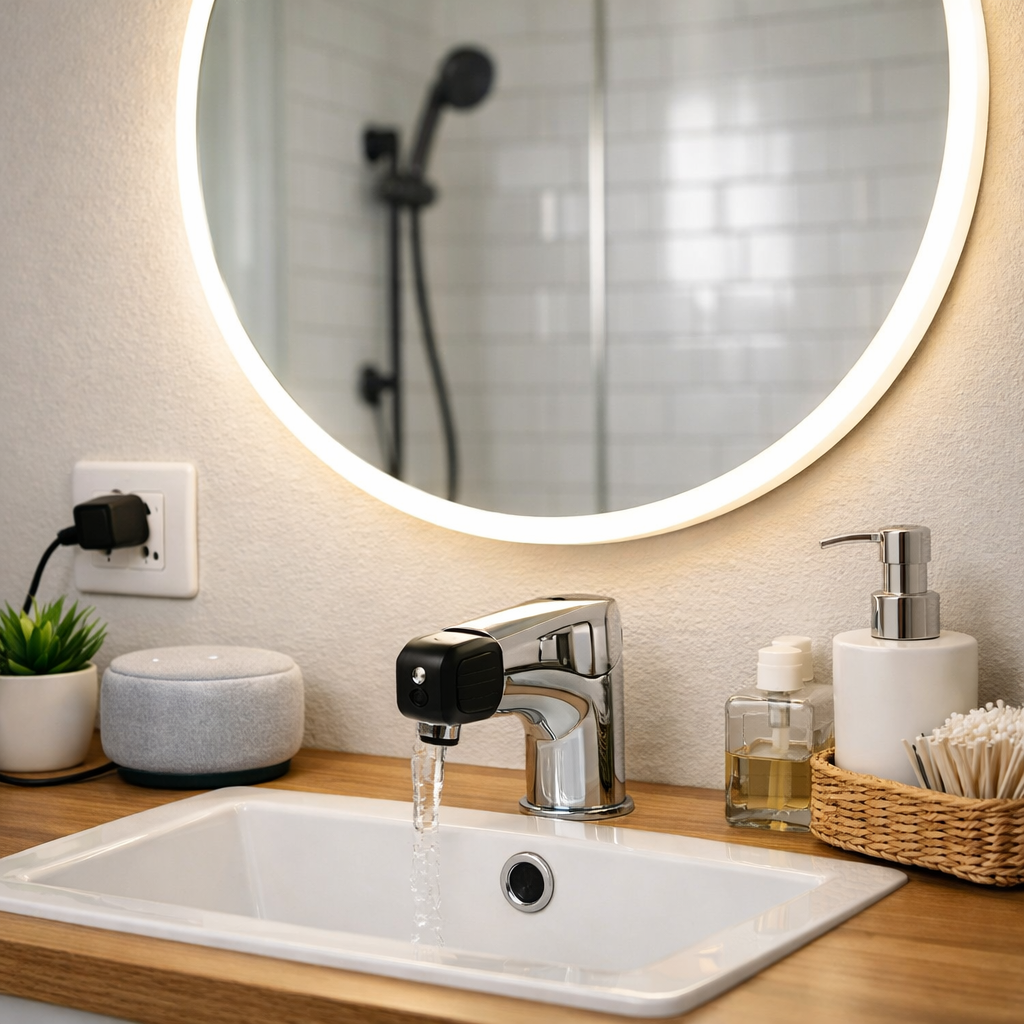
A touchless retrofit adds a battery-powered sensor valve or spout kit to bring hands-free on/off without replacing supply lines. Reviewers often highlight good value from Derpras kits around $79.99 with roughly 4.4-star ratings and Charmingwater models with about 70% five-star reviews across 1,000+ ratings, as noted in House Digest’s brand coverage.
What to know:
- Battery life: expect months per set; keep spares in the vanity.
- Reliability: clean the sensor window monthly to avoid false triggers. Confirm a manual override (handle) for power-out scenarios.
- Vet brands for warranty clarity and avoid models with persistent app or connectivity issues flagged in independent roundups.
Pros: touchless hygiene and water savings. Cons: occasional sensor misreads if the emitter window is dirty.
Bluetooth showerhead speakers
A showerhead speaker swaps in like a normal head—no rewiring. The Kohler Moxie pairs a Bluetooth speaker with the head, offering about 7 hours of playback and roughly a 32-foot range; it sits in the mid-range near $187.85, with budget alternatives around $99.99, according to Pocket-lint and HomeLight.
3-step install:
- Unscrew the old head; clean threads.
- Wrap plumber’s tape; hand-tighten the new head.
- Pair the speaker; set a weekly charging cadence to avoid mid-week silence.
Tips: descale the spray face quarterly in hard water; check the bathroom IP rating on the speaker module and keep the charging dock away from splash zones.
Portable waterproof speakers
If you want zero install, a portable like the UE Boom 3 brings sound to the bath with an IP67 rating—and it floats—making it safer around tubs, per Pocket-lint’s roundup. Place it on a shelf away from direct spray, dry after each use, and keep the charge port flap sealed.
Compared to showerhead speakers:
- Portability: use anywhere; share across rooms.
- Battery life: often longer than in-head modules.
- Audio dispersion: more flexible placement for better soundstage.
- Ownership: one device serves the whole home.
Smart scales
Smart scales track weight and body composition and sync to health apps. Pocket-lint spotlights Withings Body Cardio for full-body metrics and Fitbit Aria Air as a simpler, budget-friendly option, while Dyarrow notes Etekcity’s Bluetooth models with multi-metric tracking.
Use and placement:
- Place on flat, hard surfaces; avoid rugs for accuracy.
- Calibrate on first use and enable guest mode to protect health data.
- Secure the app login with 2FA; review data-sharing settings.
Low maintenance: wipe the glass top weekly; swap batteries annually or as prompted.
LED lighted mirrors
Philips Hue Adore is a renter-ready, surface-mountable option with an IP44 splash rating and White Ambience control offering up to 50,000 shades of white; it requires the Hue Bridge and works with Alexa, Google, and HomeKit, as detailed by Pocket-lint.
Ingress Protection (IP) ratings grade a product’s resistance to solids (first digit) and liquids (second digit). For bathrooms, IP44 means protected against most splashes from any direction. Higher ratings like IP67 add temporary water immersion protection. Match IP ratings to the zone where the device sits.
What to look for in smart mirrors: anti-fog coatings, consistent LEDs, simulated natural light, and cleanable, sealed edges; some include outlets or Bluetooth audio, according to Lowe’s and other trade guides. For rentals, prioritize plug-in or surface-mount mirrors over hardwired units.
Motion nightlights and plug-in lighting
Motion-activated plug-ins guide you safely from hall to bath without harsh glare. Place them low on walls for better detection and to keep light below eye level. LEDs commonly last around 60,000 hours versus roughly 1,500 for incandescent, meaning fewer changes and less waste, as outlined by HomeLight.
Simple placement plan:
- One in the hallway entry.
- One along the baseboard outside the bathroom.
- One just inside the door, aimed away from sleeping areas.
- Keep cords flush to walls to avoid toe catches.
Humidity-sensing fans and plug-in ventilation
Humidity-sensing fans detect moisture or odors and auto-adjust speed to maintain air quality and reduce mold risk, a feature highlighted by Ocean Electric’s value guide. For renters, consider plug-in window or doorway fans, or in-duct smart controllers only where permitted. Homeowners can replace existing fans with humidity-sensing units.
Safety and upkeep:
- Use GFCI-protected outlets where water is present.
- Place to avoid condensate dripping on cords.
- Clean grilles quarterly to maintain airflow.
Leak detectors and water monitors
Battery-powered leak sensors belong under sinks, behind toilets, and near tubs. Choose units with audible alarms and app alerts. Pairing these with WaterSense-labeled fixtures reduces waste and helps catch problems early, as Lowe’s smart-bathroom guide notes.
Placement checklist:
- Flat spot under every supply and trap.
- Behind the toilet at floor level.
- Beneath the tub edge or near the shower curb.
- Under the washing machine if nearby. Test batteries quarterly and log dates inside the vanity.
Smart shower controllers
Smart shower controllers are digital valves or controllers for setting temperature presets, starting the water remotely, or managing multiple outlets, a capability overviewed by Koalaty Bath. Some add LEDs that indicate temperature status at a glance, as remodelers like Hazley Builders point out.
Caveats: reviews are mixed on certain brands and models; one roundup flagged Moen’s four-outlet controller with roughly two-star Home Depot reviews, and network dependence can add complexity, as reported by House Digest. Renters should avoid anything that requires behind-wall plumbing.
Rental-safe vs. homeowner-only
| Type | Best for | Install | Warranty notes |
|---|---|---|---|
| Surface remotes or battery digital hand showers | Renters | Adhesive/screws; no in-wall cuts | Check for water ingress coverage |
| In-wall digital valves with multi-outlets | Homeowners | Licensed plumber; permits may apply | Confirm valve/finish coverage and electronics term |
Automatic soap dispensers
Touchless dispensers reduce mess and germs and pair well with sensor faucets. Choose foam vs. liquid based on your preferred soap, look for drip trays and anti-clog designs, and favor clear reservoirs to check fill level. Expect months of battery life; wipe the nozzle monthly and do a quarterly soak to prevent buildup. Touchless hygiene is a consistent benefit cited across smart bathroom features in USA Bath’s pros/cons briefing.
Heated towel racks
Freestanding or plug-in wall racks add cozy, faster-drying towels without hardwiring. Prioritize models with timers to curb energy use and prevent musty odors. Safety basics: keep cords off wet floors and use GFCI-protected circuits. Compare:
- Ladder vs. rail: ladder warms more items; rails fit tight spaces.
- Bar spacing: wider gaps improve airflow and drying.
- Finish: stainless or durable coatings resist bathroom humidity.
Voice assistants and simple automations
Pair devices with platforms supported by Hue—Alexa, Google, or HomeKit—to run lighting scenes, timers, and routines without rewiring, per Pocket-lint’s Hue Adore coverage. Practical automations:
- After 10 p.m., trigger nightlights via motion only.
- Run the fan until humidity drops below a set point.
- Start a “shower” playlist on your speaker for 20 minutes.
Remember network dependency: some features stop when Wi‑Fi is down; prefer local controls and manual overrides, echoing USA Bath’s reliability guidance.
How to choose renter-safe smart bathroom devices
Use Garbage Advice’s five-step framework to minimize damage, cost, and hassle:
- Install/removal: confirm no permanent alterations and easy reversibility.
- Moisture protection: match bathroom IP rating to the zone; IP44+ for splash zones, IP67 for near-tub portability.
- Power/battery: plan charging cycles and avoid messy cord runs.
- App reliability/offline control: insist on physical buttons or manual valves; Bluetooth or local control where possible.
- Budget/TCO: tally consumables (batteries, filters), cleaning supplies, and any required bridges alongside upfront price.
Vet brands for toilets and valves—Kohler, TOTO, and Woodbridge are common shortlists—while noting that some controllers see mixed results, as House Digest cautions.
Scoring table (example)
| Device | Install/removal (1–5) | Moisture protection (1–5) | Offline control (1–5) | TCO (1–5, lower is better) | Total |
|---|---|---|---|---|---|
| Bidet seat | 4 | 4 | 4 | 3 | 15 |
| Touchless faucet kit | 4 | 4 | 5 | 4 | 17 |
| LED mirror (plug-in) | 3 | 4 | 4 | 4 | 15 |
Installation and removal
Renter-safe means reversible swaps with standard tools. Prefer clamp, suction, plug-in, or battery devices; avoid drilling where leases prohibit it. Keep original hardware, photograph your setup, and store adapters and escutcheons for move-out. Showerheads and bidet seats are easy reversals; avoid in-wall valves.
Moisture protection and safety
Require splash ratings appropriate to location: IP44+ for mirrors and lights in splash zones and IP67 for portable speakers near tubs and showers. Use GFCI outlets, route cords away from spray, and keep power supplies outside wet zones. Choose anti-fog and sealed mirror enclosures; clean gaskets annually.
Power and battery life
Pick devices with predictable cycles—label change dates. Plan weekly charging for shower speakers with about seven hours of playback. Keep spare batteries for faucets, dispensers, and leak detectors. Favor energy-efficient LEDs with roughly 60,000-hour lifespans to reduce maintenance, aligning with HomeLight’s guidance.
App reliability and offline use
Verify local controls: physical buttons, manual valves, and Bluetooth fallbacks for speakers and scales. Some smart plumbing features can be disrupted by outages; favor brands with clear firmware support and strong reliability records, per USA Bath’s pros and cons. Avoid models with persistent two-star-level complaints noted in independent roundups like House Digest.
Budget and total cost of ownership
Price bands: under-$100 gadgets (speakers, smart plugs), roughly $200–$800 bidet seats, mid-range showerheads, and several-thousand-dollar full smart toilets, according to HomeLight. Add batteries, descaling agents, and bridges (such as Hue Bridge) to TCO. Expect savings from reduced paper use with bidets and lower energy via LEDs and sensor faucets.
Maintenance tips for low-hassle bathrooms
Monthly:
- Wipe sensors on faucets and dispensers.
- Descale showerheads; clean mirror edges and seals.
- Test leak alarms; vacuum or wipe fan grilles.
Quarterly:
- Rotate batteries for faucets, dispensers, leak detectors, and speakers.
- Check app firmware and update when stable releases land.
Humidity control:
- Run humidity-sensing or timed fans to keep air changes consistent and mold at bay, echoing best-practice notes from electrical pros.
Frequently asked questions
Can I add smart features to my existing bathroom without remodeling?
Yes. Choose renter-friendly retrofits like bidet seats, touchless faucet kits, portable or showerhead speakers, smart scales, and plug-in mirrors that use standard connections and remove cleanly; use Garbage Advice’s install/removal checks to avoid lease issues.
What smart bathroom upgrades are truly renter-friendly?
Bidet seats, touchless faucet retrofits, Bluetooth showerhead or portable speakers, smart scales, motion nightlights, leak detectors, and plug-in mirrors deliver value without drilling or in-wall work. See our quick side-by-side and five-step framework above.
Are smart devices safe to use in humid bathrooms?
Yes, if they carry appropriate splash ratings—IP44 for mirrors/lights and IP67 for portable speakers—are used with GFCI outlets, and kept out of direct spray when powered. Garbage Advice defaults to IP44+ near splash zones.
Do I need a plumber or electrician for these upgrades?
Not for most: bidet seats, showerhead speakers, sensors, scales, and plug-in lights are DIY-friendly. In-wall smart valves or hardwired ventilation typically require a pro and aren’t renter-safe—our rule is if it needs in-wall work, skip it as a renter.
How can I minimize connectivity issues in the bathroom?
Pick devices with local controls and Bluetooth backups, place a Wi‑Fi access point nearby, and keep firmware updated while favoring brands with dependable support if the network goes down. Garbage Advice prioritizes local control and manual overrides.