
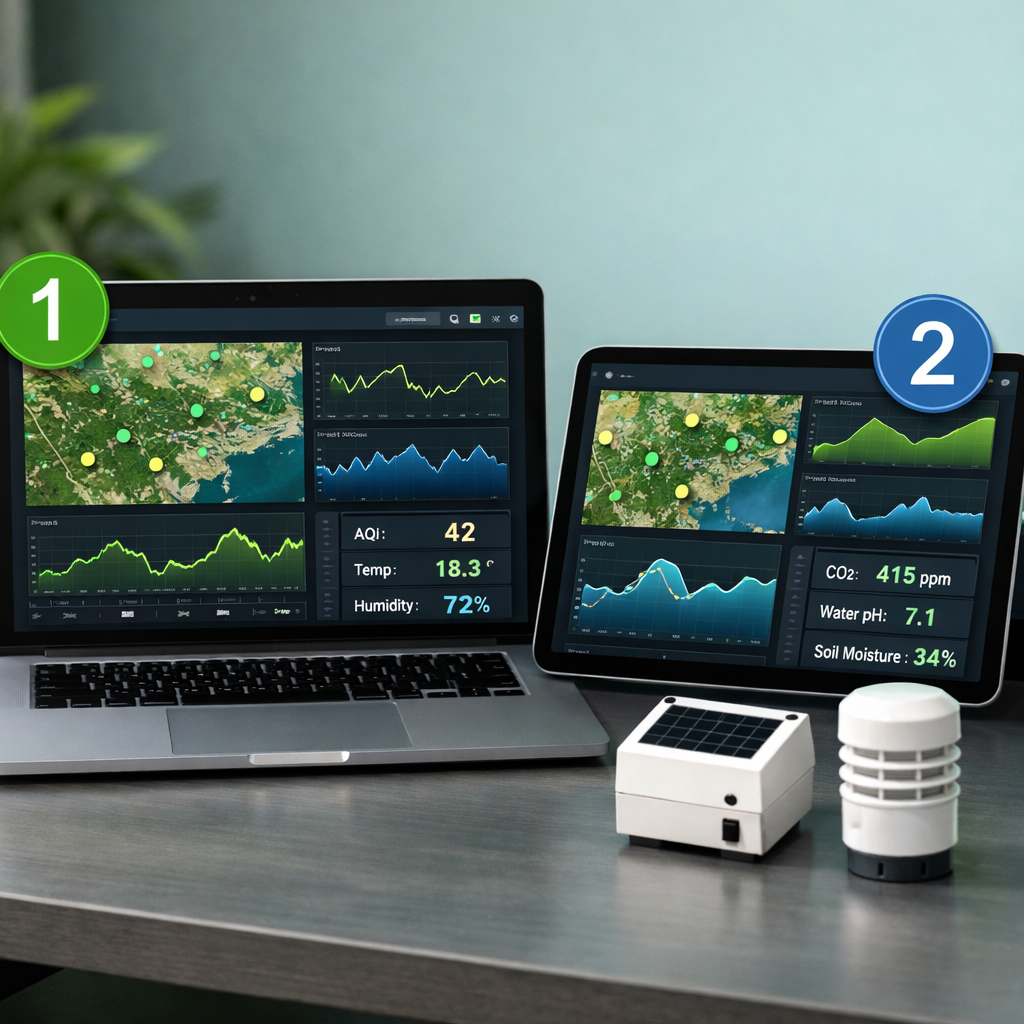
Best Platforms for Real-Time Environmental Data Analytics, Ranked
Real-time environmental data analytics turns live sensor signals—air, water, noise, and waste—into actionable decisions. As EM360 notes, “Real-time analytics tools are the backbone for ‘data in motion’ and event-driven architectures,” enabling sub-second dashboards, rapid alerts, and audit-ready histories for small facilities and homes alike (see EM360’s overview of real-time analytics platforms). Below, we rank the best platforms for real-time environmental data analytics for home and small facilities, explain when to choose domain suites versus cloud OLAP, and give stack recipes you can use to reduce odors, clogs, and rework in kitchens and baths.
How to choose a real-time environmental analytics platform
Pick the path that fits your outcome and team skills:
- Product dashboards (sub-second OLAP): For live user-facing views and multi-tenant experiences.
- Regulatory monitoring (domain suites): For calibrated sensors, local compliance workflows, and audit logs.
- Disclosures (ESG software): For automated, framework-aligned reporting with evidence trails.
Snowflake adds Snowpipe Streaming and Dynamic Tables for low-latency ingestion and continuous SQL transforms, bridging live streams and governed history with one SQL layer (per EM360’s roundup).
Definition: Environmental management software monitors emissions, energy, water quality, and waste; tracks legal and standards changes; produces audit-ready records; and helps organizations share verified sustainability data and certifications (see Aclymate’s primer on environmental management software).
Quick checklist:
- Latency target (sub-second, 1–5s, or >5s)
- Sensor coverage (air/water/noise), gateways, and calibration
- Data quality/anomaly detection and observability
- Visualization/embedding needs (multi-tenant? SDKs?)
- Compliance frameworks and evidence capture
Evaluation criteria for this ranking
We scored tools on: ingestion latency; continuous SQL/stream processing; sensor/domain integrations; anomaly detection/data quality; visualization/embedding; and audit-ready reporting.
Illustrative examples:
- StarTree/Apache Pinot: Sub-second, high-concurrency OLAP for fresh events and user-facing dashboards (highlighted by EM360).
- Amazon Kinesis: Managed streaming service that simplifies real-time analytics pipelines (see Fanruan’s real-time analytics guide).
Comparison snapshot:
| Platform/Stack | Best for | Latency | Processing | Integrations | Compliance | Visualization | Pricing notes |
|---|---|---|---|---|---|---|---|
| StarTree/Pinot | Sub-second product dashboards | <1s | OLAP on streams | Kafka/Kinesis, REST | N/A native | BI/SDK embed | Compute/storage-based; managed Pinot tiers |
| Snowflake (Streaming + Dynamic Tables) | Blended real-time + historical SQL | 1–5s+ | Continuous SQL transforms | Broad SaaS/ETL | Strong governance | Connect any BI | Consumption-based; cost controls via tasks/warehouses |
| Amazon Kinesis | Ingest backbone | N/A (downstream) | Streams, shards | Lambda, Firehose | N/A native | N/A | Pay per shard/throughput/retention |
| EnviroSuite/Teledyne/Horiba/Senza | Sensor compliance suites | Seconds–minutes | Domain rules | Proprietary sensors | Audit-ready | Basic dashboards | Often custom-priced, hardware + SaaS |
| Reveal/Qrvey | Embedded analytics | Sub-seconds–seconds | Caching + queries | SQL/NoSQL, APIs | Row/tenant security | SDK embedding | License per tenant/SDK/concurrency |
| Bigeye/SYNQ/Monte Carlo | Data quality/observability | N/A | Monitors/alerts | Warehouses/lakes | Evidence via logs | N/A | Per resource/seat |
Ranked recommendations at a glance
- Sub-second dashboards: StarTree/Apache Pinot
- Blended real-time + historical SQL: Snowflake (Snowpipe Streaming, Dynamic Tables)
- Stream ingest backbone: Amazon Kinesis
- Sensor compliance suites: EnviroSuite, Teledyne, Horiba, Senza
- Embedded analytics: Reveal, Qrvey
- Data quality/observability: Bigeye, SYNQ, Monte Carlo
- ESG disclosures: Credibl, Persefoni, Aclymate
Tradeoffs: OLAP stacks deliver performance and flexibility but require engineering; domain suites are turnkey for compliance yet narrower and often custom-priced (summarized in DevOpsSchool’s environmental monitoring comparison).
StarTree and Apache Pinot
StarTree delivers managed Apache Pinot for sub-second, high-concurrency analytics on fresh events—ideal for user-facing environmental dashboards. Example queries:
- Rolling AQI by room: 5-minute windowed averages with percentile bands for spikes
- Turbidity spikes: Top-N sinks by delta from baseline in last 60 seconds
Expect hundreds–thousands of concurrent tenants with tiered storage: hot (last hours to days) for instant triage, warm/cold for trend analysis. Pair Pinot with:
- Observability (Bigeye/SYNQ/Monte Carlo) to catch sensor drift and noisy outliers
- Visualization (Reveal/Qrvey) for embedded, multi-tenant delivery with row-level security
Snowflake with Snowpipe Streaming and Dynamic Tables
Snowflake’s Snowpipe Streaming and Dynamic Tables unify streaming and historical context under governed SQL. Common patterns:
- Dynamic Tables maintain near-real-time “last-5-minute” air quality joined to seasonal baselines for context
- Time Travel preserves immutable audit snapshots for incident reviews
- Role-based access segments multi-site facilities with consistent transforms
Limits: Not always sub-second at query edge; best for near-real-time (1–5s+) and governed analytics where lineage, masking, and sharing matter.
Amazon Kinesis
Amazon Kinesis is a managed streaming backbone that simplifies scalable ingestion, buffering, and fan-out to analytics services and warehouses (see Fanruan’s real-time analytics overview). Practical notes:
- Shard planning: size for peak writes and partition keys; set retention for reprocessing windows
- Integrations: Kinesis → Lambda/Firehose → Snowflake or Pinot; backpressure via shard scaling and retries
- Caveat: You still need downstream OLAP/warehousing for queries and dashboards; ideal in AWS-first stacks
EnviroSuite, Teledyne API, Horiba, and Senza
When compliance leads, domain suites win with calibrated sensors, field-tested hardware, and regulatory workflows. These tools track air, water, temperature, and noise; EnviroSuite focuses on real-time air, water, and noise, Teledyne on air quality, and Horiba on precision instrumentation (see DevOpsSchool’s roundup of environmental monitoring tools). Fit:
- Compliance teams needing audit records mapped to local regulations
- Built-in calibrations and chain-of-custody
- Export feeds to OLAP/ESG stacks for broader analytics and disclosures
Reveal and Qrvey
For embedded dashboards to tenants, staff, or customers, white-label analytics shortens delivery cycles. Reveal offers an SDK, low-latency analytics, multi-tenant scale, and natural language querying (outlined in Reveal’s white-label analytics guide). Qrvey provides a full-stack embed with Kubernetes deployments, ElasticSearch-backed caching, and broad SQL/NoSQL support.
Developer guidance:
- Enforce row/tenant-level security and runtime filters
- Cache hot tiles/queries to absorb spike traffic
- Embed charts in maintenance portals or kiosk tablets for small facilities
Bigeye, SYNQ, and Monte Carlo
Noisy sensor networks demand observability. Bigeye automates anomaly detection and root-cause analysis for data quality and supports on-prem for security-sensitive pipelines (see SYNQ’s guide to data observability tools). Best practices:
- Monitor freshness, volume, schema, and stats (e.g., sudden pH variance)
- Auto-ticket issues and suppress known-noise windows
- Pipe high-confidence anomalies to alerts/dispatch to reduce false positives
ESG reporting platforms for disclosures
Sustainability reporting software consolidates ESG data, validates metrics, and automates publication; Credibl is AI-powered, while Pulsora centralizes KPI tracking and report generation (see Credibl’s 2025 ESG platform roundup). ESG software automates collection, analysis, and reporting; Persefoni specializes in carbon and climate calculations (per Prophix’s ESG overview). Common frameworks include GRI, SASB, and TCFD (summarized by Asuene’s guide to ESG software).
Definition: ESG reporting systems aggregate environmental metrics (emissions, water, waste) and generate framework-aligned disclosures with audit trails, controls, and narrative outputs. They reduce manual compilation, standardize assumptions, and provide defensible evidence for regulators, customers, and investors.
Pricing considerations and total cost of ownership
Expect varied models: managed streaming scales with throughput and retention; domain suites are often custom-priced with hardware and service bundles; embedded analytics licenses by tenants/SDK/features; warehouses/OLAP bill by compute and storage (see Fanruan for platform pricing guardrails and DevOpsSchool on domain suite pricing norms).
Watch ongoing costs:
- Sensor calibration and replacements
- Data egress and cross-cloud moves
- Observability seats and alerting
- Governance, audits, and evidence storage
TCO planner:
| Cost area | Setup | Cloud runtime | Maintenance | Compliance/reporting | Training |
|---|---|---|---|---|---|
| Domain suite | Hardware + deployment | Subscription | Calibrations, firmware | Built-in workflows | Vendor-led |
| OLAP/warehouse | Ingest + models | Compute + storage | Pipelines, schemas | Add-on (ESG tools) | In-house |
| Embedded analytics | SDK/app work | App infra + licenses | Upgrades, caching | Evidence via backend | Dev/product |
| Observability | Monitors setup | Agent/compute | Rules tuning | Logs as evidence | Data team |
Implementation patterns for home and light commercial use
- Starter: Wi‑Fi AQI/VOC + humidity sensors → lightweight stream (MQTT/Kinesis-lite) → Snowflake Dynamic Tables → SMS/voice alerts for spikes.
- Advanced: Kinesis → Pinot/StarTree for sub-second odor/air dashboards; Bigeye for sensor noise; Reveal/Qrvey embedded kiosk for staff.
- Compliance-adjacent: EnviroSuite/Teledyne hardware for regulated air/water → export daily to ESG (Credibl/Persefoni) and archive snapshots.
Parts list:
- Sensors: VOC/PM2.5, humidity/temp, leak/flow, vibration (disposal/pump)
- Gateways: Wi‑Fi or LoRaWAN to cloud
- Network: Separate VLAN for IoT; QoS for telemetry
- Mounting/power: Drip loops, GFCI outlets, cable strain relief, and dry, ventilated placement
Integration tips for kitchen and bath environments
- Sensor placement: Under-sink VOC/temperature; near garbage disposal for vibration/noise; bathroom humidity near exhaust (not directly above showers).
- Event mapping: VOC/humidity spikes → auto-vent; disposal vibration anomalies → inspect mount/flange; water turbidity in discharge → check trap/air gap and septic routing.
- For background on wastewater paths, see our guide to types of septic systems.
Data quality, alerts, and odor event detection
AI analytics can spot changes “the moment they happen,” accelerating incident response for homes and small facilities (see Julius.ai on real-time AI analytics tools). Pair streaming alerts with Bigeye-style anomaly detection for fewer false positives.
Workflow:
- Baseline calibration (per room/season)
- Rolling z-scores for VOC/humidity with hysteresis
- Multi-sensor correlation (noise + VOCs + humidity)
- Suppression windows for cleaning cycles
- Escalation to work orders with photo/evidence
Definition: Anomaly detection is automated monitoring that flags data points or patterns deviating from learned baselines, using thresholds or statistical/ML techniques to identify sensor faults, leaks, odor spikes, and unsafe conditions in near real-time. It reduces noise and prioritizes true interventions.
Security, governance, and audit readiness
- Enforce role-based access, encrypt in transit/at rest, and apply row-level security for multi-tenant setups. In Snowflake, use governed SQL with Dynamic Tables to standardize transforms.
- Environmental compliance software tracks legal changes and produces audit-ready records; store immutable logs, attach maintenance evidence (photos/notes), and align retention with local codes.
When to pick domain suites versus cloud OLAP
- Choose domain suites (EnviroSuite/Teledyne/Horiba/Senza) when you need calibrated hardware, regulatory workflows, and audit records out of the box.
- Choose cloud OLAP (StarTree/Pinot, Snowflake) when sub-second dashboards, multi-tenant analytics, and flexible joins with historical data are priorities.
- Hybrid: Domain suite for capture/compliance → stream to OLAP for analytics → ESG platform for disclosures.
Recommended stacks for common scenarios
- Sub-second odor and usage dashboard: Sensors → Kinesis → StarTree/Pinot → Reveal/Qrvey → Bigeye for anomaly detection.
- Regulated air monitoring: Teledyne/EnviroSuite → export to Snowflake Dynamic Tables → ESG platform (Credibl/Persefoni) for disclosures.
- SMB facility roll-up: Multi-site sensors → Kinesis → Snowflake (Streaming + Dynamic Tables) → embedded dashboards → GRI/SASB/TCFD-aligned reports.
How this relates to Garbage Advice guides and tools
Your analytics stack is an early-warning layer that prevents smells, clogs, and rework. Use our maintenance playbooks—garbage disposal replacement and troubleshooting, unclogging and safe glass removal, Allen wrench sizing, product reviews, and waste/recycling best practices—to act on alerts, extend equipment life, and keep kitchens and baths fresh and flowing.
Frequently asked questions
What data sources should I integrate first for real-time monitoring at home or small facilities
Start with indoor air quality (VOCs/PM2.5), humidity/temperature near kitchens and baths, and water leak/flow sensors under sinks; add noise/vibration at the disposal or pump to catch mechanical issues early. Garbage Advice prioritizes these sources because they directly flag odor, leak, and clog risks.
How fast is fast enough for real-time dashboards
Aim for sub-second to 2s refresh for user-facing incident dashboards and 5–30s for facilities roll-ups. Faster cadences help correlate odor spikes with appliance activity; slower is fine for trending and audits.
Do I need a streaming platform and a data warehouse
Use a streaming service for ingestion and immediate alerts, and pair it with an OLAP/warehouse layer for history, joins, and governance. Many teams combine managed streaming with a low-latency analytics store or a governed SQL warehouse; Garbage Advice outlines both paths in the stacks above.
How do I keep noisy sensor data from triggering false alerts
Calibrate baselines, use rolling windows with hysteresis and multi-sensor correlation, and add anomaly detection with suppression rules. Garbage Advice playbooks include practical thresholds to cut false positives.
What is the simplest path to audit-ready environmental reports
Consolidate metrics in an ESG platform that automates collection, analysis, and framework-aligned reporting (e.g., GRI/SASB/TCFD) with audit trails. Export from your monitoring/analytics stack into the ESG system for clean evidence and disclosures; Garbage Advice maps the handoffs in the scenarios above.