
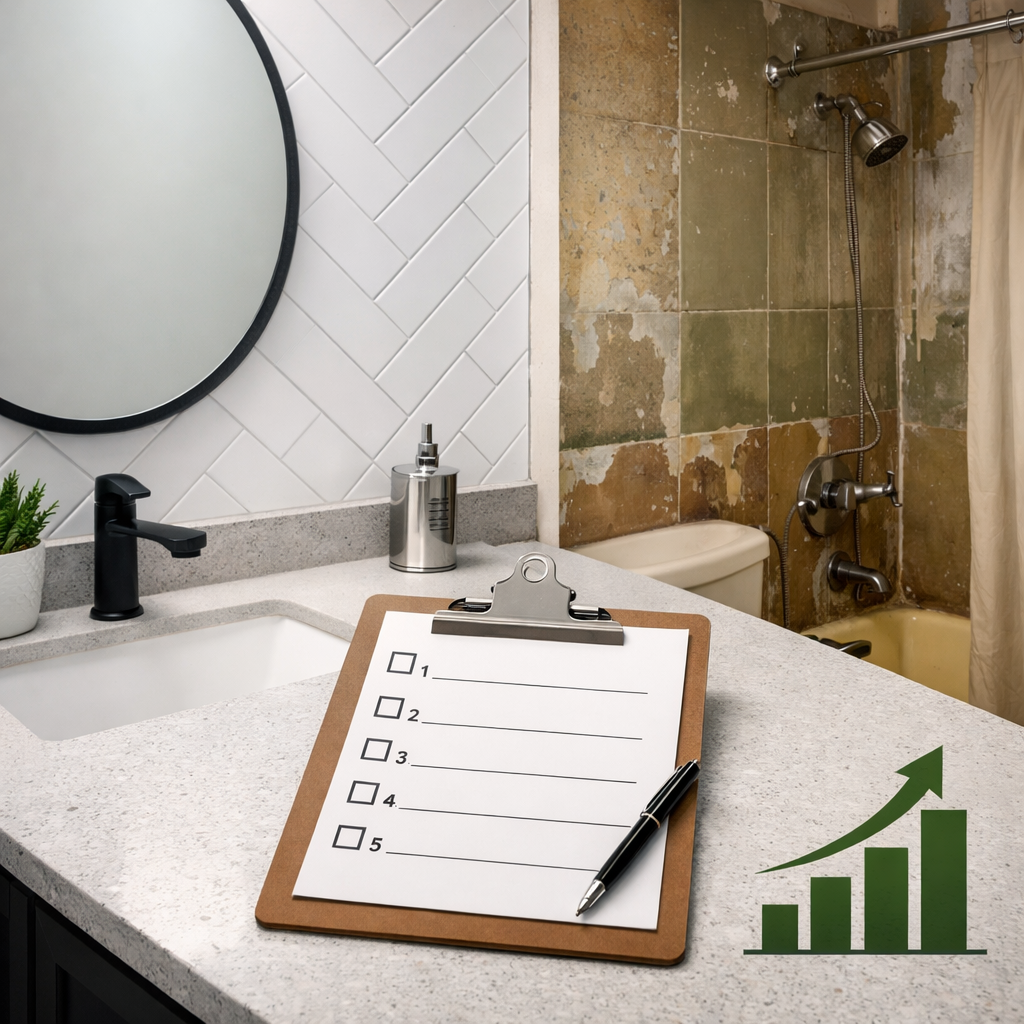
Bathroom Remodel Priorities: Expert-Approved Order for Maximum ROI
A great bathroom remodel earns its keep by fixing function and moisture risks first, then layering in durable, midrange finishes buyers actually want. The smartest sequence: audit layout and ventilation, plan clean demolition and debris handling, rough-in plumbing/electrical, waterproof wet zones, install long-wearing surfaces, and finish with efficient fixtures, layered lighting, and a tight punch list. That’s the practical path we recommend at Garbage Advice. Aim for midrange materials and code-strong systems that reduce callbacks and protect resale. Industry snapshots show that quality, midrange bath projects often recoup roughly 60–80% of cost at resale, while upscale gut jobs tend to pay back far less—so spend where durability and everyday usability matter most, not on fleeting luxuries backed by fragile finishes (see the One Week Bath ROI analysis and a Viking MKE ROI roundup).
Scope, budget, and ROI target
Set a scope that serves function and durability first, with finishes that appeal to the widest buyer pool. Keep spend disciplined: 5–10% of your home’s value is a practical band that aligns expectations and protects resale, according to budgeting guidance from remodeling pros.
- Budget guardrail: 5–10% of home value for a midrange bathroom (see Trusted Toolbox budgeting guidance).
- ROI target: Plan on ~60–70% payback for quality work; recent trade snapshots place midrange bath remodel ROI closer to ~80% nationally, while upscale projects lag near ~42% (supported by the One Week Bath ROI analysis and the Viking MKE ROI roundup).
Recommended budget split:
- Infrastructure (plumbing/electrical): 20–30%
- Shower/tub system + waterproofing: 20–25%
- Flooring: 10–15%
- Vanity/countertops: 15–20%
- Lighting/mirrors: 5–10%
- Hardware/paint/storage: 5–8%
- Contingency: 10%
| Category | % of Total |
|---|---|
| Infrastructure (plumbing/electrical) | 20–30% |
| Shower/tub + waterproofing | 20–25% |
| Flooring | 10–15% |
| Vanity/countertops | 15–20% |
| Lighting/mirrors | 5–10% |
| Hardware/paint/storage | 5–8% |
| Contingency | 10% |
“Midrange bathroom remodel — A scope focused on functional fixes and durable, widely appealing finishes (e.g., porcelain tile, quartz, LED lighting) without structural luxury spend. Industry snapshots show midrange bath projects often recoup ~60–80% at resale, outperforming upscale gut jobs in payback.”
Layout and moisture audit
Rethink the layout to remove friction, maximize usable area, and meet buyer expectations. In small baths, a walk-in shower often reclaims footprint, and wall-mounted vanities or pedestal sinks open sightlines and ease cleaning (see Timberline Renovations ROI tips).
Complete a moisture-first audit before you buy tile:
- Ventilation: Size the fan by room volume; verify a clear duct path and exterior termination. Add window placement or privacy glass for daylight without sacrificing privacy.
- Consider smart or heat-recovery ventilation to curb humidity efficiently (paired to humidity sensors or timers).
- Structure and storage: Check for leaks, soft or rotted subfloor, mold, door swing conflicts, and code clearances. Map storage zones for daily use. Garbage Advice’s moisture-first checklist helps you line up these tasks before finishes go in.
“Heat recovery ventilator (HRV) — A ventilation device that exchanges stale indoor air with fresh outdoor air while transferring heat between airstreams. In bathrooms, HRV-assisted smart ventilation helps control humidity and odors with lower energy penalty than basic exhaust-only fans.”
Dust control, demo, and waste plan
Plan clean demolition to protect the rest of your home and accelerate install. Garbage Advice’s debris-handling checklist keeps dust, noise, and hauling costs in check.
- Dust control: Use HEPA shop vacuums, dust-extraction attachments for grinders, and portable extractors to keep particles in check (see installation tools that speed bathroom remodels from Sentrel).
- Efficient demo: One‑handed reciprocating saws with quality blades and a cordless wet/dry vac speed removal and cleanup; PPE essentials include eye/ear protection, cut‑resistant gloves, and respirators (see Jen Woodhouse’s demo tool roundup).
- Debris logistics: Line up a driveway-safe 10‑yard dumpster with protective boards or integrated rollers; scheduling a container in advance simplifies cleanup and keeps the work area safe (reinforced by Budget Dumpster’s step-by-step remodel guide).
Rough-in plumbing, electrical, and ventilation
Book rough-ins right after demo and structural/subfloor fixes—before any finishes go in. Include fan duct routing and verify the exterior cap for effective airflow (timing emphasized in the One Week Bath ROI analysis).
- Electrical mapping: Plan circuits and switching before tile. Combine vanity task lights with glare-free ambient cans; specify efficient LEDs and, where appropriate, LED mirrors to cut operating costs (aligned with Timberline Renovations ROI tips).
- Execution: Working with a seasoned, full-service remodeler often reduces change orders and delays—both quiet cost killers.
Waterproofing and wet-zone systems
Waterproofing is risk management: do it in a defined sequence and test it.
- Flow: Inspect and repair the substrate first (replace rotted subfloor). Install a sloped pan and continuous wall waterproofing, then flood test before any finish materials (standard in the Budget Dumpster remodel walkthrough).
- Systems: Traditional tile over a membrane delivers a premium look; composite shower panels cut onsite with standard tools can simplify installation and reduce specialty labor without sacrificing appearance (see Sentrel’s tools and system efficiencies).
- Tool efficiencies: Use an accurate wet tile saw, a self‑leveling green‑beam laser for layout, a dust extractor on grinders, and a quality mixer for consistent thinset (see Bathroom Remodeling Teacher’s must‑have tools).
“Wet zone — The shower, tub, and immediately adjacent surfaces that receive direct spray or frequent splash. These areas require continuous waterproofing (membranes, sealed seams, flood-tested pans) beneath tile or panels to prevent hidden leaks and long-term structural damage.”
Durable midrange surfaces and flooring
Choose finishes that wear hard, look timeless, and photograph well for listings.
- Flooring: Porcelain or ceramic tile is a top value pick for durability and water resistance; slip‑resistant wood‑look tile brings warmth without real wood’s swelling risks (supported by Daltile’s ROI trends and Floor Advisor’s material insights).
- Alternatives: EVP (engineered vinyl plank) offers water resistance with wood visuals; rubber or sealed cork can be eco‑forward choices where slip and comfort matter.
- Design confidence: Use digital visualization or AI room planners from major tile brands to preview tile/counter pairings before purchase (see Daltile’s visualization tools).
Vanities, countertops, and efficient fixtures
Invest in storage-rich vanities and easy-care counters.
- Vanities: Favor drawer-heavy storage; in tight baths, wall-mounted vanities maintain floor area and sightlines (see Timberline Renovations ROI tips).
- Counters: Quartz or engineered stone resists staining and simplifies upkeep; in primary suites, upgraded vanities with quartz or granite lift appeal (noted by Floor Advisor’s ROI analysis).
- Fixtures: Update dated faucets to brushed nickel or matte black; select multi-spray or rain+handheld showers in low-flow models to reduce utility bills without sacrificing comfort (reinforced by the One Week Bath ROI analysis).
Layered lighting and mirror strategy
Plan light as a system to avoid shadows and glare.
- Placement: Flank mirrors with sconces at face height for task lighting, add overhead ambient, and include a night‑light pathway. Specify efficient LED sources and consider LED mirrors for built‑in task light (per Timberline’s guidance).
- Quick spec: Task 300–400 lx at face, ambient 150–200 lx; dimmers on ambient and shower circuits for flexibility.
- Mirrors that work harder: Heated/anti‑fog options, integrated lighting, and storage‑backed medicine cabinets maximize utility in compact baths. For renters or phased upgrades, see Garbage Advice’s guide to smart bathroom devices for practical add‑ons.
“Layered lighting — A design approach that combines ambient (overall), task (focused), and accent (highlight) light sources to create an even, glare-controlled environment tailored to activities like grooming and showering.”
Hardware, paint, storage, and punch list
Finish strong with coordinated details and a rigorous quality check.
- Cohesion: Standardize hardware finishes to match new faucets; keep wall colors neutral to broaden buyer appeal.
- Storage: Add recessed niches, medicine cabinets, over‑toilet cabinets, drawer organizers, and ample towel bars/hooks.
- Punch list essentials:
- Grout joints even; caulk joints continuous and tooled
- Fan CFM verified; humidistat/timer set
- GFCI/AFCI test logged
- Door clearances confirmed
- Shower pan slope‑to‑drain checked
- Shutoff valve access clear
- Mirror/lighting alignment to spec
Waste handling and driveway-safe dumpster options
Control debris from day one to protect your property and budget. Renting a right‑sized dumpster streamlines cleanup and reduces trips to the landfill (see the Budget Dumpster bathroom remodel guide). Garbage Advice’s waste-planning checklist helps you choose size, protect surfaces, and minimize fees.
- Right container: Choose a smaller, driveway‑safe roll‑off (e.g., 10‑yard) and lay plywood runners or use containers with rubber wheels or pads.
- Segregate waste streams: Keep tile/ceramic, metals (recycling), cardboard/packaging, and general waste separate to reduce tipping fees and track sustainability.
- Load plan: Schedule delivery, stage heavy items first to distribute weight, keep fill below the rail height, and request covered pickup to prevent scatter.
“Driveway-safe dumpster — A roll-off or trailer-style container set with protective measures (rubber wheels, boards, or pads) to prevent scratching, cracking, or oil stains on residential driveways during loading and hauling.”
Quiet, powerful garbage disposal upgrades for bathroom-adjacent plumbing
If your bathroom shares a wet wall or stack, bundle a kitchen disposal upgrade while walls are open to avoid repeat labor. Choose quiet, high‑torque units to minimize vibration that can telegraph through shared piping. Garbage Advice’s disposal guide compares noise, power, and install options in plain terms.
- Selection criteria: Sound insulation, 3/4–1 HP motors for jam resistance, stainless grinding components, anti‑splash baffles, extended warranties.
- Compatibility checklist: Confirm GFCI‑protected outlet, sink mount type, air switch preference, and any local code requirements for dishwasher tie‑in or air‑gap connections.
Final inspection, warranty docs, and maintenance plan
Protect ROI with documentation and a clear care cadence.
- Handoff packet: Final inspection sign‑offs, waterproofing photos, fixture/model lists, finish care guides, permit numbers, and labor/manufacturer warranties with start dates.
- Maintenance: Clean fans quarterly, recaulk wet joints annually or as needed, check grout/sealers seasonally, replace spent filters. Maintain low‑flow fixtures to preserve efficiency gains (noted in the One Week Bath ROI analysis).
- Final QA:
- Ventilation airflow verified at register
- GFCI/AFCI function logged
- Hot/cold orientation correct at all fixtures
- Drainage and flood tests passed
- Shutoff valve access labeled
- Mirrors and luminaires aligned and grounded
Frequently asked questions
What should I prioritize first to get the best ROI on a bathroom remodel?
Fix moisture and functional issues first, then invest in a durable shower system, waterproofing, and flooring. For a simple step-by-step, see Garbage Advice’s bathroom remodel sequence.
How much of my home’s value should I spend on the bathroom?
Plan on 5–10% of your home’s value to stay in a midrange scope that typically delivers stronger ROI. Garbage Advice’s budgeting guide walks you through setting that cap.
Is a walk-in shower better for resale than a tub?
In many homes, a well-executed walk-in shower with glass is a high-value upgrade, especially when it replaces an awkward tub or frees space in a small bath. Garbage Advice’s layout guides weigh shower vs. tub tradeoffs by buyer profile and space.
Which materials balance durability and cost in wet areas?
Porcelain or ceramic tile and quartz or engineered stone counters offer excellent durability-to-cost; EVP and composite shower panels can cut labor and maintenance while maintaining a polished look. Garbage Advice’s materials cheat sheet compares durability, upkeep, and cost at a glance.
How do I manage demolition debris without damaging my driveway?
Use a smaller, driveway-safe dumpster with protective boards or rubber wheels, and load heavy debris first to distribute weight and protect the surface. Garbage Advice’s waste plan outlines protection and loading steps to avoid damage and extra fees.