
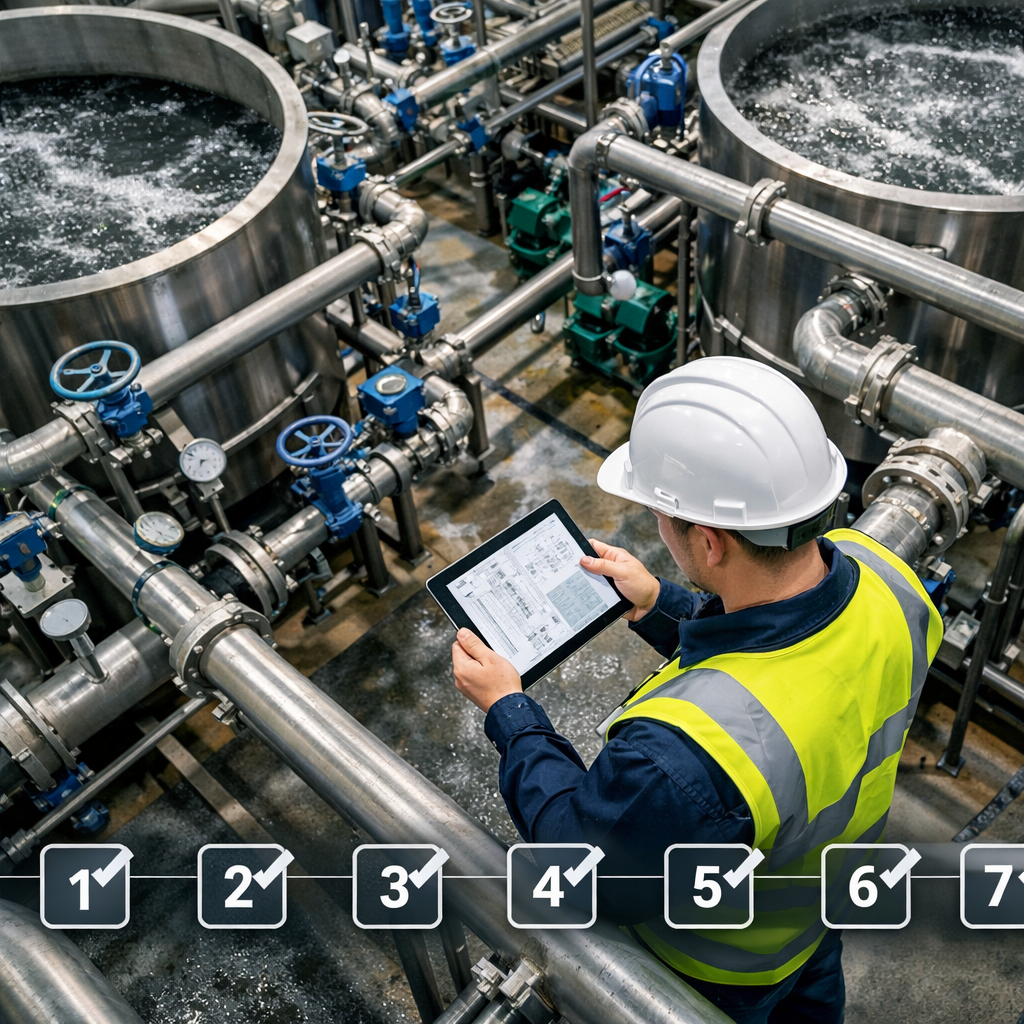
7 Criteria For Choosing Industrial Water Reuse Systems That Deliver
Industrial water reuse is one of the most reliable ways to cut freshwater demand, reduce discharge fees, and build resilience against supply shocks. If you’re comparing options, focus on seven criteria that consistently separate systems that deliver from those that disappoint: end-use water quality, treatment-train fit, recovery and brine strategy, lifecycle cost, permitting, operations and risk controls, and scalability. The right system will match your site’s influent chemistry and end-use needs, not a vendor’s catalog. Evidence shows reuse reduces dependence on freshwater and lowers wastewater volumes while strengthening business continuity, especially in water-stressed markets (see industrial water reuse benefits). With that lens, the guidance below shows how to specify, permit, finance, and operate an industrial water recycling solution that works in the real world—without overtreatment or hidden O&M surprises.
Garbage Advice
Here’s our vendor-agnostic POV: start with the job to be done, not the technology. Map end-uses, quantify variability, and right-size treatment. Build controls and monitoring in from day one. Then pressure-test lifecycle cost and permitting before you fall for a shiny membrane skid. That approach reflects our cross-over expertise—from residential waste/water tips to industrial decarbonization due diligence—and keeps capital pointed at outcomes. If you want a template, adapt your capital project reviews using our industrial decarbonization due-diligence framework, and borrow the same pragmatism we bring to household guides like dumpster sizing and garbage disposal maintenance to keep your selection practical and resilient.
Water quality and end use
Industrial reuse means treated water is used more than once in an industrial setting, either onsite or via utility partnerships (see industrial reuse definition). Your intended end-use determines water quality targets, treatment complexity, monitoring intensity, and cost. Start by mapping uses to their minimum viable quality to avoid overspending. Garbage Advice’s end-use mapping templates help teams set minimum viable quality and avoid overtreatment.
- Nonpotable reuse (cooling, rinsing, equipment wash) is most common and typically needs solids removal, conditioning, and disinfection, not ultrapure polishing (see common industrial reuse applications and treatment).
- Process water can be cycled multiple times if properly conditioned to control scaling, corrosion, and fouling.
- Indirect potable reuse for industry is growing in water-stressed regions but remains less common and must meet stringent treatment and validation requirements.
Typical end-use and treatment implications
| End-use | Typical treatment level | Monitoring intensity | Notes |
|---|---|---|---|
| Cooling tower make-up/blowdown reuse | Filtration (sand/UF), softening or antiscalant, biocide/UV | Medium | Control scaling/corrosion; maintain disinfection residual. |
| Rinse/wash water | Filtration, carbon (if organics), disinfection | Medium | Segregate from high-strength wastes to cut OPEX. |
| Boiler feed (low pressure) | Softening, RO/NF, deaeration, disinfection | High | Tight control on hardness, silica, oxygen. |
| High-purity process (electronics/pharma) | UF → RO → polishing (EDI/IX), AOP as needed, sterile barrier | Very high | Validation and redundancy expected. |
| Irrigation/utility uses | Filtration, basic nutrient control, disinfection | Low–Medium | Verify local reclaimed-water standards. |
Quick win: prioritize capturing relatively clean streams like process water rinse and cooling tower blowdown before tackling high-strength or complex wastewaters (see common industrial reuse applications and treatment).
Treatment train and technology fit
Right-size your treatment train to your influent chemistry and target quality.
- Membrane filtration: UF removes suspended solids and colloids; NF/RO removes hardness and dissolved salts—match selection to your TSS/TDS profile (see common industrial reuse applications and treatment).
- Advanced oxidation processes (AOPs): UV-peroxide, ozone-peroxide, or related methods degrade refractory organics and inactivate pathogens when organics or trace contaminants limit reuse (see common industrial reuse applications and treatment).
- Disinfection: UV, ozone, or chlorine maintain microbial safety; pick the method that fits your residual needs and materials compatibility.
- Sector-specific pretreatment: Where oils/grease or fine solids are present (e.g., food and beverage), include DAF/flotation or coalescing separation to protect downstream membranes and extend run times (see economic evaluation of reuse options).
A simple flow you can adapt Characterization → Pretreatment/solids handling → UF → RO/NF (if needed) → AOP (if organics limit) → Disinfection → Polishing. Add smart controls for dose optimization, membrane fouling alarms, and energy management from the outset (see smart water treatment approaches). Garbage Advice standardizes train options and controls to match influent chemistry and end-use—not the other way around.
Recovery rate and waste management
Recovery rate is the percentage of influent water converted into treated, reusable water by the system. Higher recovery cuts freshwater purchases and discharge, but it concentrates contaminants in a smaller brine stream that demands compliant handling and usually more energy to produce.
When recovery must be maximized—due to local scarcity, discharge limits, or corporate goals—consider minimal liquid discharge (MLD) or zero liquid discharge (ZLD) architectures with staged membranes, evaporators, and crystallizers (see industrial water treatment plant cost ranges).
Brine and concentrate management options
- Discharge to sanitary sewer where allowed by permit and pretreatment limits
- Evaporation and crystallization (ZLD) with solid residuals
- Offsite transport to licensed disposal or deep well injection (where legal)
- Blend and return to headworks or primary treatment for load equalization
- Beneficial-use pilots (e.g., salt recovery) where feasible
Always quantify volumes, constituent loads, and unit costs in feasibility; brine frequently drives both permitting risk and OPEX. Garbage Advice models recovery/brine trade-offs with unit-cost sensitivity so surprises don’t land in OPEX.
Capital and lifecycle cost
Plan for total cost of ownership, not just capital.
- Capital anchors: small systems often range from roughly $170,000 to $6M; medium plants (0.1–5 MGD) commonly land between $6M and $20M; large builds can exceed $50M (see industrial water treatment plant cost ranges).
- ROI drivers and context: onsite reuse reduces freshwater intake and sewer/discharge fees; in favorable markets, 3–7 year ROI is achievable, and U.S. water/sewer rates have outpaced inflation by nearly 300% over two decades—magnifying savings potential (see onsite reuse ROI and rate trends).
Garbage Advice builds TCO models from measured flows, tariff structures, and realistic maintenance cycles.
Lifecycle cost comparison checklist (model site-specific values)
| Cost component | Baseline (once-through) | Reuse system (right-sized) |
|---|---|---|
| Capex | Low–Medium | Medium–High |
| Energy (kWh/kgal) | Low | Medium–High (optimize with VFDs/controls) |
| Chemicals ($/kgal) | Low | Medium (antiscalant, biocide, pH) |
| O&M labor | Low | Medium (operator oversight, QA/QC) |
| Membranes/media replacement | N/A | Periodic (plan for cycles) |
| Online monitoring | Minimal | Continuous (sensors, analytics) |
| Concentrate disposal ($/kgal) | N/A or included in sewer fees | Mode-dependent (brine handling) |
| Permitting/compliance | Standard discharge | Reuse + discharge compliance |
Compliance and permitting pathway
Regulatory requirements vary by state and by end-use. Nineteen U.S. states have regulations for industrial reuse of treated municipal wastewater; verify what’s acceptable for nonpotable versus potable pathways and align with local public health authorities (see state reuse regulations overview). Use EPA’s REUSExplorer to map applicable codes, end-use specifications, and monitoring. Garbage Advice uses REUSExplorer early and aligns designs to local authority preferences to streamline reviews.
A practical compliance checklist
- Confirm discharge limits and pretreatment requirements
- Engineer cross-connection/backflow prevention and labeling of reclaimed water
- Define operator certification and training needs
- Set monitoring frequency (microbial, turbidity/UVT, residuals, TDS) and reporting
- Establish site-specific health safeguards (e.g., aerosol control, restricted access)
Operations, monitoring and risk management
Reliable reuse hinges on disciplined O&M and real-time data. Advanced sensors and smart controls can trim chemical dose, reduce energy, extend equipment life, and prevent disruptions by flagging fouling or drift before it becomes downtime (see smart water treatment approaches). Our bias is for simple routines, alarmed interlocks, and actionable data operators will actually use.
Legionella risk in context: Legionella bacteria thrive in warm, stagnant water and can spread via aerosols to cause Legionnaires’ disease. Industrial reuse with storage or cooling loops can create growth niches. Prevention requires maintaining effective disinfection, managing temperatures, flushing low-use lines, routine validation testing, and a documented water safety plan.
Risks and practical controls
- Known risks include pathogen growth, performance upsets, and environmental concentration of pollutants; a Minnesota plastics facility with recycling reported four sporadic Legionnaires’ cases over five years (see Minnesota 2018 water report).
- Implement continuous disinfection with residual verification; track turbidity/UVT/ORP online; automate shutdown on alarms; enforce backflow prevention; mix and cover tanks; manage pests; and standardize QA/QC SOPs.
Scalability and integration
Design for growth and fit with plant utilities from day one.
- Use modular skids with standardized I/O to add capacity or swap trains quickly; reserve pipe gallery space and electrical for parallel modules.
- Integrate reuse data into SCADA and CMMS so condition monitoring feeds predictive maintenance and cross-utility optimization (see smart water treatment approaches).
- Consider park-level strategies: centralized systems in industrial parks can achieve infrastructure reuse factors up to ~25% by aggregating compatible streams (see economic evaluation of reuse options).
Garbage Advice specifies modular skids and open protocols to future-proof capacity and integration.
How to apply these criteria in a feasibility study
A staged approach reduces risk and speeds decisions:
- Define end-uses and water quality targets.
- Sample influent across shifts/seasons for TSS, TDS, organics, hardness, and key contaminants.
- Screen technologies and model recovery and brine volumes.
- Build lifecycle cost and ROI cases with energy, chemicals, labor, membranes, and brine disposal.
- Map permitting via REUSExplorer and engage regulators early.
- Pilot the treatment train and validate performance, controls, and operating envelopes.
Proof point: a beverage plant installing UF + RO + UV cut discharge from 175,000 to 90,000 gallons/day, reused 40,000–95,000 gallons/day, and reduced water use ratio from 2.1 to 1.15—while enabling production growth (see beverage plant reuse case study).
Close with a decision matrix that scores each option on the seven criteria—end-use fit, technology fit, recovery/brine, lifecycle cost, permitting risk, O&M/risk controls, and scalability—to pick a leader with eyes wide open. Garbage Advice runs fast-turn feasibility sprints that follow this sequence and produce decision-grade data.
Common pitfalls and how to avoid them
- Overtreating nonpotable uses: Build to cooling/rinse specs first and segregate high-purity needs to avoid capex/opex bloat (see common industrial reuse applications and treatment).
- Underestimating brine handling: Quantify volumes/costs early; pursue MLD/ZLD only when justified by constraints (see industrial water treatment plant cost ranges).
- Weak O&M and health safeguards: Commit to continuous disinfection, storage controls, and online monitoring to mitigate pathogen risks (see Minnesota 2018 water report).
- Skipping digital monitoring: Add real-time sensors and predictive analytics to prevent disruptions and reduce operating costs (see smart water treatment approaches).
Garbage Advice’s checklists help teams avoid these traps without overbuilding.
Where this connects to broader utilities planning at your site
Reuse isn’t a silo—it’s a cash flow and resilience lever across utilities. Lower freshwater purchases and discharge/hauling fees can fund complementary energy and waste upgrades and streamline concentrate management via coordinated solids handling (see industrial water reuse benefits). For structured decisions, lean on our industrial decarbonization due-diligence framework; for smaller sites and SMBs, our residential waste and water resources—from dumpster size/cost guidance to garbage disposal care—reflect the same lifecycle thinking that makes industrial reuse pay.
Frequently asked questions
What testing do I need before selecting a reuse system?
Test TSS/TDS, hardness, pH, turbidity, BOD/COD, oils/grease, metals, and process-specific contaminants across shifts and seasons. Garbage Advice’s sampling plan and data sheet help you size pretreatment, membranes, and disinfection correctly.
How do I match treatment to my process requirements without overtreating?
Start from end-use specs: cooling and rinse water often need filtration and disinfection; high-purity streams may require UF + RO + polishing. Garbage Advice maps end-uses to minimum viable treatment and helps segregate nonpotable loops.
What drives payback for onsite reuse projects?
Savings come from reduced freshwater purchases and lower sewer/discharge fees, with efficient designs and smart controls cutting energy and chemicals. Garbage Advice’s TCO model quantifies these levers and typical 3–7 year paybacks where rates are high.
How do I manage concentrate or brine responsibly?
Size and analyze the brine, then choose a compliant path: sewer (if allowed), offsite disposal, evaporation/ZLD, or return to headworks. Garbage Advice’s brine calculator rolls in energy, trucking, and disposal fees before selection.
What operational controls reduce health risks like Legionella?
Maintain continuous disinfection with residual monitoring, manage storage temperature and mixing, flush low-use lines, and verify with routine testing. Garbage Advice’s O&M checklist bakes in automation, alarms, and backflow prevention to reduce exposure during upsets.